
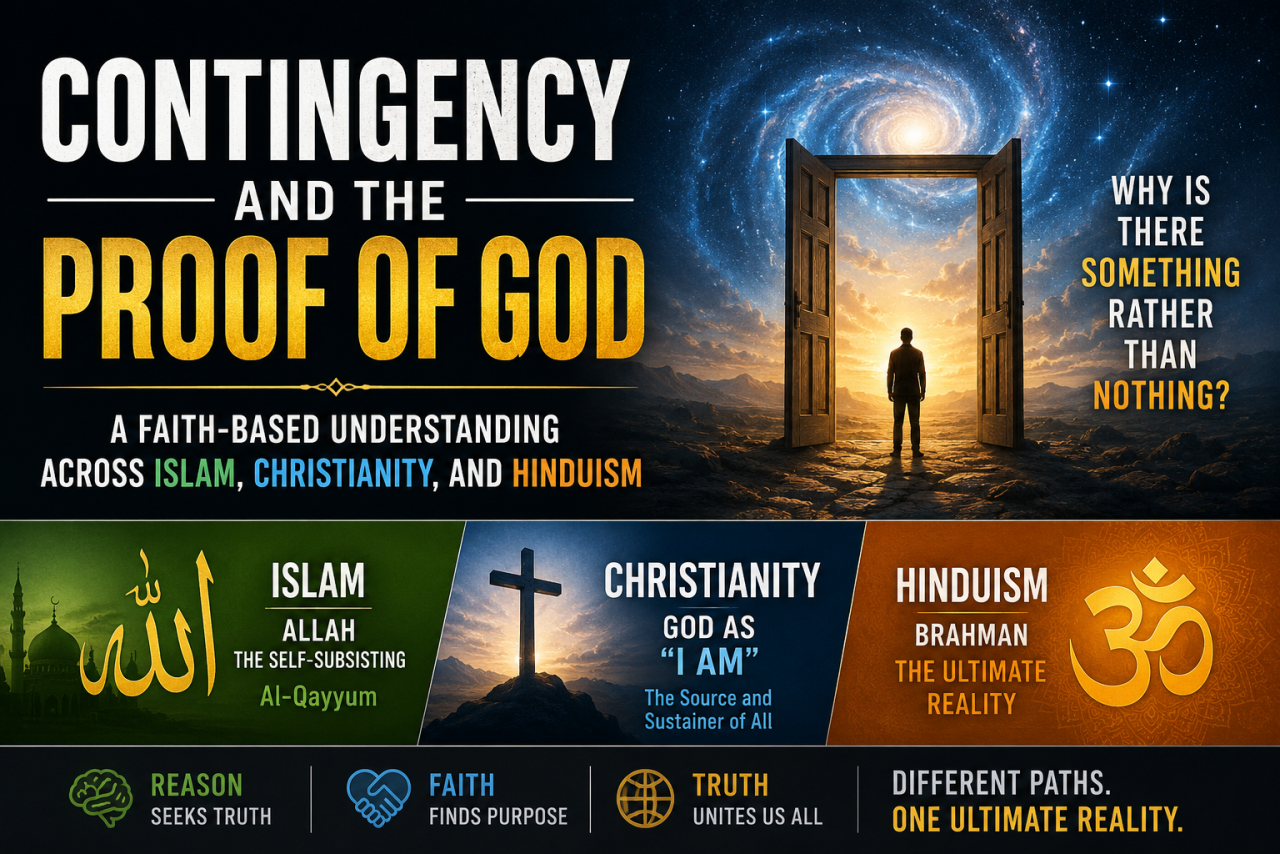
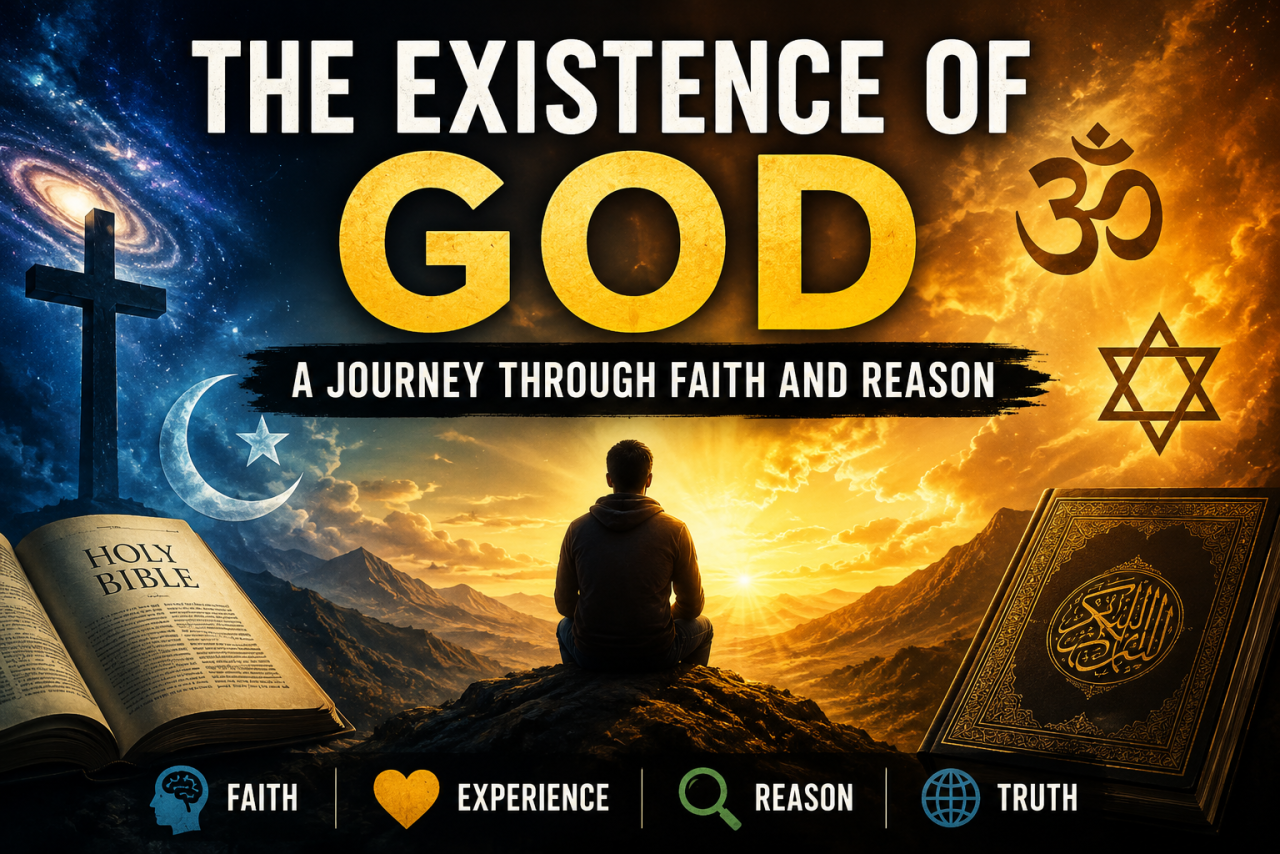
Can the existence of the universe point to God? Explore how Islam, Christianity, and Hinduism use the principle of contingency to understand the ultimate source of existence.
From the dawn of human consciousness, one question has echoed across civilizations: Why does anything exist at all?
Why is there a universe instead of nothing? Why do human beings, stars, time, and matter exist when they just as easily might not have?
Across the world's major religious traditions, this question has inspired profound reflection. One of the most enduring answers is rooted in the concept of contingency—the understanding that everything in existence depends on something beyond itself, and that this chain of dependence ultimately points to God.
This is not presented as blind belief, but as faith illuminated by reason.
Understanding Contingency
A thing is called contingent if it exists but does not have to exist. Its existence depends on something else.
Human beings are contingent. We depend on parents, food, air, and countless biological processes.
Nature is contingent. Trees rely on soil, water, and sunlight, while planets depend on the laws of physics.
Even the universe itself, according to modern cosmology, had a beginning and therefore appears to be dependent rather than self-existent.
If everything we observe is contingent, a natural question follows:
What sustains existence itself?
Many religious traditions answer by pointing to a reality that is not contingent—a Necessary Being, one that exists by its own nature and depends on nothing else.
The Islamic Perspective: Allah, the Self-Subsisting
In Islam, the principle of contingency is deeply embedded in the doctrine of Tawhid, the absolute oneness of Allah.
The Qur'an declares:
"Allah—there is no deity except Him, the Ever-Living, the Self-Sustaining (Al-Qayyum)."
(Qur'an 2:255)
Everything other than Allah is created (makhluq). Creation exists, but it does not exist independently. Every moment of its existence depends upon Allah's sustaining will.
Allah alone is Al-Qayyum—the One who upholds all existence while Himself depending on nothing.
The Qur'an further states:
"He neither begets nor is born."
(Qur'an 112:3)
This verse emphasizes that Allah is not contingent. He neither comes into existence nor can He cease to exist. Time, matter, life, and death all depend upon Him.
From the Islamic perspective, the universe cannot explain itself. A dependent creation requires an independent Creator. Allah is described as Al-Awwal (The First) and Al-Akhir (The Last)—the eternal foundation upon which all existence rests.
The Christian Perspective: God as "I AM"
Christian theology expresses contingency through a profound understanding of God as the sustaining source of all existence.
The Bible teaches:
"For in Him all things were created... and in Him all things hold together."
(Colossians 1:16–17)
Creation continues to exist because God continually wills it to exist.
When Moses asks God for His name, the response is one of the most significant declarations in Scripture:
"I AM WHO I AM."
(Exodus 3:14)
Rather than identifying Himself as one being among many, God reveals Himself as the One whose existence is self-sufficient.
Christian philosopher and theologian Thomas Aquinas later articulated this distinction by differentiating between:
- Contingent beings, which receive existence from another.
- God, who is existence itself.
The universe changes, ages, and depends on external causes. God does not. Without God, Christian theology teaches, nothing could exist or continue for even a moment.
Thus, contingency leads not only to belief in God but also to trust in God as the constant sustainer of creation.
The Hindu Perspective: Brahman, the Ultimate Reality
Hindu philosophy approaches contingency with remarkable metaphysical depth.
The world of names and forms is understood to be temporary, changing, and dependent. Birth, growth, decay, and dissolution characterize everything within the material universe, making it contingent.
The Upanishads teach that beyond this changing world lies Brahman, the eternal, self-existent reality:
"That from which all beings are born, by which they live, and into which they return—that is Brahman."
Brahman does not depend on the universe. Rather, the universe depends upon Brahman. Individual forms arise and disappear, but Brahman remains eternal and unchanged.
Within Hindu thought, recognizing contingency is more than an intellectual exercise—it is a spiritual awakening. As one realizes the dependent nature of both the self and the world, attention shifts toward the unchanging foundation of all existence.
This realization ultimately leads toward moksha, liberation through the knowledge of ultimate reality.
A Shared Insight Across Faiths
Despite significant theological differences, Islam, Christianity, and Hinduism converge on a profound philosophical insight:
- The world is dependent.
- Ultimate reality is independent.
- Existence cannot fully explain itself.
- There must be a necessary foundation underlying all being.
Whether this reality is understood as Allah, God, or Brahman, it is described as eternal, self-existent, and the source of everything that exists.
Different traditions employ different languages and theological frameworks, yet each points toward an ultimate reality beyond the contingent world.
Faith and Reason in Harmony
The concept of contingency does not diminish faith—it seeks to illuminate it.
Faith affirms the existence of God.
Contingency offers a philosophical explanation for why belief in God has been regarded by many thinkers as rational.
It suggests that belief in an eternal, necessary source of existence is not simply a matter of tradition or emotion but a reasoned response to the observation that everything around us is fragile, dependent, and temporary.
Science explores how the universe functions.
Contingency asks a different question:
Why is there something rather than nothing?
For many believers, this is where faith offers an answer beyond the reach of empirical science.
God as the Ground of All Existence
Every human life, every star, every moment of time exists in a state of dependence. Nothing in the observable universe stands entirely on its own.
The idea of contingency suggests that behind this dependent reality must stand something that is not dependent—a reality that simply is.
Faith gives this reality a name.
Reason points toward it.
Worship responds to it.
For countless people across civilizations and centuries, this understanding has formed one of the enduring foundations for belief in God—not merely out of fear or tradition, but through a profound reflection on the nature of existence itself.
From the dawn of human consciousness, one question has echoed across civilizations: Why does anything exist at all?
Why is there a universe instead of nothing? Why do human beings, stars, time, and matter exist when they just as easily might not have?
Across the world's major religious traditions, this question has inspired profound reflection. One of the most enduring answers is rooted in the concept of contingency—the understanding that everything in existence depends on something beyond itself, and that this chain of dependence ultimately points to God.
This is not presented as blind belief, but as faith illuminated by reason.
Understanding Contingency
A thing is called contingent if it exists but does not have to exist. Its existence depends on something else.
Human beings are contingent. We depend on parents, food, air, and countless biological processes.
Nature is contingent. Trees rely on soil, water, and sunlight, while planets depend on the laws of physics.
Even the universe itself, according to modern cosmology, had a beginning and therefore appears to be dependent rather than self-existent.
If everything we observe is contingent, a natural question follows:
What sustains existence itself?
Many religious traditions answer by pointing to a reality that is not contingent—a Necessary Being, one that exists by its own nature and depends on nothing else.
The Islamic Perspective: Allah, the Self-Subsisting
In Islam, the principle of contingency is deeply embedded in the doctrine of Tawhid, the absolute oneness of Allah.
The Qur'an declares:
"Allah—there is no deity except Him, the Ever-Living, the Self-Sustaining (Al-Qayyum)."
(Qur'an 2:255)
Everything other than Allah is created (makhluq). Creation exists, but it does not exist independently. Every moment of its existence depends upon Allah's sustaining will.
Allah alone is Al-Qayyum—the One who upholds all existence while Himself depending on nothing.
The Qur'an further states:
"He neither begets nor is born."
(Qur'an 112:3)
This verse emphasizes that Allah is not contingent. He neither comes into existence nor can He cease to exist. Time, matter, life, and death all depend upon Him.
From the Islamic perspective, the universe cannot explain itself. A dependent creation requires an independent Creator. Allah is described as Al-Awwal (The First) and Al-Akhir (The Last)—the eternal foundation upon which all existence rests.
The Christian Perspective: God as "I AM"
Christian theology expresses contingency through a profound understanding of God as the sustaining source of all existence.
The Bible teaches:
"For in Him all things were created... and in Him all things hold together."
(Colossians 1:16–17)
Creation continues to exist because God continually wills it to exist.
When Moses asks God for His name, the response is one of the most significant declarations in Scripture:
"I AM WHO I AM."
(Exodus 3:14)
Rather than identifying Himself as one being among many, God reveals Himself as the One whose existence is self-sufficient.
Christian philosopher and theologian Thomas Aquinas later articulated this distinction by differentiating between:
- Contingent beings, which receive existence from another.
- God, who is existence itself.
The universe changes, ages, and depends on external causes. God does not. Without God, Christian theology teaches, nothing could exist or continue for even a moment.
Thus, contingency leads not only to belief in God but also to trust in God as the constant sustainer of creation.
The Hindu Perspective: Brahman, the Ultimate Reality
Hindu philosophy approaches contingency with remarkable metaphysical depth.
The world of names and forms is understood to be temporary, changing, and dependent. Birth, growth, decay, and dissolution characterize everything within the material universe, making it contingent.
The Upanishads teach that beyond this changing world lies Brahman, the eternal, self-existent reality:
"That from which all beings are born, by which they live, and into which they return—that is Brahman."
Brahman does not depend on the universe. Rather, the universe depends upon Brahman. Individual forms arise and disappear, but Brahman remains eternal and unchanged.
Within Hindu thought, recognizing contingency is more than an intellectual exercise—it is a spiritual awakening. As one realizes the dependent nature of both the self and the world, attention shifts toward the unchanging foundation of all existence.
This realization ultimately leads toward moksha, liberation through the knowledge of ultimate reality.
A Shared Insight Across Faiths
Despite significant theological differences, Islam, Christianity, and Hinduism converge on a profound philosophical insight:
- The world is dependent.
- Ultimate reality is independent.
- Existence cannot fully explain itself.
- There must be a necessary foundation underlying all being.
Whether this reality is understood as Allah, God, or Brahman, it is described as eternal, self-existent, and the source of everything that exists.
Different traditions employ different languages and theological frameworks, yet each points toward an ultimate reality beyond the contingent world.
Faith and Reason in Harmony
The concept of contingency does not diminish faith—it seeks to illuminate it.
Faith affirms the existence of God.
Contingency offers a philosophical explanation for why belief in God has been regarded by many thinkers as rational.
It suggests that belief in an eternal, necessary source of existence is not simply a matter of tradition or emotion but a reasoned response to the observation that everything around us is fragile, dependent, and temporary.
Science explores how the universe functions.
Contingency asks a different question:
Why is there something rather than nothing?
For many believers, this is where faith offers an answer beyond the reach of empirical science.
God as the Ground of All Existence
Every human life, every star, every moment of time exists in a state of dependence. Nothing in the observable universe stands entirely on its own.
The idea of contingency suggests that behind this dependent reality must stand something that is not dependent—a reality that simply is.
Faith gives this reality a name.
Reason points toward it.
Worship responds to it.
For countless people across civilizations and centuries, this understanding has formed one of the enduring foundations for belief in God—not merely out of fear or tradition, but through a profound reflection on the nature of existence itself.





















Leave a Comment