
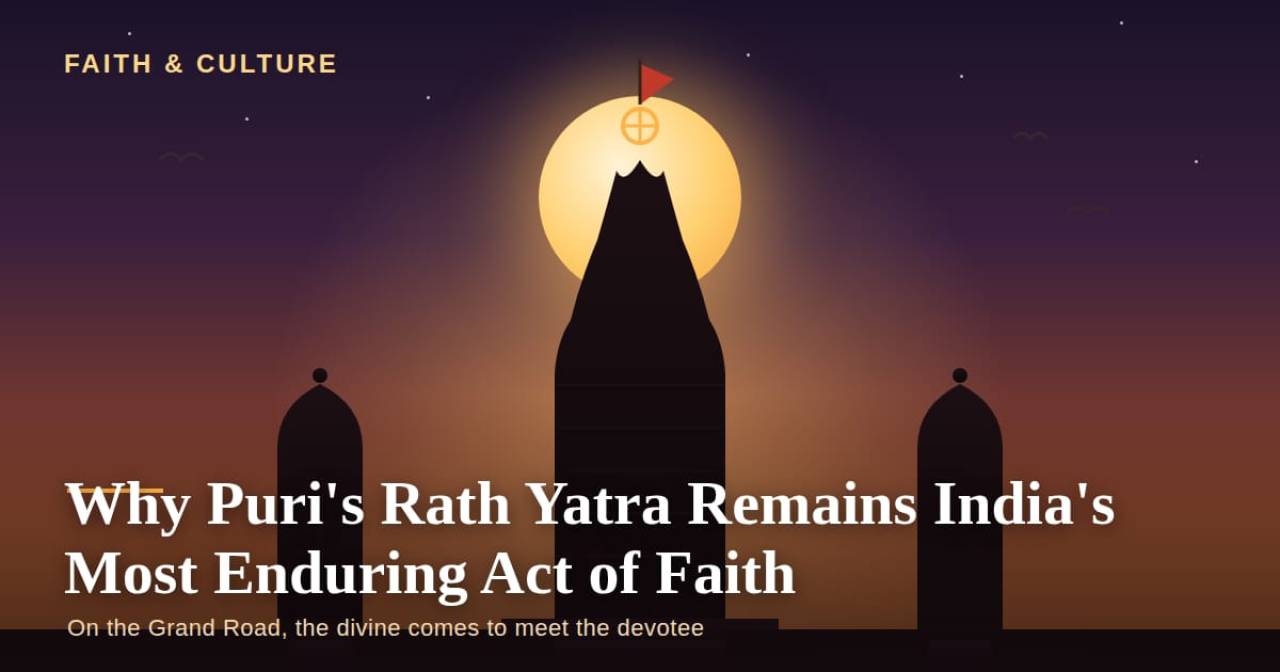
Every year, the gods leave their temple and join the people on the streets. In Puri's Rath Yatra, faith is not confined behind sacred walls—it rolls forward on giant chariots, pulled by thousands of hands united in devotion.
Every year, on the streets of Puri, three wooden chariots move through a sea of people, pulled not by machines or animals but by thousands of human hands. This is the Rath Yatra of Lord Jagannath, and it is one of the few festivals in the world where the deity leaves the sanctum of the temple and comes out to meet the people directly, on the open road, without barriers of caste, class or ritual distance. That single act explains why this festival has survived for centuries and continues to draw crowds larger than almost any other religious gathering in India.
The temple town of Puri, in Odisha, hosts thirteen major festivals through the year dedicated to Lord Jagannath, his brother Balabhadra and sister Subhadra. But among all of them, the Rath Yatra holds a place apart. It marks the one occasion when the deities, ordinarily kept within the temple's inner sanctum, are brought out onto the Bada Danda, the Grand Road of Puri, and taken in a procession to the Gundicha Temple, a few kilometres away. For nine days, the gods live outside their permanent home before returning in a second procession known as the Bahuda Yatra.
What makes this ritual distinct is not just its scale but its philosophy. In most temple traditions, the deity remains fixed in one place, and devotees travel to seek darshan. At Puri, the deity travels to the devotee. Anyone standing on the Grand Road, regardless of their background, can touch the ropes of the chariot and pull it forward. This inversion, of the divine coming down to the level of the ordinary person, is central to why the Rath Yatra is remembered as a festival of equality as much as devotion.
The chariots themselves are rebuilt every single year from scratch, using specified types of wood and following measurements and designs passed down through generations of temple carpenters. Nothing from the previous year's chariot is reused in construction, though the old wood is later used to build items for the temple kitchen or is distributed among devotees as sacred relics. This annual renewal is itself a quiet lesson. Faith, like the chariot, has to be rebuilt and recommitted to, not simply inherited and left unattended.
The idols of Jagannath, Balabhadra and Subhadra are also unusual in form. Unlike most Hindu deities carved in intricate detail, they are simple, almost abstract wooden figures with large round eyes and no hands or feet in the conventional sense. Various legends explain this incompleteness, but the effect on the devotee is the same. It creates an image that is instantly recognisable, deeply personal and stripped of ornamentation, allowing the focus to rest entirely on faith rather than iconography.
For millions across Odisha and Bihar in particular, Jagannath is not a distant, formal deity but a familiar presence woven into daily life, referred to affectionately as "Mahaprabhu" rather than by a formal title. Families structure entire years around the festival calendar, and even those who move away from Odisha for work or education often try to return to Puri at least once during the Yatra, treating it less as an obligation and more as a homecoming. Personal accounts describe how the memory of standing in the same crowd year after year, pulling the same ropes as strangers who quickly become companions for the day, is what gives the festival its lasting pull far beyond its religious significance.
This year, as in every year, an estimated crowd running into several lakhs is expected to converge on Puri's Grand Road. Security arrangements, crowd management and medical facilities have all been scaled up by the state administration, a reminder that a festival of this scale requires as much planning as devotion. Yet what continues to draw people back is not spectacle but something simpler. It is the chance to be part of a collective act of faith that has repeated itself, largely unchanged in spirit, for centuries.
In a country where religious gatherings are often associated with division or exclusivity, the Rath Yatra stands out as a rare example of a festival built around openness. It does not require initiation, caste standing or prior ritual knowledge. It only asks that a person show up and pull the rope alongside everyone else. That simplicity, more than any single myth or legend attached to it, is what has kept Puri's Grand Road, and the festival that fills it each year, alive in the hearts of devotees across generations.
Every year, on the streets of Puri, three wooden chariots move through a sea of people, pulled not by machines or animals but by thousands of human hands. This is the Rath Yatra of Lord Jagannath, and it is one of the few festivals in the world where the deity leaves the sanctum of the temple and comes out to meet the people directly, on the open road, without barriers of caste, class or ritual distance. That single act explains why this festival has survived for centuries and continues to draw crowds larger than almost any other religious gathering in India.
The temple town of Puri, in Odisha, hosts thirteen major festivals through the year dedicated to Lord Jagannath, his brother Balabhadra and sister Subhadra. But among all of them, the Rath Yatra holds a place apart. It marks the one occasion when the deities, ordinarily kept within the temple's inner sanctum, are brought out onto the Bada Danda, the Grand Road of Puri, and taken in a procession to the Gundicha Temple, a few kilometres away. For nine days, the gods live outside their permanent home before returning in a second procession known as the Bahuda Yatra.
What makes this ritual distinct is not just its scale but its philosophy. In most temple traditions, the deity remains fixed in one place, and devotees travel to seek darshan. At Puri, the deity travels to the devotee. Anyone standing on the Grand Road, regardless of their background, can touch the ropes of the chariot and pull it forward. This inversion, of the divine coming down to the level of the ordinary person, is central to why the Rath Yatra is remembered as a festival of equality as much as devotion.
The chariots themselves are rebuilt every single year from scratch, using specified types of wood and following measurements and designs passed down through generations of temple carpenters. Nothing from the previous year's chariot is reused in construction, though the old wood is later used to build items for the temple kitchen or is distributed among devotees as sacred relics. This annual renewal is itself a quiet lesson. Faith, like the chariot, has to be rebuilt and recommitted to, not simply inherited and left unattended.
The idols of Jagannath, Balabhadra and Subhadra are also unusual in form. Unlike most Hindu deities carved in intricate detail, they are simple, almost abstract wooden figures with large round eyes and no hands or feet in the conventional sense. Various legends explain this incompleteness, but the effect on the devotee is the same. It creates an image that is instantly recognisable, deeply personal and stripped of ornamentation, allowing the focus to rest entirely on faith rather than iconography.
For millions across Odisha and Bihar in particular, Jagannath is not a distant, formal deity but a familiar presence woven into daily life, referred to affectionately as "Mahaprabhu" rather than by a formal title. Families structure entire years around the festival calendar, and even those who move away from Odisha for work or education often try to return to Puri at least once during the Yatra, treating it less as an obligation and more as a homecoming. Personal accounts describe how the memory of standing in the same crowd year after year, pulling the same ropes as strangers who quickly become companions for the day, is what gives the festival its lasting pull far beyond its religious significance.
This year, as in every year, an estimated crowd running into several lakhs is expected to converge on Puri's Grand Road. Security arrangements, crowd management and medical facilities have all been scaled up by the state administration, a reminder that a festival of this scale requires as much planning as devotion. Yet what continues to draw people back is not spectacle but something simpler. It is the chance to be part of a collective act of faith that has repeated itself, largely unchanged in spirit, for centuries.
In a country where religious gatherings are often associated with division or exclusivity, the Rath Yatra stands out as a rare example of a festival built around openness. It does not require initiation, caste standing or prior ritual knowledge. It only asks that a person show up and pull the rope alongside everyone else. That simplicity, more than any single myth or legend attached to it, is what has kept Puri's Grand Road, and the festival that fills it each year, alive in the hearts of devotees across generations.


















Leave a Comment