
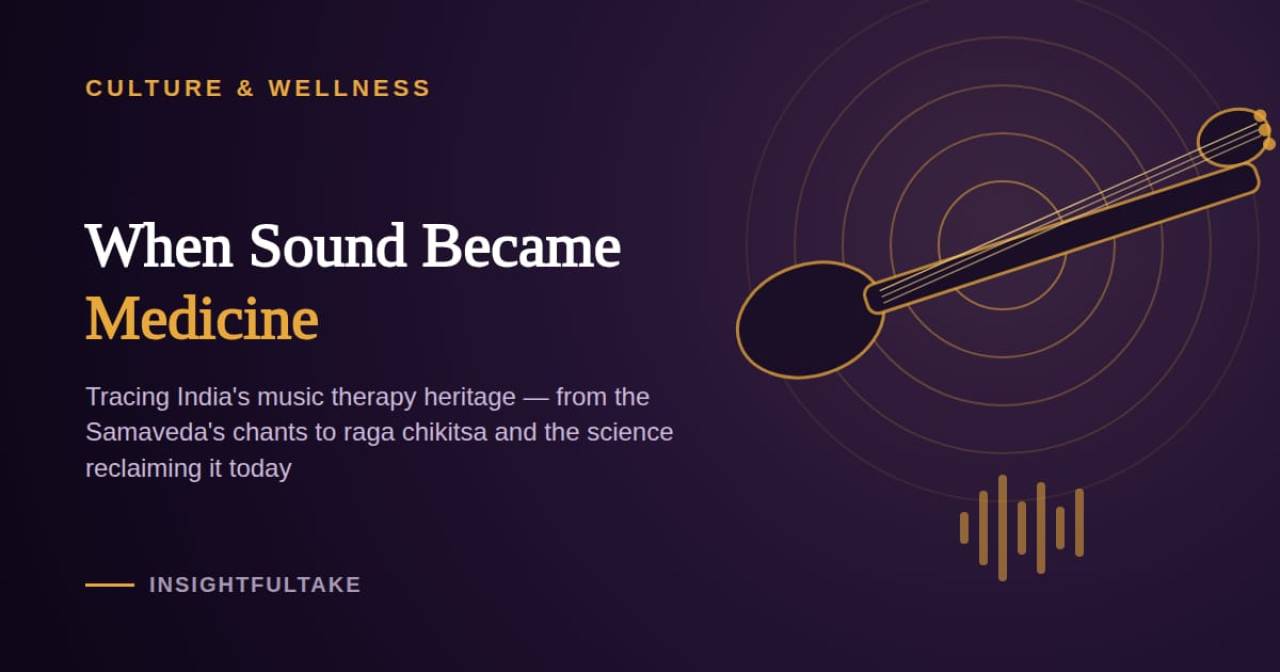
Long before neuroscience began studying the healing power of music, Indian scholars had already mapped how specific sounds could influence the human mind and body.
For centuries, music has been celebrated for its ability to soothe the soul, but in India it was once regarded as something far more profound. Ancient scholars viewed sound as a therapeutic force capable of influencing the body, mind and emotions. At a time when India faces a growing shortage of mental health professionals, revisiting this forgotten tradition offers more than cultural nostalgia. It highlights a knowledge system that explored the healing potential of music long before the term "music therapy" entered modern medical vocabulary.
The Vedic Foundation of Healing Through Sound
The earliest roots of India's music therapy tradition can be traced to the Samaveda, one of the four Vedas. Unlike the Rigveda, whose hymns were primarily intended for recitation, the Samaveda arranged its verses for singing according to carefully structured melodic patterns.
The chants followed strict rules governing pitch, rhythm and duration, reflecting an understanding that sound possessed its own intrinsic power rather than serving merely as a vehicle for sacred words. This remains one of the earliest documented examples of music being treated as a disciplined system with psychological and spiritual significance.
The Natyashastra and the Psychology of Music
The concept evolved further in the Natyashastra, the ancient Sanskrit treatise on performing arts traditionally attributed to sage Bharata. Although widely known for its contributions to drama and dance, the text also presents sophisticated theories on ragas and their emotional impact through the concept of rasa.
Each raga was believed to evoke a distinct emotional state such as peace, courage, devotion, longing or joy. More importantly, the text established a systematic relationship between musical structures and human emotions, an idea that modern researchers continue to investigate through neuroscience and clinical studies.
Raga Chikitsa: Music as Medicine
Building upon these foundations emerged Raga Chikitsa, literally meaning healing through ragas. According to this tradition, ragas are not merely artistic compositions but structured combinations of notes carrying unique vibrational qualities capable of influencing physical and emotional well-being.
Each raga possesses its own tonal character and is traditionally associated with particular times of the day and specific mental or physical conditions. Practitioners believed that aligning music with the body's natural rhythms could help restore balance and promote healing.
Historical Evidence Beyond Philosophy
The idea of music as medicine was not confined to scriptures alone. Historical records from the Thanjavur kingdom, which flourished between 1684 and 1711, provide evidence of organised music-based healing practices.
Court documents describe physicians and musicians working together to use ragas in treating patients. These records indicate that music therapy functioned as an institutional practice with trained practitioners rather than remaining an informal or purely spiritual exercise.
Nada Yoga: The Yoga of Sound
Another important pillar of India's musical healing tradition is Nada Yoga, often described as the yoga of sound. Unlike passive listening, Nada Yoga emphasises internally generated sound through controlled breathing, vocalisation and deep concentration.
The practice treats sound as an extension of breath and consciousness, aiming to regulate the nervous system while enhancing mental clarity and emotional stability. Its close relationship with Ayurveda demonstrates how India's traditional sciences viewed music, breath and health as interconnected aspects of human well-being.
Bridging Ancient Wisdom and Modern Science
For generations, much of this knowledge remained confined to gurukuls, royal courts and Ayurvedic traditions. Today, efforts are underway to examine these ancient concepts using modern scientific methods.
A significant milestone came in August 2024 when the Indian Knowledge System Centre at IIT Mandi introduced a postgraduate programme in Nada Yoga under the Ministry of AYUSH framework. The programme combines Indian classical traditions with neuroscience and clinical research, signalling growing academic recognition of music therapy as a serious field of study.
Why This Ancient Knowledge Matters Today
India's mental healthcare system continues to face a shortage of trained professionals, making affordable and non-invasive complementary therapies increasingly relevant. Music therapy offers a promising avenue because it builds upon cultural traditions that remain widely accessible while requiring relatively limited infrastructure.
However, wider adoption will require rigorous scientific validation, standardised education, clinical protocols and recognised professional qualifications. Integrating traditional knowledge with evidence-based research could help create effective complementary therapies for hospitals, schools, rehabilitation centres and mental health programmes.
A Legacy Waiting to Be Rediscovered
The Samaveda's melodic chants, the Natyashastra's theories of emotional resonance, the documented practice of Raga Chikitsa in the Thanjavur court and the revival of Nada Yoga through modern academic institutions together reveal a remarkable continuity in Indian thought.
Long before contemporary medicine began exploring the therapeutic effects of music, India's scholars had already developed sophisticated frameworks linking sound with emotional and physical well-being. Rediscovering this heritage is not simply an exercise in cultural pride. It is an opportunity to re-examine an ancient science that may still hold valuable insights for improving mental health and holistic healthcare in the modern world.
For centuries, music has been celebrated for its ability to soothe the soul, but in India it was once regarded as something far more profound. Ancient scholars viewed sound as a therapeutic force capable of influencing the body, mind and emotions. At a time when India faces a growing shortage of mental health professionals, revisiting this forgotten tradition offers more than cultural nostalgia. It highlights a knowledge system that explored the healing potential of music long before the term "music therapy" entered modern medical vocabulary.
The Vedic Foundation of Healing Through Sound
The earliest roots of India's music therapy tradition can be traced to the Samaveda, one of the four Vedas. Unlike the Rigveda, whose hymns were primarily intended for recitation, the Samaveda arranged its verses for singing according to carefully structured melodic patterns.
The chants followed strict rules governing pitch, rhythm and duration, reflecting an understanding that sound possessed its own intrinsic power rather than serving merely as a vehicle for sacred words. This remains one of the earliest documented examples of music being treated as a disciplined system with psychological and spiritual significance.
The Natyashastra and the Psychology of Music
The concept evolved further in the Natyashastra, the ancient Sanskrit treatise on performing arts traditionally attributed to sage Bharata. Although widely known for its contributions to drama and dance, the text also presents sophisticated theories on ragas and their emotional impact through the concept of rasa.
Each raga was believed to evoke a distinct emotional state such as peace, courage, devotion, longing or joy. More importantly, the text established a systematic relationship between musical structures and human emotions, an idea that modern researchers continue to investigate through neuroscience and clinical studies.
Raga Chikitsa: Music as Medicine
Building upon these foundations emerged Raga Chikitsa, literally meaning healing through ragas. According to this tradition, ragas are not merely artistic compositions but structured combinations of notes carrying unique vibrational qualities capable of influencing physical and emotional well-being.
Each raga possesses its own tonal character and is traditionally associated with particular times of the day and specific mental or physical conditions. Practitioners believed that aligning music with the body's natural rhythms could help restore balance and promote healing.
Historical Evidence Beyond Philosophy
The idea of music as medicine was not confined to scriptures alone. Historical records from the Thanjavur kingdom, which flourished between 1684 and 1711, provide evidence of organised music-based healing practices.
Court documents describe physicians and musicians working together to use ragas in treating patients. These records indicate that music therapy functioned as an institutional practice with trained practitioners rather than remaining an informal or purely spiritual exercise.
Nada Yoga: The Yoga of Sound
Another important pillar of India's musical healing tradition is Nada Yoga, often described as the yoga of sound. Unlike passive listening, Nada Yoga emphasises internally generated sound through controlled breathing, vocalisation and deep concentration.
The practice treats sound as an extension of breath and consciousness, aiming to regulate the nervous system while enhancing mental clarity and emotional stability. Its close relationship with Ayurveda demonstrates how India's traditional sciences viewed music, breath and health as interconnected aspects of human well-being.
Bridging Ancient Wisdom and Modern Science
For generations, much of this knowledge remained confined to gurukuls, royal courts and Ayurvedic traditions. Today, efforts are underway to examine these ancient concepts using modern scientific methods.
A significant milestone came in August 2024 when the Indian Knowledge System Centre at IIT Mandi introduced a postgraduate programme in Nada Yoga under the Ministry of AYUSH framework. The programme combines Indian classical traditions with neuroscience and clinical research, signalling growing academic recognition of music therapy as a serious field of study.
Why This Ancient Knowledge Matters Today
India's mental healthcare system continues to face a shortage of trained professionals, making affordable and non-invasive complementary therapies increasingly relevant. Music therapy offers a promising avenue because it builds upon cultural traditions that remain widely accessible while requiring relatively limited infrastructure.
However, wider adoption will require rigorous scientific validation, standardised education, clinical protocols and recognised professional qualifications. Integrating traditional knowledge with evidence-based research could help create effective complementary therapies for hospitals, schools, rehabilitation centres and mental health programmes.
A Legacy Waiting to Be Rediscovered
The Samaveda's melodic chants, the Natyashastra's theories of emotional resonance, the documented practice of Raga Chikitsa in the Thanjavur court and the revival of Nada Yoga through modern academic institutions together reveal a remarkable continuity in Indian thought.
Long before contemporary medicine began exploring the therapeutic effects of music, India's scholars had already developed sophisticated frameworks linking sound with emotional and physical well-being. Rediscovering this heritage is not simply an exercise in cultural pride. It is an opportunity to re-examine an ancient science that may still hold valuable insights for improving mental health and holistic healthcare in the modern world.























Leave a Comment