
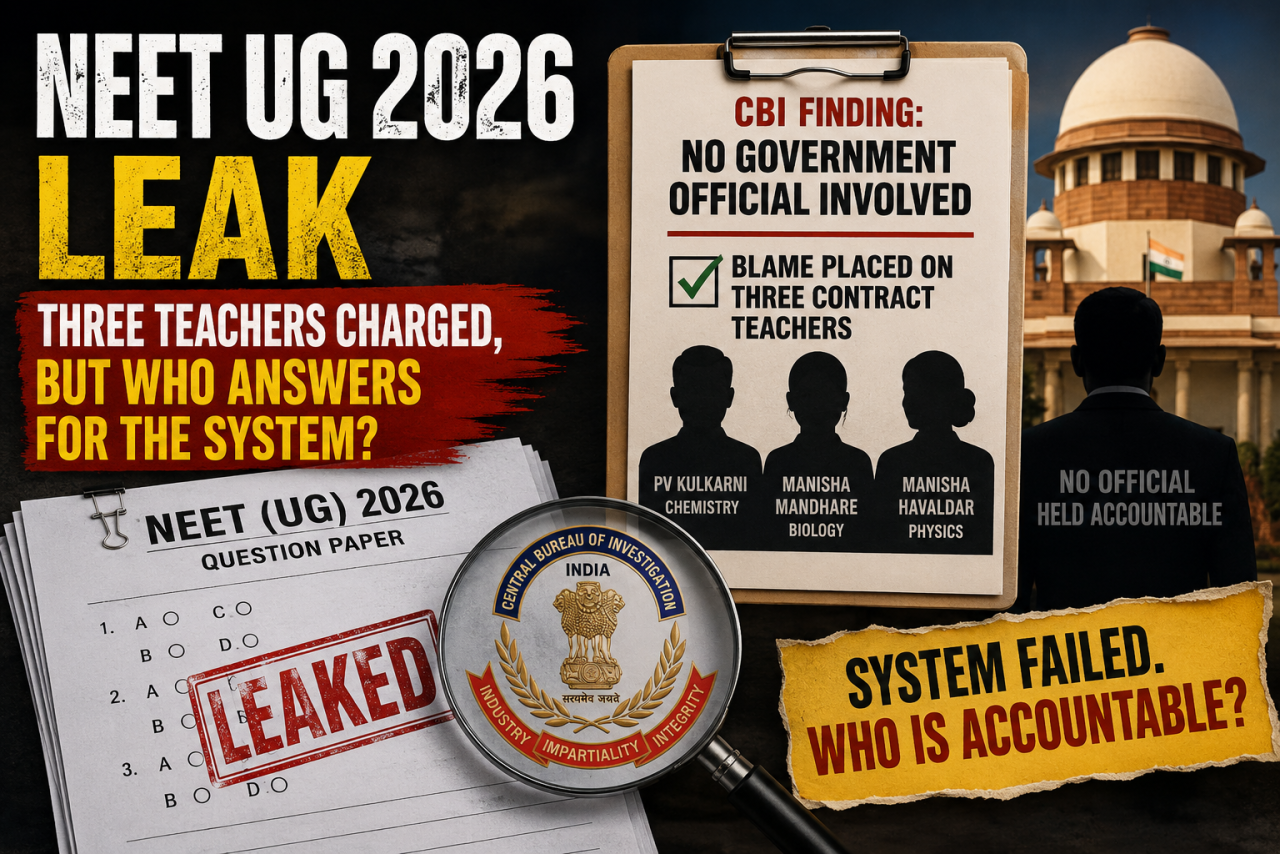
The CBI says no government official was involved in the NEET UG 2026 paper leak. But if the system failed, should only three contract teachers bear the blame, or does institutional accountability matter too?
The Central Bureau of Investigation has concluded that not a single government official was involved in the NEET UG 2026 paper leak. According to the agency, the question papers were taken out of the National Testing Agency's custody by teachers hired on contract to set them, and no NTA office bearer had any role in the matter. The charge sheet, expected to be filed this month, will reportedly name only private individuals: the thirteen people already arrested in the case, including three teachers identified as central to the leak: PV Kulkarni for Chemistry, Manisha Mandhare for Biology, and Manisha Havaldar for Physics.
An investigating officer, speaking on condition of anonymity, said that in two months of investigation, no evidence had surfaced pointing to any government officer's involvement. On paper, this appears to be a clear and swift conclusion. In practice, however, it raises far more questions than it answers, especially for the lakhs of students whose futures were disrupted by the leak.
The first question is one of accountability. The NTA selected and contracted these teachers to prepare one of the country's most important entrance examinations. That decision was made through a process designed, supervised, and safeguarded by the agency itself. If those safeguards failed badly enough for question papers to leave official custody before the examination, the failure cannot be viewed solely as an individual's breach of trust. It also reflects weaknesses in the system that entrusted them with highly confidential material.
The CBI's conclusion that no official "aided" the leak addresses criminal involvement. It does not answer whether there was administrative negligence or institutional failure in preventing the leak. Those are separate questions, and equally important ones, that the reported charge sheet does not appear to examine.
This is not the first time the NTA has faced questions over examination security. NEET UG has repeatedly been surrounded by controversies involving paper leaks and irregularities. Each time, the response follows a familiar pattern: investigations are launched, a handful of individuals are arrested, and the matter gradually comes to a close. What rarely follows is a transparent public audit of how confidential examination papers move through the system, whether security protocols failed, and what reforms have been introduced to prevent another breach.
Equally absent is any meaningful institutional accountability. No independent oversight mechanism has been created to review the NTA's examination processes. No detailed public report explains where the safeguards broke down or how they will be strengthened. For an examination that determines the future of more than twenty lakh medical aspirants each year, such silence inevitably weakens public confidence.
For students who appeared for NEET UG 2026, the investigation's conclusion offers little reassurance. Many spent months living with uncertainty over months. Some may already have lost valuable admission opportunities because of the confusion that followed. Seeing only private individuals prosecuted, while no official is held accountable for the system's failure, is unlikely to restore their faith in the examination process.
Trust in a national examination cannot depend solely on the promise that offenders will eventually be identified and prosecuted. It also depends on visible evidence that the institution has learned from its mistakes. Stronger protocols for handling question papers, tighter oversight of paper setters, greater transparency, and clear consequences for administrative lapses are all essential if future examinations are to command public confidence. None of these reforms has featured prominently in the findings reported so far.
The absence of government officials from the charge sheet may accurately reflect where criminal liability ends. But criminal liability is only one form of accountability. Institutional responsibility matters just as much when a system entrusted with the aspirations of millions fails to protect the integrity of a national examination.
Between the declaration that no evidence was found against officials and the filing of the charge sheet, one uncomfortable question remains unanswered: if the system failed, who answers for the system?
The Central Bureau of Investigation has concluded that not a single government official was involved in the NEET UG 2026 paper leak. According to the agency, the question papers were taken out of the National Testing Agency's custody by teachers hired on contract to set them, and no NTA office bearer had any role in the matter. The charge sheet, expected to be filed this month, will reportedly name only private individuals: the thirteen people already arrested in the case, including three teachers identified as central to the leak: PV Kulkarni for Chemistry, Manisha Mandhare for Biology, and Manisha Havaldar for Physics.
An investigating officer, speaking on condition of anonymity, said that in two months of investigation, no evidence had surfaced pointing to any government officer's involvement. On paper, this appears to be a clear and swift conclusion. In practice, however, it raises far more questions than it answers, especially for the lakhs of students whose futures were disrupted by the leak.
The first question is one of accountability. The NTA selected and contracted these teachers to prepare one of the country's most important entrance examinations. That decision was made through a process designed, supervised, and safeguarded by the agency itself. If those safeguards failed badly enough for question papers to leave official custody before the examination, the failure cannot be viewed solely as an individual's breach of trust. It also reflects weaknesses in the system that entrusted them with highly confidential material.
The CBI's conclusion that no official "aided" the leak addresses criminal involvement. It does not answer whether there was administrative negligence or institutional failure in preventing the leak. Those are separate questions, and equally important ones, that the reported charge sheet does not appear to examine.
This is not the first time the NTA has faced questions over examination security. NEET UG has repeatedly been surrounded by controversies involving paper leaks and irregularities. Each time, the response follows a familiar pattern: investigations are launched, a handful of individuals are arrested, and the matter gradually comes to a close. What rarely follows is a transparent public audit of how confidential examination papers move through the system, whether security protocols failed, and what reforms have been introduced to prevent another breach.
Equally absent is any meaningful institutional accountability. No independent oversight mechanism has been created to review the NTA's examination processes. No detailed public report explains where the safeguards broke down or how they will be strengthened. For an examination that determines the future of more than twenty lakh medical aspirants each year, such silence inevitably weakens public confidence.
For students who appeared for NEET UG 2026, the investigation's conclusion offers little reassurance. Many spent months living with uncertainty over months. Some may already have lost valuable admission opportunities because of the confusion that followed. Seeing only private individuals prosecuted, while no official is held accountable for the system's failure, is unlikely to restore their faith in the examination process.
Trust in a national examination cannot depend solely on the promise that offenders will eventually be identified and prosecuted. It also depends on visible evidence that the institution has learned from its mistakes. Stronger protocols for handling question papers, tighter oversight of paper setters, greater transparency, and clear consequences for administrative lapses are all essential if future examinations are to command public confidence. None of these reforms has featured prominently in the findings reported so far.
The absence of government officials from the charge sheet may accurately reflect where criminal liability ends. But criminal liability is only one form of accountability. Institutional responsibility matters just as much when a system entrusted with the aspirations of millions fails to protect the integrity of a national examination.
Between the declaration that no evidence was found against officials and the filing of the charge sheet, one uncomfortable question remains unanswered: if the system failed, who answers for the system?























Leave a Comment