
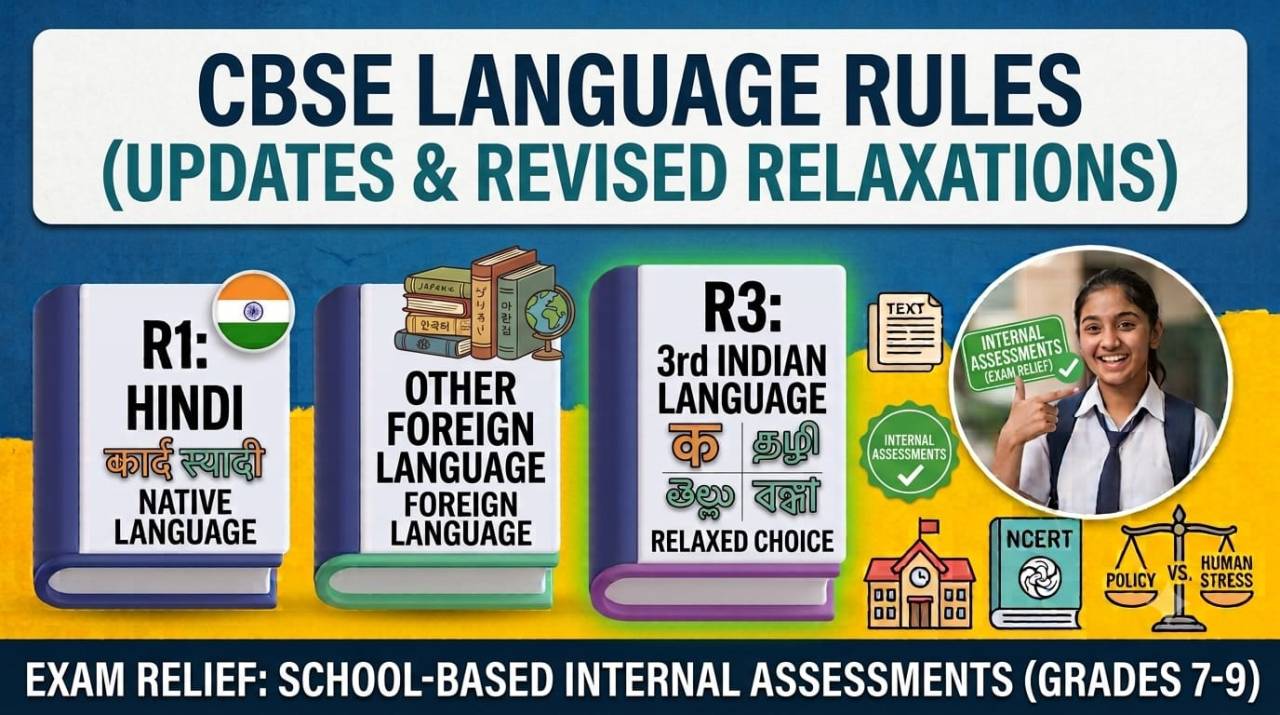
After widespread concerns from students, parents, and schools, CBSE has softened the rollout of the Three-Language Formula with a one-time relaxation for existing batches.
In a diverse and multilingual country like India, language is more than a tool of communication—it reflects identity, culture, and heritage. The Three-Language Formula, introduced under the National Education Policy (NEP) 2020 and detailed in the National Curriculum Framework for School Education (NCF-SE) 2023, seeks to promote multilingualism while strengthening students' connection with Indian languages.
However, implementing a nationwide policy across millions of students is rarely straightforward. The Central Board of Secondary Education (CBSE) recently revised its implementation strategy after concerns raised by students, parents, and schools, highlighting the need to balance educational reform with practical realities.
What Is the Three-Language Formula?
The Three-Language Formula requires students to study three languages during their school education. Under the policy, at least two of the three languages must be native Indian languages, while the third may be English or another language.
The objective is to encourage multilingual learning, preserve India's linguistic diversity, and promote national integration without discouraging students from learning foreign languages.
Why Did the Policy Create Concerns?
For many students already studying in middle and secondary school, the policy created unexpected challenges.
Several students had previously opted for English and a foreign language such as French or German alongside only one Indian language. A strict implementation of the revised policy would have required them to begin studying an additional Indian language midway through their schooling.
Students and parents argued that introducing a new language alongside subjects such as Mathematics, Science, and Social Science would significantly increase academic pressure and affect students' mental well-being.
CBSE's One-Time Relief for Existing Students
After receiving feedback from schools and families, CBSE announced a one-time relaxation for students currently studying in Classes 7, 8, and 9.
Under the revised arrangement:
- Students may continue studying their existing language combination.
- They must add one native Indian language to comply with the policy.
- When these batches reach Class 10, the third language will not be part of the Board examination.
- Instead, their proficiency in the additional language will be assessed through internal school-based evaluation.
The decision aims to ensure that students are not academically disadvantaged during the transition to the new framework.
What Happens to Future Students?
The relaxation is temporary.
Students entering Class 6 under the new curriculum will follow the Three-Language Formula in its entirety. They will study three languages throughout their schooling, with at least two being native Indian languages, and will eventually appear for the third-language Board examination in Class 10.
Implementation at a Glance
Student Group
Policy Status
Assessment
Current Classes 7–9
One-time relaxation
Internal school assessment for third language
Current Class 10
No change
Existing Board examination pattern
Students entering Class 6 onwards
Full implementation
Board examination in third language in Class 10
Inclusive Provisions
CBSE has also incorporated several exemptions to ensure the policy remains inclusive.
Children with Special Needs (CWSN) will receive relaxations in accordance with the Rights of Persons with Disabilities (RPwD) Act, 2016.
Similarly, CBSE-affiliated schools located outside India and foreign students enrolling in Indian CBSE schools are exempt from the compulsory third Indian language requirement.
Recognising the shortage of qualified language teachers in some schools, CBSE has also permitted flexible staffing arrangements, including retired teachers, online and hybrid teaching, and resource sharing among neighbouring schools.
A Lesson in Policy Implementation
The evolution of the Three-Language Formula illustrates an important principle of public policy: successful reforms require flexibility as well as vision.
While the policy seeks to strengthen multilingual education and preserve India's linguistic diversity, its phased implementation acknowledges the academic realities faced by students already in the system. By introducing transitional relief, CBSE has attempted to ensure that educational reform does not come at the cost of student well-being.
Ultimately, the Three-Language Formula represents an effort to prepare students for a multilingual future while recognising that meaningful educational change must remain practical, inclusive, and student-centric.
In a diverse and multilingual country like India, language is more than a tool of communication—it reflects identity, culture, and heritage. The Three-Language Formula, introduced under the National Education Policy (NEP) 2020 and detailed in the National Curriculum Framework for School Education (NCF-SE) 2023, seeks to promote multilingualism while strengthening students' connection with Indian languages.
However, implementing a nationwide policy across millions of students is rarely straightforward. The Central Board of Secondary Education (CBSE) recently revised its implementation strategy after concerns raised by students, parents, and schools, highlighting the need to balance educational reform with practical realities.
What Is the Three-Language Formula?
The Three-Language Formula requires students to study three languages during their school education. Under the policy, at least two of the three languages must be native Indian languages, while the third may be English or another language.
The objective is to encourage multilingual learning, preserve India's linguistic diversity, and promote national integration without discouraging students from learning foreign languages.
Why Did the Policy Create Concerns?
For many students already studying in middle and secondary school, the policy created unexpected challenges.
Several students had previously opted for English and a foreign language such as French or German alongside only one Indian language. A strict implementation of the revised policy would have required them to begin studying an additional Indian language midway through their schooling.
Students and parents argued that introducing a new language alongside subjects such as Mathematics, Science, and Social Science would significantly increase academic pressure and affect students' mental well-being.
CBSE's One-Time Relief for Existing Students
After receiving feedback from schools and families, CBSE announced a one-time relaxation for students currently studying in Classes 7, 8, and 9.
Under the revised arrangement:
- Students may continue studying their existing language combination.
- They must add one native Indian language to comply with the policy.
- When these batches reach Class 10, the third language will not be part of the Board examination.
- Instead, their proficiency in the additional language will be assessed through internal school-based evaluation.
The decision aims to ensure that students are not academically disadvantaged during the transition to the new framework.
What Happens to Future Students?
The relaxation is temporary.
Students entering Class 6 under the new curriculum will follow the Three-Language Formula in its entirety. They will study three languages throughout their schooling, with at least two being native Indian languages, and will eventually appear for the third-language Board examination in Class 10.
Implementation at a Glance
|
Student Group |
Policy Status |
Assessment |
|
Current Classes 7–9 |
One-time relaxation |
Internal school assessment for third language |
|
Current Class 10 |
No change |
Existing Board examination pattern |
|
Students entering Class 6 onwards |
Full implementation |
Board examination in third language in Class 10 |
Inclusive Provisions
CBSE has also incorporated several exemptions to ensure the policy remains inclusive.
Children with Special Needs (CWSN) will receive relaxations in accordance with the Rights of Persons with Disabilities (RPwD) Act, 2016.
Similarly, CBSE-affiliated schools located outside India and foreign students enrolling in Indian CBSE schools are exempt from the compulsory third Indian language requirement.
Recognising the shortage of qualified language teachers in some schools, CBSE has also permitted flexible staffing arrangements, including retired teachers, online and hybrid teaching, and resource sharing among neighbouring schools.
A Lesson in Policy Implementation
The evolution of the Three-Language Formula illustrates an important principle of public policy: successful reforms require flexibility as well as vision.
While the policy seeks to strengthen multilingual education and preserve India's linguistic diversity, its phased implementation acknowledges the academic realities faced by students already in the system. By introducing transitional relief, CBSE has attempted to ensure that educational reform does not come at the cost of student well-being.
Ultimately, the Three-Language Formula represents an effort to prepare students for a multilingual future while recognising that meaningful educational change must remain practical, inclusive, and student-centric.





















Leave a Comment