
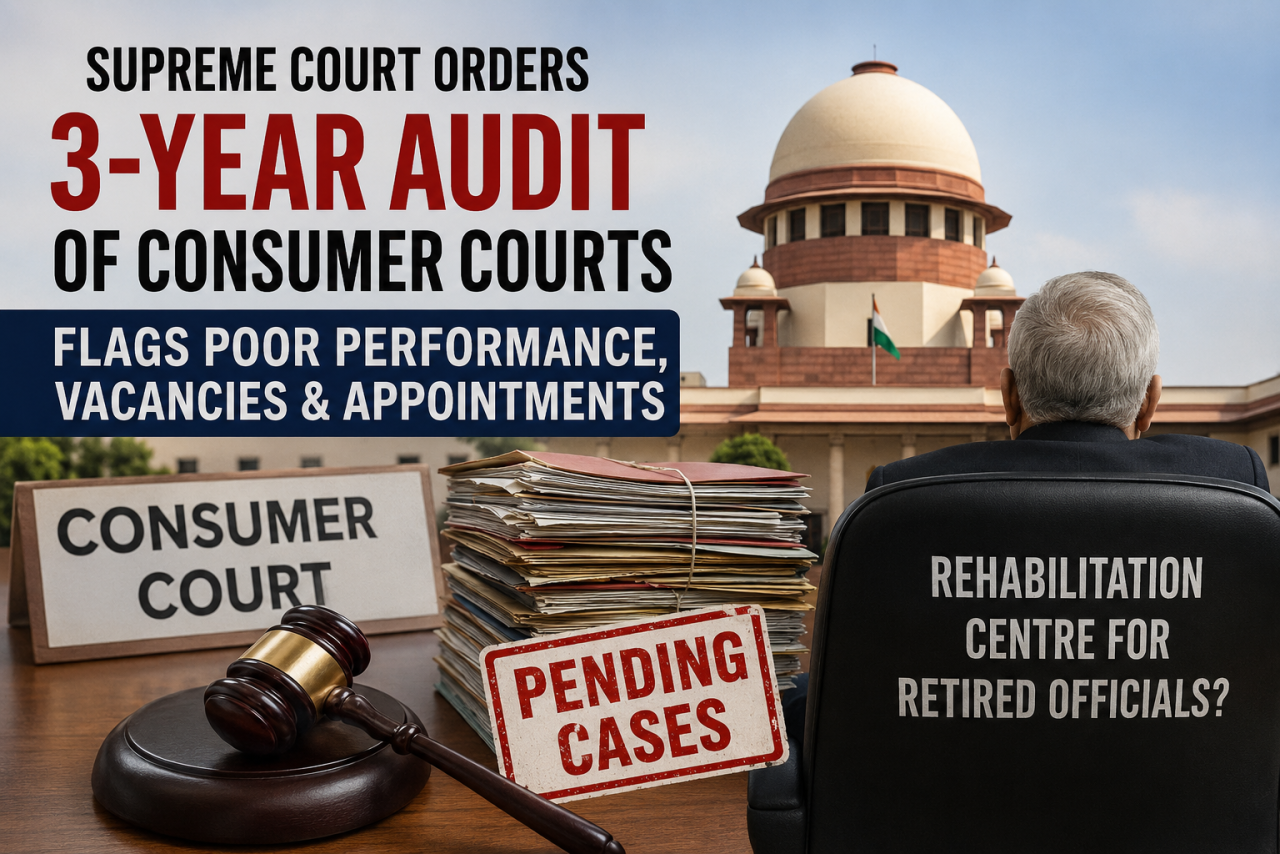
Consumer courts were created for speedy justice. The Supreme Court now wants to know why so many consumers are still waiting.
The Supreme Court has sent a strong message to India’s consumer justice system that the consumer courts are meant to deliver justice, not provide a comfortable post-retirement destination for officials.
The court’s concern goes beyond the slow disposal of cases. It points to a deeper institutional problem. If consumer commissions remain burdened with vacancies, weak infrastructure, poor appointments and inadequate accountability, adding more buildings or facilities alone will not solve the crisis.
The Supreme Court has ordered a three-year performance audit of consumer commissions across the country. The presidents of the National Consumer Disputes Redressal Commission (NCDRC) and state consumer commissions have been asked to evaluate their performance and submit reports. The court has also sought information on pending cases, disposal rates, the composition of benches and the estimated time required to clear the backlog.
The intervention followed concerns over the poor functioning of consumer commissions. During the hearing, the bench questioned whether some of these institutions had effectively become “rehabilitation centres for retired” officials.
That observation raises an uncomfortable but important question: Who is the consumer justice system really designed to serve?
Justice cannot depend on the age of the person hearing the case
Consumer courts were created to provide ordinary people with a relatively quick and accessible way to resolve disputes involving defective products, deficient services, unfair practices and other consumer grievances.
But a consumer who approaches such a forum is often already dealing with a financial loss, inadequate service or a dispute with a much larger organisation. If the case then remains pending for years, the purpose of the system is defeated.
The Supreme Court reportedly noted that appointments to consumer commissions must not be treated as a form of post-retirement rehabilitation. The concern is not about retired professionals themselves. Experienced judges, administrators and experts can make valuable contributions. The real issue is whether appointments are based on competence, suitability and commitment to consumer justice, rather than simply availability after retirement.
More buildings will not fix a broken system
One of the most important aspects of the court’s intervention is its focus on quality and accountability, rather than infrastructure alone.
The government indicated that a large number of consumer cases remain pending across the country. But the court observed that simply increasing infrastructure or providing additional facilities would not address the problem unless there was corresponding accountability.
This is a crucial distinction.
A commission may have a courtroom, computers and staff, yet still perform poorly if hearings are repeatedly adjourned, orders take too long, vacancies remain unfilled or cases are not examined carefully on their merits.
Consumer justice requires both speed and quality. A quick but poorly reasoned decision is not justice. A technically sound decision delivered after years of waiting is also inadequate.
The real test should be performance
The proposed three-year audit could become a turning point if it measures what actually matters.
Every consumer commission should be assessed through transparent indicators such as the number of cases received, cases disposed of, average time taken, age of pending cases, vacancies, frequency of adjournments and the quality and timeliness of orders.
The data should ideally be made public.
Such transparency would allow citizens to understand which commissions are functioning efficiently and which ones require urgent intervention.
The court has also highlighted another weakness: district commissions may not always examine the nature of disputes carefully before deciding them. When matters are not properly resolved at the first level, appeals increase and the burden eventually moves upward.
That creates a chain reaction. A weak district-level system produces more appeals, which increases pressure on state commissions and eventually the national commission.
Consumers need a system that works before they lose faith
The consumer protection framework exists because an ordinary citizen often has less bargaining power than a corporation, service provider or institution.
But legal rights have little value if obtaining a remedy takes so long that the consumer eventually gives up.
The Supreme Court’s audit should therefore not become another report that sits on a shelf. It should lead to measurable reforms in appointments, vacancies, case management, training, digital monitoring and accountability.
Consumer courts cannot be judged by how many benches they have, but by how effectively they deliver justice.
A consumer commission should be a place where a citizen expects a fair and timely remedy, not another institution where a grievance grows older with every passing year.
The Supreme Court has sent a strong message to India’s consumer justice system that the consumer courts are meant to deliver justice, not provide a comfortable post-retirement destination for officials.
The court’s concern goes beyond the slow disposal of cases. It points to a deeper institutional problem. If consumer commissions remain burdened with vacancies, weak infrastructure, poor appointments and inadequate accountability, adding more buildings or facilities alone will not solve the crisis.
The Supreme Court has ordered a three-year performance audit of consumer commissions across the country. The presidents of the National Consumer Disputes Redressal Commission (NCDRC) and state consumer commissions have been asked to evaluate their performance and submit reports. The court has also sought information on pending cases, disposal rates, the composition of benches and the estimated time required to clear the backlog.
The intervention followed concerns over the poor functioning of consumer commissions. During the hearing, the bench questioned whether some of these institutions had effectively become “rehabilitation centres for retired” officials.
That observation raises an uncomfortable but important question: Who is the consumer justice system really designed to serve?
Justice cannot depend on the age of the person hearing the case
Consumer courts were created to provide ordinary people with a relatively quick and accessible way to resolve disputes involving defective products, deficient services, unfair practices and other consumer grievances.
But a consumer who approaches such a forum is often already dealing with a financial loss, inadequate service or a dispute with a much larger organisation. If the case then remains pending for years, the purpose of the system is defeated.
The Supreme Court reportedly noted that appointments to consumer commissions must not be treated as a form of post-retirement rehabilitation. The concern is not about retired professionals themselves. Experienced judges, administrators and experts can make valuable contributions. The real issue is whether appointments are based on competence, suitability and commitment to consumer justice, rather than simply availability after retirement.
More buildings will not fix a broken system
One of the most important aspects of the court’s intervention is its focus on quality and accountability, rather than infrastructure alone.
The government indicated that a large number of consumer cases remain pending across the country. But the court observed that simply increasing infrastructure or providing additional facilities would not address the problem unless there was corresponding accountability.
This is a crucial distinction.
A commission may have a courtroom, computers and staff, yet still perform poorly if hearings are repeatedly adjourned, orders take too long, vacancies remain unfilled or cases are not examined carefully on their merits.
Consumer justice requires both speed and quality. A quick but poorly reasoned decision is not justice. A technically sound decision delivered after years of waiting is also inadequate.
The real test should be performance
The proposed three-year audit could become a turning point if it measures what actually matters.
Every consumer commission should be assessed through transparent indicators such as the number of cases received, cases disposed of, average time taken, age of pending cases, vacancies, frequency of adjournments and the quality and timeliness of orders.
The data should ideally be made public.
Such transparency would allow citizens to understand which commissions are functioning efficiently and which ones require urgent intervention.
The court has also highlighted another weakness: district commissions may not always examine the nature of disputes carefully before deciding them. When matters are not properly resolved at the first level, appeals increase and the burden eventually moves upward.
That creates a chain reaction. A weak district-level system produces more appeals, which increases pressure on state commissions and eventually the national commission.
Consumers need a system that works before they lose faith
The consumer protection framework exists because an ordinary citizen often has less bargaining power than a corporation, service provider or institution.
But legal rights have little value if obtaining a remedy takes so long that the consumer eventually gives up.
The Supreme Court’s audit should therefore not become another report that sits on a shelf. It should lead to measurable reforms in appointments, vacancies, case management, training, digital monitoring and accountability.
Consumer courts cannot be judged by how many benches they have, but by how effectively they deliver justice.
A consumer commission should be a place where a citizen expects a fair and timely remedy, not another institution where a grievance grows older with every passing year.



























Leave a Comment