
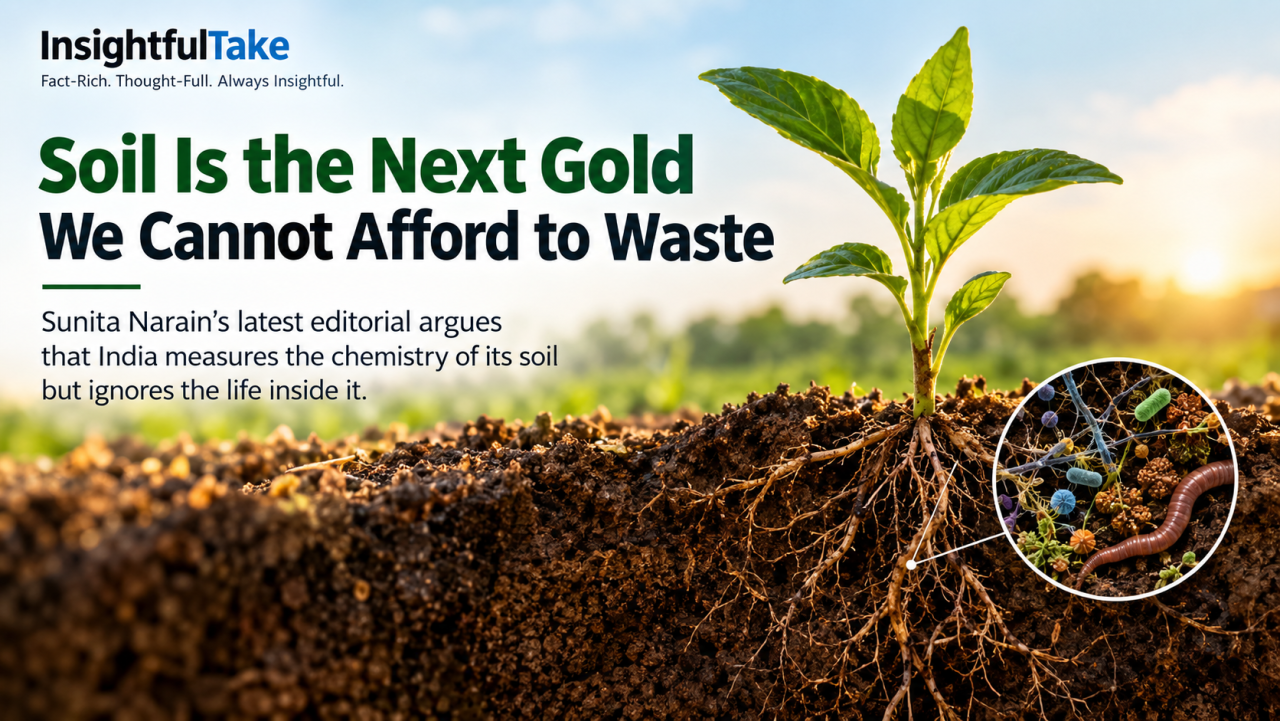
What lies beneath India’s farms may be more valuable than we realise. Soil is alive, and its health could shape both food security and climate resilience.
We walk on soil every day, grow our food in it and build our homes over it. Yet, despite its importance, soil is often treated as little more than a medium in which crops grow. Sunita Narain, Director General of the Centre for Science and Environment, argues that this limited understanding could be costing India both its agricultural future and its climate resilience.
In a recent editorial published by Down To Earth, Narain makes a simple but important point: soil is not merely a collection of nutrients. It is a living system.
Soil is more than chemistry
Modern agriculture has placed considerable emphasis on measuring the chemical condition of soil. India's Soil Health Card programme tests parameters such as nitrogen, phosphorus, potassium, organic carbon and micronutrients including zinc and copper.
These measurements are useful, but Narain argues that they do not tell the whole story.
Beneath the surface exists a complex biological community of bacteria, fungi, algae, protozoa, earthworms and other organisms. These organisms help break down organic matter, make nutrients available to plants and contribute to the overall functioning of soil.
Narain compares this biological diversity with the microbial life inside the human gut. Just as the diversity of microorganisms in the gut is connected with what we eat, the biological health of soil is influenced by the diversity of crops and organic matter returned to it.
The broader message is that soil cannot remain healthy simply because a laboratory report shows that certain nutrients are present.
Are more fertilisers solving the problem?
This question becomes important when public spending on fertilisers is considered.
According to the analysis cited by Narain, India's fertiliser subsidy is around Rs 1.71 lakh crore. At the same time, chemical fertiliser consumption has continued to rise.
Yet increasing chemical inputs have not necessarily translated into healthier soil.
CSE researchers examined approximately 13 million Soil Health Cards issued between 2023 and 2025 and compared fertiliser use with the nutrient condition of soils. Their analysis, as presented by Narain, found that fertiliser use had increased by about 20 per cent, while significant deficiencies in nitrogen and other macro- and micronutrients continued to be reported.
This raises an uncomfortable question: if more chemical inputs are being used but soil deficiencies remain widespread, are we measuring and addressing the problem correctly?
The consequences are not limited to government budgets. Farmers ultimately bear much of the cost through higher input expenses. If soil productivity does not improve in proportion to these investments, the economic burden becomes harder to ignore.
The life beneath the surface
The missing element, Narain argues, is biological health.
Soil organisms help plants access nutrients and contribute to the structure and fertility of the land. Their presence is also closely connected with the diversity of crops grown on it.
This makes crop diversity important not only from an ecological perspective but also for the biological functioning of soil.
A field repeatedly planted with the same crop and dependent heavily on external chemical inputs may produce food, but that does not automatically mean the soil beneath it is becoming healthier.
India's soil monitoring system, therefore, may need to look beyond what can be measured through conventional chemical tests.
Soil and the climate challenge
There is another reason to pay attention to what lies beneath our feet: climate change.
Soils are among the world's major carbon stores. Healthy soils can contribute to carbon sequestration, making soil management relevant not only to agriculture but also to climate policy.
Narain points out that soil organic carbon is already measured, but this too has limitations. Organic carbon includes both living and dead material. It therefore cannot, by itself, provide a complete picture of the biological activity taking place in the soil.
The distinction matters because the living organisms within soil are central to how nutrients move, plants grow and carbon cycles through the ecosystem.
If soil is to play a larger role in climate action, measuring its biological condition may therefore become increasingly important.
A case for looking beneath our feet
Narain's argument is ultimately less about rejecting fertilisers and more about questioning an approach that focuses heavily on chemistry while giving limited attention to biology.
For policymakers, the argument raises the possibility of including biological indicators in future soil assessments. For farmers, it reinforces the importance of crop diversity and farming practices that protect soil organisms. For citizens, it offers a reminder that food security and climate resilience begin much closer to home than many realise.
Soil may not have the visual appeal of gold, but its value is far greater in everyday life. Gold can be stored in a vault. Soil has to remain alive.
The larger lesson from Narain's argument is straightforward that India cannot secure its agricultural future merely by adding more inputs to the land. It must also understand and protect the living system that makes those inputs useful.
The wealth beneath our feet is largely invisible.
We walk on soil every day, grow our food in it and build our homes over it. Yet, despite its importance, soil is often treated as little more than a medium in which crops grow. Sunita Narain, Director General of the Centre for Science and Environment, argues that this limited understanding could be costing India both its agricultural future and its climate resilience.
In a recent editorial published by Down To Earth, Narain makes a simple but important point: soil is not merely a collection of nutrients. It is a living system.
Soil is more than chemistry
Modern agriculture has placed considerable emphasis on measuring the chemical condition of soil. India's Soil Health Card programme tests parameters such as nitrogen, phosphorus, potassium, organic carbon and micronutrients including zinc and copper.
These measurements are useful, but Narain argues that they do not tell the whole story.
Beneath the surface exists a complex biological community of bacteria, fungi, algae, protozoa, earthworms and other organisms. These organisms help break down organic matter, make nutrients available to plants and contribute to the overall functioning of soil.
Narain compares this biological diversity with the microbial life inside the human gut. Just as the diversity of microorganisms in the gut is connected with what we eat, the biological health of soil is influenced by the diversity of crops and organic matter returned to it.
The broader message is that soil cannot remain healthy simply because a laboratory report shows that certain nutrients are present.
Are more fertilisers solving the problem?
This question becomes important when public spending on fertilisers is considered.
According to the analysis cited by Narain, India's fertiliser subsidy is around Rs 1.71 lakh crore. At the same time, chemical fertiliser consumption has continued to rise.
Yet increasing chemical inputs have not necessarily translated into healthier soil.
CSE researchers examined approximately 13 million Soil Health Cards issued between 2023 and 2025 and compared fertiliser use with the nutrient condition of soils. Their analysis, as presented by Narain, found that fertiliser use had increased by about 20 per cent, while significant deficiencies in nitrogen and other macro- and micronutrients continued to be reported.
This raises an uncomfortable question: if more chemical inputs are being used but soil deficiencies remain widespread, are we measuring and addressing the problem correctly?
The consequences are not limited to government budgets. Farmers ultimately bear much of the cost through higher input expenses. If soil productivity does not improve in proportion to these investments, the economic burden becomes harder to ignore.
The life beneath the surface
The missing element, Narain argues, is biological health.
Soil organisms help plants access nutrients and contribute to the structure and fertility of the land. Their presence is also closely connected with the diversity of crops grown on it.
This makes crop diversity important not only from an ecological perspective but also for the biological functioning of soil.
A field repeatedly planted with the same crop and dependent heavily on external chemical inputs may produce food, but that does not automatically mean the soil beneath it is becoming healthier.
India's soil monitoring system, therefore, may need to look beyond what can be measured through conventional chemical tests.
Soil and the climate challenge
There is another reason to pay attention to what lies beneath our feet: climate change.
Soils are among the world's major carbon stores. Healthy soils can contribute to carbon sequestration, making soil management relevant not only to agriculture but also to climate policy.
Narain points out that soil organic carbon is already measured, but this too has limitations. Organic carbon includes both living and dead material. It therefore cannot, by itself, provide a complete picture of the biological activity taking place in the soil.
The distinction matters because the living organisms within soil are central to how nutrients move, plants grow and carbon cycles through the ecosystem.
If soil is to play a larger role in climate action, measuring its biological condition may therefore become increasingly important.
A case for looking beneath our feet
Narain's argument is ultimately less about rejecting fertilisers and more about questioning an approach that focuses heavily on chemistry while giving limited attention to biology.
For policymakers, the argument raises the possibility of including biological indicators in future soil assessments. For farmers, it reinforces the importance of crop diversity and farming practices that protect soil organisms. For citizens, it offers a reminder that food security and climate resilience begin much closer to home than many realise.
Soil may not have the visual appeal of gold, but its value is far greater in everyday life. Gold can be stored in a vault. Soil has to remain alive.
The larger lesson from Narain's argument is straightforward that India cannot secure its agricultural future merely by adding more inputs to the land. It must also understand and protect the living system that makes those inputs useful.
The wealth beneath our feet is largely invisible.





















Leave a Comment