
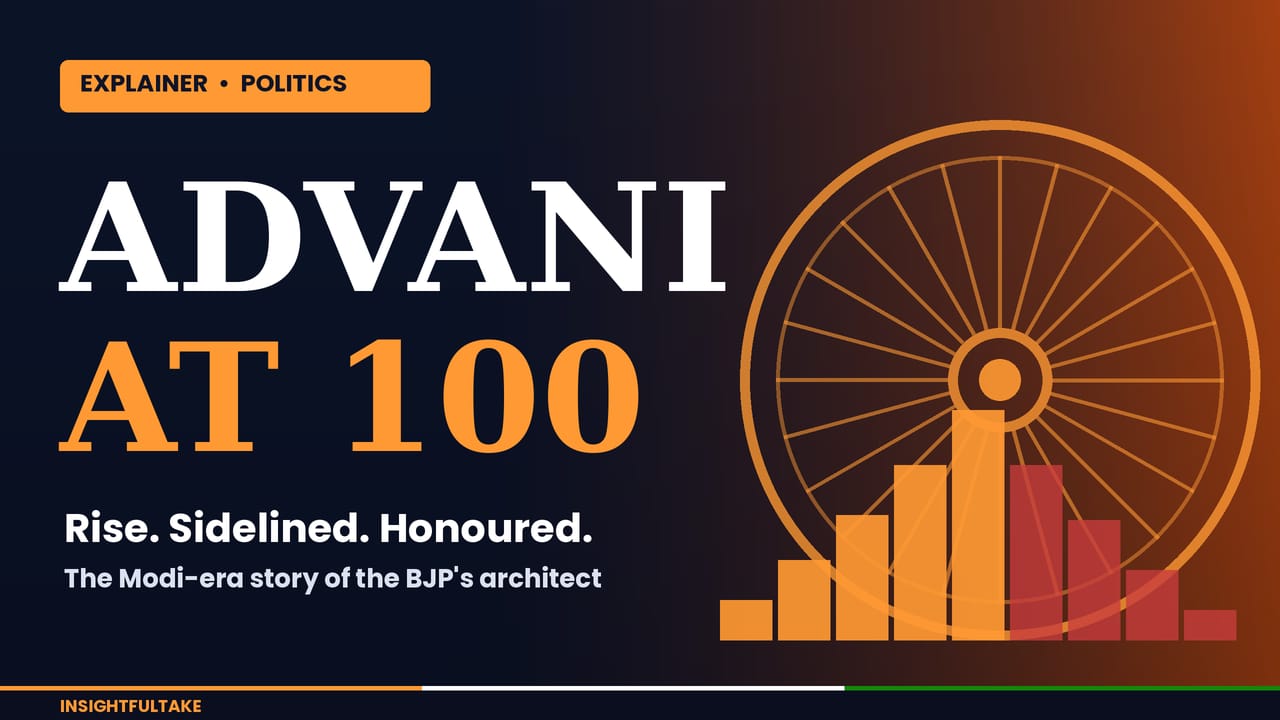
From building the BJP and leading the Ram Rath Yatra to the Margdarshak Mandal, LK Advani's journey reflects the changing face of power in Indian politics.
When Prime Minister Narendra Modi paid tribute to Lal Krishna Advani on his 99th birthday, he highlighted an interesting coincidence: the occasion fell during Diwali, a festival closely associated with Lord Ram. The symbolism was difficult to miss. Few political leaders have been as closely associated with the Ram Mandir movement as Advani. Yet his political journey also reflects one of the most striking shifts of power within the Bharatiya Janata Party (BJP), an organisation he helped build.
As Advani enters his 100th year, his legacy presents a complicated political picture. He remains one of the BJP's most influential founders, the leader who helped transform it into a national political force. However, the party he once dominated is now firmly controlled by a new generation of leadership under Narendra Modi.
The Architect of the BJP's Rise
Advani's political journey began long before Narendra Modi emerged as a national leader. Born in Karachi in 1927, he experienced the upheaval of Partition before rebuilding his life in independent India.
He worked through the Bharatiya Jana Sangh before becoming one of the founding figures of the BJP in 1980. As party president, he played a central role in expanding its political influence and shaping its ideological identity. Under his leadership, the BJP moved from the margins of national politics to becoming the single-largest party in the Lok Sabha in 1996.
His defining political intervention was the Ram Rath Yatra of 1990. Beginning from Somnath in Gujarat, the journey transformed the Ram Janmabhoomi demand into a nationwide political mobilisation. It brought the BJP unprecedented public attention and fundamentally changed the country's political discourse.
Narendra Modi, then a young party organiser in Gujarat, was associated with the movement. The Rath Yatra also helped establish a political relationship between the two leaders. Advani subsequently became one of the most powerful figures in the BJP and served as Deputy Prime Minister in the Atal Bihari Vajpayee government.
For much of the 1990s and early 2000s, Advani was not merely a senior leader. He was among the principal architects of the BJP's political strategy and expansion.
The Political Shift After 2013
The turning point came in 2013, when the BJP began preparing for the 2014 general election.
In June 2013, Narendra Modi was appointed chairman of the party's campaign committee. Two months later, he was declared the BJP's prime ministerial candidate. The decision marked a generational shift within the organisation.
Advani, who had played an important role in Modi's political rise in Gujarat, was increasingly finding himself outside the centre of decision-making. His reservations about the leadership transition reflected a larger question facing the BJP: how would a party built around senior leaders accommodate a new generation seeking greater control?
The 2014 electoral victory settled that question decisively.
After assuming power, the BJP placed Advani, Murli Manohar Joshi and several other senior leaders in the Margdarshak Mandal, a body intended to provide guidance to the organisation.
Officially, it was presented as a mark of respect for senior leadership. Politically, however, the arrangement was widely interpreted as a way of moving veteran leaders away from active organisational responsibilities.
The Margdarshak Mandal attracted particular criticism because it reportedly remained largely inactive, with no significant meetings during its initial years. For critics, it became a symbol of how the party's old guard had lost influence under its new leadership.
The 2019 Election: When Gandhinagar Changed Hands
The clearest indication of Advani's declining political position came before the 2019 general election.
When the BJP released its first list of candidates in March 2019, Advani's name was missing. Instead, party president Amit Shah was nominated from Gandhinagar, the constituency Advani had represented six consecutive times.
The decision was politically significant. Gandhinagar had long been identified with Advani's electoral career and his influence within the BJP.
The Congress criticised the move, arguing that the veteran leader had effectively been pushed aside. Its leaders questioned the party's treatment of someone who had contributed so much to its growth.
The BJP's supporters offered a different explanation. Advani was 91 at the time, and the party maintained that age and the need for generational change were legitimate considerations in candidate selection.
There were also reports that Advani was deeply disappointed by the decision, although he did not launch any public confrontation with the party leadership.
Amit Shah subsequently met Advani and Murli Manohar Joshi, but the political message had already been delivered. The party's most powerful decisions were now being made by a leadership in which Advani had little direct role.
The Ram Temple and the Bharat Ratna
Perhaps the most complicated chapter in Advani's political journey concerns the Ram Temple in Ayodhya.
The Ram Janmabhoomi movement had been central to his political identity. His Rath Yatra helped turn the demand for a temple into one of the defining issues of Indian politics.
Yet when the Ram Temple consecration ceremony was organised in January 2024, Advani's participation became a subject of public debate.
The Ram Temple Trust initially indicated that Advani and Murli Manohar Joshi had been advised against attending because of their advanced age. Both leaders accepted the advice, according to the trust. The decision attracted criticism, following which the Vishwa Hindu Parishad extended invitations to them.
Advani eventually did not attend, citing health considerations.
In February 2024, the Modi government announced the Bharat Ratna, India's highest civilian award, for Advani. Modi described the announcement as an emotional moment and praised the veteran leader's contribution to public life.
The award was widely welcomed as recognition of Advani's role in shaping Indian politics. However, its timing also generated political discussion. Some commentators interpreted it as an effort to acknowledge the contribution of the BJP's older generation at a time when the party was preparing to consolidate its political legacy around the Ram Temple.
The contrast was difficult to ignore. The temple movement that had defined Advani's political career had reached its most visible milestone under a government led by Narendra Modi, while Advani himself had largely moved out of active politics.
Fall or Political Transition?
Was Advani politically sidelined, or was his departure simply an inevitable generational transition?
The answer depends partly on the political perspective from which his career is examined.
Critics argue that a leader who helped build the BJP and expand its national influence deserved greater consideration from the organisation. His removal from electoral politics, the largely inactive Margdarshak Mandal and his absence from major political decisions are cited as evidence of the changing attitude towards the party's veterans.
The BJP's position rests on a different argument. Political organisations cannot remain dependent on the same leadership indefinitely. Advani had served the party for decades, and the transition towards younger leadership was part of an organisational evolution. His contribution, according to this view, remains beyond question, regardless of his present political position.
There is merit in both arguments. Advani's political influence declined substantially after 2014, but his ideological legacy continued to shape the BJP's direction. The Ram Temple, the expansion of Hindutva politics and the party's transformation into a dominant national force are all closely connected to the political movement he helped lead.
At 99, Advani occupies a distinctive place in Indian politics. He is honoured as one of the BJP's principal architects, but the organisation he helped establish is now led by others. His political ideas remain influential, even as his personal role in shaping the party's future has diminished.
His journey is therefore not simply a story of political decline. It is also a reflection of how power operates within political organisations, how movements outlive their founders, and how a new generation eventually takes ownership of a legacy created by its predecessors.
Advani helped build the BJP of his time. The Modi era has built a different BJP, one that continues to draw upon his political legacy while operating largely without his participation.














Leave a Comment