
A Texas Tech study says India may have been richer without Modi. But the research is a counterfactual model, not proof of an alternative India.
A new academic paper from Texas Tech University has reignited debate over Narendra Modi's economic record, arguing that India could have been wealthier, more democratic and less corrupt had the BJP lost the 2014 general election.
The claim has travelled quickly through social media, often reduced to a simple headline: India would have been richer without Modi. But the research behind that claim is considerably more complicated.
The paper, titled "Promises, Promises: Governance and Growth in India under Modi and the BJP," was authored by Kevin Grier of Texas Tech's political science department and Robin Grier of its agricultural and applied economics department.
Rather than simply comparing India's economy before and after 2014, the researchers use a statistical technique known as "synthetic control". The method constructs a modelled version of India using the economic and governance trajectories of comparable emerging economies.
The researchers then compare this "Synthetic India" with the India that actually existed under Modi and the BJP, asking a counterfactual question: what might India's trajectory have looked like if the country had continued along a path similar to the one it appeared to be following before 2014?
The $1,000 Per-Capita Difference
The study's most striking finding concerns income.
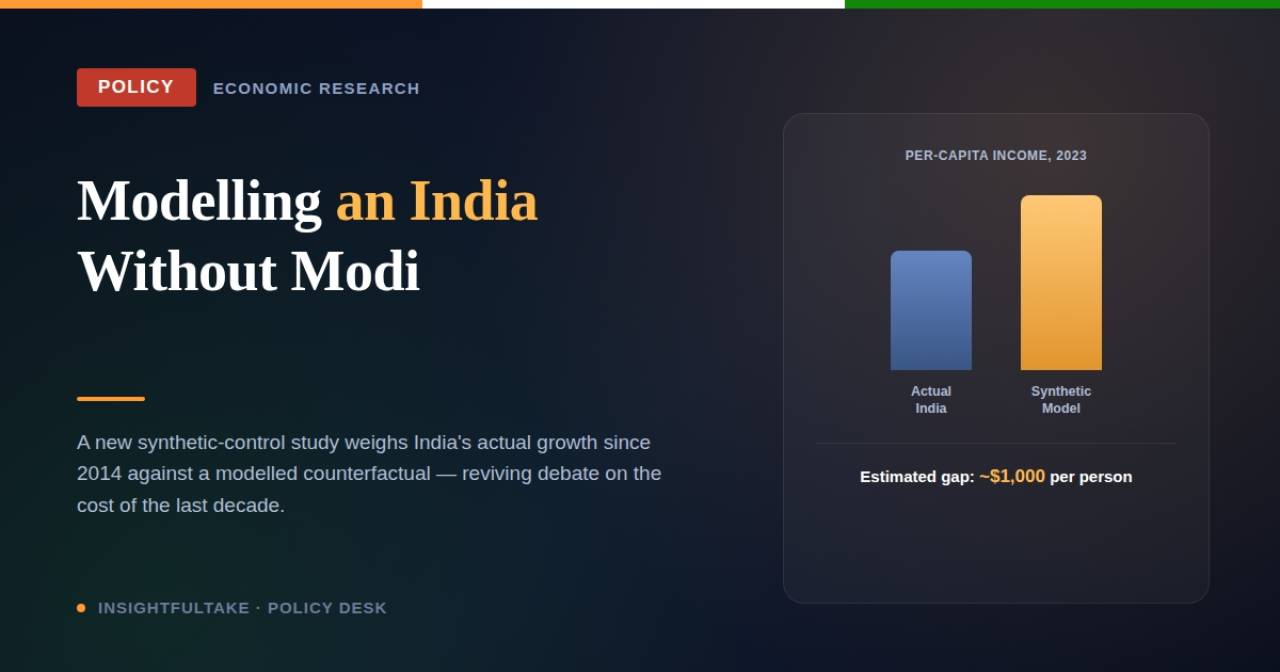
According to the researchers' model, India's real per-capita income in 2023 could have been roughly $1,000 higher had the country followed the synthetic counterfactual path.
The authors translate that difference into a more relatable figure. For a family of four, they estimate the gap would amount to roughly Rs 27,000 a month if the additional income were distributed equally.
By the end of the study period, the researchers estimate that India's actual income was nearly 10 percent below the level projected by their synthetic benchmark.
The paper also calculates the cumulative economic difference in trillions of dollars, making the argument much larger than a one-year income gap.
But there is an important qualification. These are not observed losses that can be directly measured in government accounts. They are estimates generated by a counterfactual model. In other words, the study is estimating what might have happened under a different political and economic path.
That distinction matters.
The Argument Goes Beyond GDP
The paper does not limit its analysis to economic growth.
The researchers also examine ten governance indicators, including political corruption, freedom of religion, freedom of association and equality before the law.
Their analysis finds India performing worse than the synthetic benchmark on most of these measures.
The broader argument is that the Modi government's record cannot be judged by GDP growth alone. The researchers compare the government's performance against the "minimum government, maximum governance" promise associated with the BJP's 2014 campaign.
Their conclusion is therefore about both economic performance and governance.
Why the Study Has Been Challenged
The findings have already attracted criticism.
Kanchan Gupta, an official at the Ministry of Information and Broadcasting, publicly questioned the study's data choices and framing after the research was reported. The Grier authors subsequently defended their methodology.
Other commentators have raised methodological concerns as well.
One issue is statistical significance. Some of the governance indicators examined in the paper do not meet conventional statistical significance thresholds. That does not automatically invalidate the findings, but it does mean that some conclusions should be treated more cautiously than the headline versions circulating online suggest.
There is also the question of how "Synthetic India" is constructed.
Synthetic-control models depend heavily on the countries selected as the comparison group and the weights assigned to them. Choosing a different set of comparable countries can potentially produce a different counterfactual. For an economy as large and unusual as India, deciding which countries provide the most meaningful comparison is itself a significant methodological judgment.
That is one reason the study should be read as an estimate of an alternative trajectory, rather than proof of what India "would have" become.
Two Very Different Scorecards
Supporters of Modi's economic record point to a different set of indicators.
India has maintained relatively strong GDP growth over much of the decade, expanded highways, railways and other infrastructure, increased digital public infrastructure and moved significantly higher in the global ranking of the world's largest economies.
Supporters also point to reductions in extreme poverty and the expansion of welfare and financial-inclusion programmes as evidence that the economic story cannot be captured by a single counterfactual income estimate.
Critics, meanwhile, argue that headline GDP growth does not tell the entire story. They point to employment, inequality, institutional independence, civil liberties and the quality of governance as equally important measures of economic and social progress.
That disagreement is hardly new.
JPMorgan Chase chief executive Jamie Dimon has praised Modi's record on poverty reduction and economic development, while Nobel laureate Amartya Sen has been considerably more critical of the government's broader direction.
Both perspectives draw on the same decade of Indian experience. They simply place greater weight on different indicators.
What the Study Really Tells Us
The significance of the Texas Tech paper lies less in proving that India would definitely have been richer without Modi and more in showing how dramatically the answer can change when economists construct a different counterfactual.
Synthetic-control modelling is an established research technique. But no model can observe the alternative India that never existed.
A different government after 2014 could have made different policy choices, faced different global conditions, experienced different political shocks and produced outcomes that no statistical model can fully capture.
The study therefore offers one evidence-based interpretation of India's post-2014 trajectory. It does not settle the political argument.
The viral claim that "India would be richer without Modi" is a much simpler statement than the research itself.
The paper's actual contribution is narrower and more useful: it presents a statistical estimate suggesting that India's income and several governance outcomes might have been better had the country followed a different post-2014 path.
Whether that counterfactual is the most convincing way to judge Modi's decade in power remains open to debate.
And that is where the real argument begins.
A new academic paper from Texas Tech University has reignited debate over Narendra Modi's economic record, arguing that India could have been wealthier, more democratic and less corrupt had the BJP lost the 2014 general election.
The claim has travelled quickly through social media, often reduced to a simple headline: India would have been richer without Modi. But the research behind that claim is considerably more complicated.
The paper, titled "Promises, Promises: Governance and Growth in India under Modi and the BJP," was authored by Kevin Grier of Texas Tech's political science department and Robin Grier of its agricultural and applied economics department.
Rather than simply comparing India's economy before and after 2014, the researchers use a statistical technique known as "synthetic control". The method constructs a modelled version of India using the economic and governance trajectories of comparable emerging economies.
The researchers then compare this "Synthetic India" with the India that actually existed under Modi and the BJP, asking a counterfactual question: what might India's trajectory have looked like if the country had continued along a path similar to the one it appeared to be following before 2014?
The $1,000 Per-Capita Difference
The study's most striking finding concerns income.
According to the researchers' model, India's real per-capita income in 2023 could have been roughly $1,000 higher had the country followed the synthetic counterfactual path.
The authors translate that difference into a more relatable figure. For a family of four, they estimate the gap would amount to roughly Rs 27,000 a month if the additional income were distributed equally.
By the end of the study period, the researchers estimate that India's actual income was nearly 10 percent below the level projected by their synthetic benchmark.
The paper also calculates the cumulative economic difference in trillions of dollars, making the argument much larger than a one-year income gap.
But there is an important qualification. These are not observed losses that can be directly measured in government accounts. They are estimates generated by a counterfactual model. In other words, the study is estimating what might have happened under a different political and economic path.
That distinction matters.
The Argument Goes Beyond GDP
The paper does not limit its analysis to economic growth.
The researchers also examine ten governance indicators, including political corruption, freedom of religion, freedom of association and equality before the law.
Their analysis finds India performing worse than the synthetic benchmark on most of these measures.
The broader argument is that the Modi government's record cannot be judged by GDP growth alone. The researchers compare the government's performance against the "minimum government, maximum governance" promise associated with the BJP's 2014 campaign.
Their conclusion is therefore about both economic performance and governance.
Why the Study Has Been Challenged
The findings have already attracted criticism.
Kanchan Gupta, an official at the Ministry of Information and Broadcasting, publicly questioned the study's data choices and framing after the research was reported. The Grier authors subsequently defended their methodology.
Other commentators have raised methodological concerns as well.
One issue is statistical significance. Some of the governance indicators examined in the paper do not meet conventional statistical significance thresholds. That does not automatically invalidate the findings, but it does mean that some conclusions should be treated more cautiously than the headline versions circulating online suggest.
There is also the question of how "Synthetic India" is constructed.
Synthetic-control models depend heavily on the countries selected as the comparison group and the weights assigned to them. Choosing a different set of comparable countries can potentially produce a different counterfactual. For an economy as large and unusual as India, deciding which countries provide the most meaningful comparison is itself a significant methodological judgment.
That is one reason the study should be read as an estimate of an alternative trajectory, rather than proof of what India "would have" become.
Two Very Different Scorecards
Supporters of Modi's economic record point to a different set of indicators.
India has maintained relatively strong GDP growth over much of the decade, expanded highways, railways and other infrastructure, increased digital public infrastructure and moved significantly higher in the global ranking of the world's largest economies.
Supporters also point to reductions in extreme poverty and the expansion of welfare and financial-inclusion programmes as evidence that the economic story cannot be captured by a single counterfactual income estimate.
Critics, meanwhile, argue that headline GDP growth does not tell the entire story. They point to employment, inequality, institutional independence, civil liberties and the quality of governance as equally important measures of economic and social progress.
That disagreement is hardly new.
JPMorgan Chase chief executive Jamie Dimon has praised Modi's record on poverty reduction and economic development, while Nobel laureate Amartya Sen has been considerably more critical of the government's broader direction.
Both perspectives draw on the same decade of Indian experience. They simply place greater weight on different indicators.
What the Study Really Tells Us
The significance of the Texas Tech paper lies less in proving that India would definitely have been richer without Modi and more in showing how dramatically the answer can change when economists construct a different counterfactual.
Synthetic-control modelling is an established research technique. But no model can observe the alternative India that never existed.
A different government after 2014 could have made different policy choices, faced different global conditions, experienced different political shocks and produced outcomes that no statistical model can fully capture.
The study therefore offers one evidence-based interpretation of India's post-2014 trajectory. It does not settle the political argument.
The viral claim that "India would be richer without Modi" is a much simpler statement than the research itself.
The paper's actual contribution is narrower and more useful: it presents a statistical estimate suggesting that India's income and several governance outcomes might have been better had the country followed a different post-2014 path.
Whether that counterfactual is the most convincing way to judge Modi's decade in power remains open to debate.
And that is where the real argument begins.






















Leave a Comment