
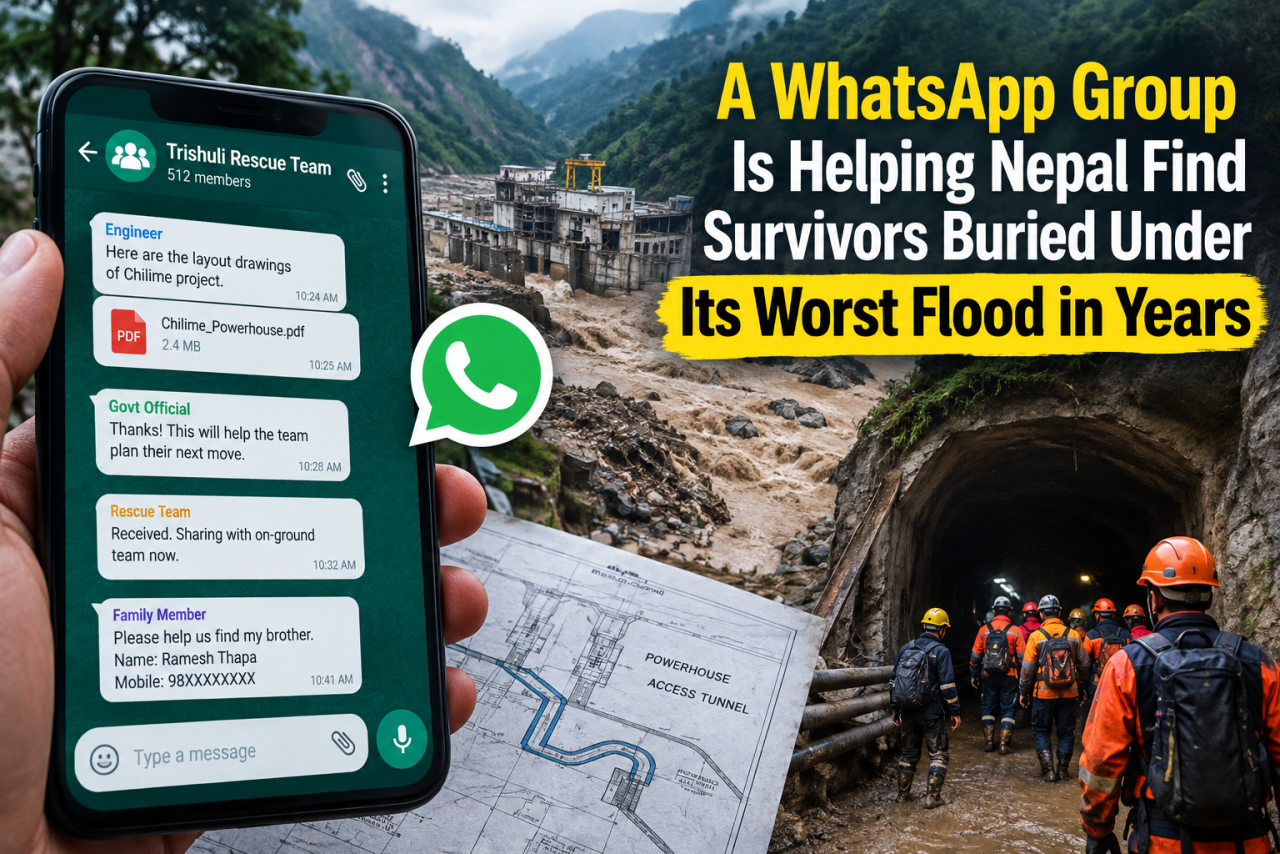
A WhatsApp group of engineers has become an unlikely lifeline in Nepal’s desperate search for workers trapped inside hydropower tunnels after the devastating Trishuli flood.
More than a week after a glacier collapse sent 2.2 million tonnes of mud, rock and water crashing through Nepal’s Trishuli valley, one of the most useful tools in the rescue effort is not a helicopter or an excavator. It is a WhatsApp group.
The flood, triggered on August 26, tore through six hydropower plants in the valley, at least three of them still under construction. Around 900 workers are still listed as missing. Authorities believe some may have escaped into the tunnels connected to the plants, passages originally built to carry water or provide access to underground machinery.
Those same tunnels have now become a desperate search ground for rescuers.
The scale of destruction has made the physical search painfully slow. Tunnel entrances that engineers once knew by heart have been buried, blocked or completely reshaped. Nepal Army spokesperson Raja Ram Basnet described the situation as unlike a normal tunnel closure. Debris, silt and rocks have altered the internal structure, making navigation difficult even for workers who spent years inside the facilities.
That is where the WhatsApp group has proved useful.
Created by engineers as the floodwaters receded, the group quickly grew to more than 500 members. It brings together government officials, army personnel, engineers, disaster survivors and relatives of missing workers.
Members have been sharing tunnel layouts, powerhouse diagrams and access routes. In effect, the group has become a crowdsourced technical archive, allowing rescue teams to draw on the institutional memory of people who know the projects from the inside.
One exchange showed how quickly that information could be put to use.
A government official asked for layout drawings of the Chilime project. Within minutes, another member who had helped expand the group to bring in technical expertise responded with sketches of the powerhouse and access tunnels.
Such drawings have helped rescue teams understand what lies beyond blocked entrances and plan their next moves.
The results remain limited, but they are significant.
At the Upper Trishuli 3A hydropower project, two people were pulled out alive nine days after the disaster. It was a small breakthrough, but an important one. It showed that people could still be alive inside the damaged tunnel network.
Rescue workers had spent nearly six days trying to reach the tunnel because its entrance was completely buried. Before the breakthrough, teams had been pumping oxygen through pipes into possible pockets where trapped workers might have taken shelter.
At other sites, uncertainty remains.
At the Chilime plant, officials estimate that at least eight people could still be trapped. At Rasuwagadhi, a Nepal Electricity Authority board member said around 46 workers may be inside a chamber where they could potentially have access to food and water.
That possibility is keeping hopes alive as the rescue window narrows.
Teams at Rasuwagadhi managed to push about 250 metres into one tunnel before encountering a blockage. They have said the search will continue.
The WhatsApp group is also serving another purpose. It has become an informal network for locating missing workers.
Members have been sharing names and phone numbers and asking officials to pass the information to telecom providers in the hope of tracing the last known location of mobile phones.
It is an unusual use of a rescue channel, but the circumstances are unusual too. With formal systems struggling to cope with the scale of the disaster, families have needed another way to get information to people who might be able to help.
The wider toll is still being assessed. More than 1,200 people have died, while over 4,000 remain missing. The missing include workers feared to be trapped inside the tunnel networks.
The disaster has also damaged Nepal’s energy infrastructure, wiping out roughly a tenth of the country’s total power generation capacity. The consequences will extend well beyond the rescue operation.
For now, though, the WhatsApp group represents something more immediate.
In a disaster that has overwhelmed roads, infrastructure and official coordination systems, a group created by engineers is helping rescuers reconstruct a map of a world that has been buried under tonnes of mud and rock.
The tunnels may no longer look the way they once did. But somewhere on a phone screen, an old drawing, a remembered passage or a message from someone who knows the terrain could still point rescuers towards a survivor.
More than a week after a glacier collapse sent 2.2 million tonnes of mud, rock and water crashing through Nepal’s Trishuli valley, one of the most useful tools in the rescue effort is not a helicopter or an excavator. It is a WhatsApp group.
The flood, triggered on August 26, tore through six hydropower plants in the valley, at least three of them still under construction. Around 900 workers are still listed as missing. Authorities believe some may have escaped into the tunnels connected to the plants, passages originally built to carry water or provide access to underground machinery.
Those same tunnels have now become a desperate search ground for rescuers.
The scale of destruction has made the physical search painfully slow. Tunnel entrances that engineers once knew by heart have been buried, blocked or completely reshaped. Nepal Army spokesperson Raja Ram Basnet described the situation as unlike a normal tunnel closure. Debris, silt and rocks have altered the internal structure, making navigation difficult even for workers who spent years inside the facilities.
That is where the WhatsApp group has proved useful.
Created by engineers as the floodwaters receded, the group quickly grew to more than 500 members. It brings together government officials, army personnel, engineers, disaster survivors and relatives of missing workers.
Members have been sharing tunnel layouts, powerhouse diagrams and access routes. In effect, the group has become a crowdsourced technical archive, allowing rescue teams to draw on the institutional memory of people who know the projects from the inside.
One exchange showed how quickly that information could be put to use.
A government official asked for layout drawings of the Chilime project. Within minutes, another member who had helped expand the group to bring in technical expertise responded with sketches of the powerhouse and access tunnels.
Such drawings have helped rescue teams understand what lies beyond blocked entrances and plan their next moves.
The results remain limited, but they are significant.
At the Upper Trishuli 3A hydropower project, two people were pulled out alive nine days after the disaster. It was a small breakthrough, but an important one. It showed that people could still be alive inside the damaged tunnel network.
Rescue workers had spent nearly six days trying to reach the tunnel because its entrance was completely buried. Before the breakthrough, teams had been pumping oxygen through pipes into possible pockets where trapped workers might have taken shelter.
At other sites, uncertainty remains.
At the Chilime plant, officials estimate that at least eight people could still be trapped. At Rasuwagadhi, a Nepal Electricity Authority board member said around 46 workers may be inside a chamber where they could potentially have access to food and water.
That possibility is keeping hopes alive as the rescue window narrows.
Teams at Rasuwagadhi managed to push about 250 metres into one tunnel before encountering a blockage. They have said the search will continue.
The WhatsApp group is also serving another purpose. It has become an informal network for locating missing workers.
Members have been sharing names and phone numbers and asking officials to pass the information to telecom providers in the hope of tracing the last known location of mobile phones.
It is an unusual use of a rescue channel, but the circumstances are unusual too. With formal systems struggling to cope with the scale of the disaster, families have needed another way to get information to people who might be able to help.
The wider toll is still being assessed. More than 1,200 people have died, while over 4,000 remain missing. The missing include workers feared to be trapped inside the tunnel networks.
The disaster has also damaged Nepal’s energy infrastructure, wiping out roughly a tenth of the country’s total power generation capacity. The consequences will extend well beyond the rescue operation.
For now, though, the WhatsApp group represents something more immediate.
In a disaster that has overwhelmed roads, infrastructure and official coordination systems, a group created by engineers is helping rescuers reconstruct a map of a world that has been buried under tonnes of mud and rock.
The tunnels may no longer look the way they once did. But somewhere on a phone screen, an old drawing, a remembered passage or a message from someone who knows the terrain could still point rescuers towards a survivor.



















Leave a Comment