
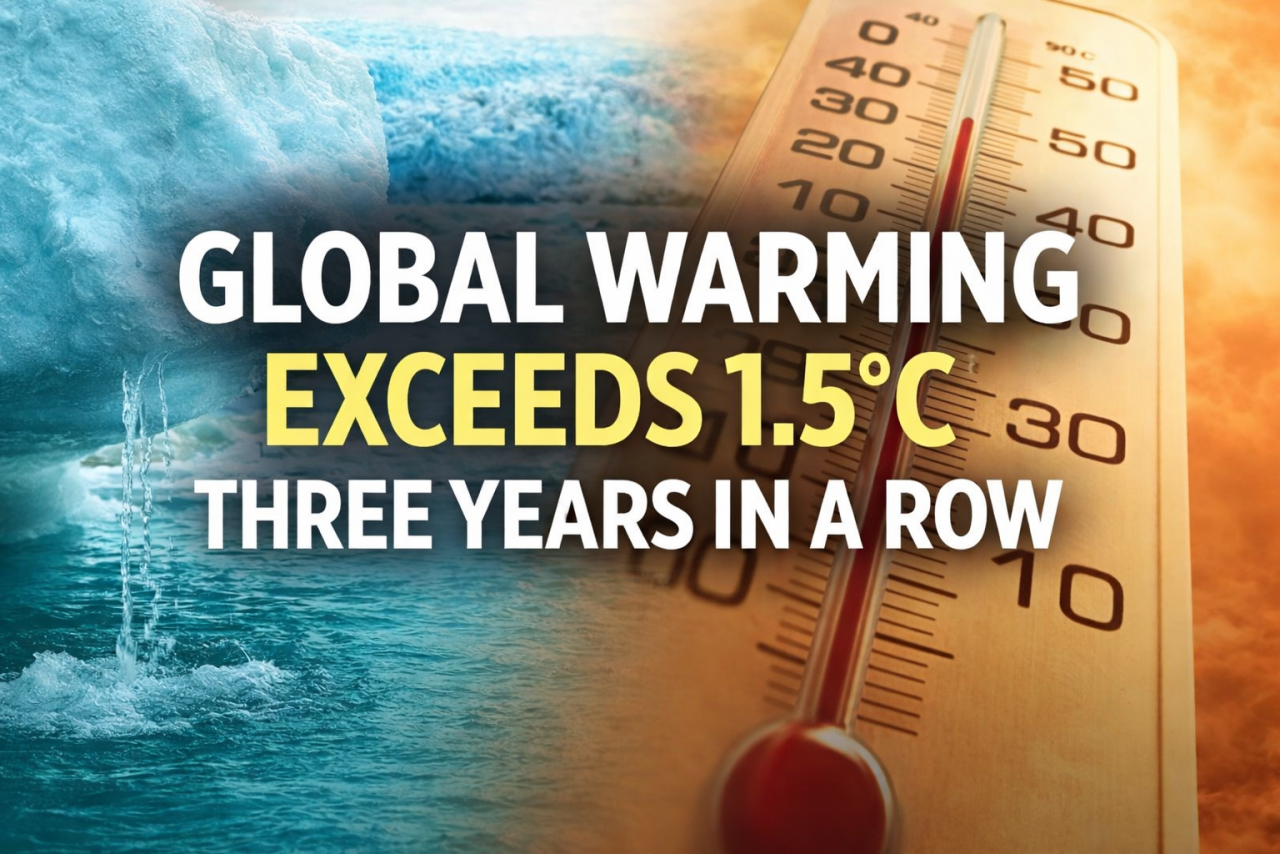
For the first time since modern climate records began, the planet has experienced three consecutive years in which global temperatures remained more than 1.5°C above pre-industrial levels. Data from major climate monitoring agencies shows that the period from 2023 to 2025 represents a significant moment in the ongoing progression of global warming, not a short-term fluctuation.
The Copernicus Climate Change Service (C3S) has confirmed that average global temperatures across these three years exceeded the benchmark set under the Paris Climate Agreement. The World Meteorological Organization (WMO) has further reported that 2025 ranked among the three warmest years on record, extending a prolonged phase of elevated global heat.
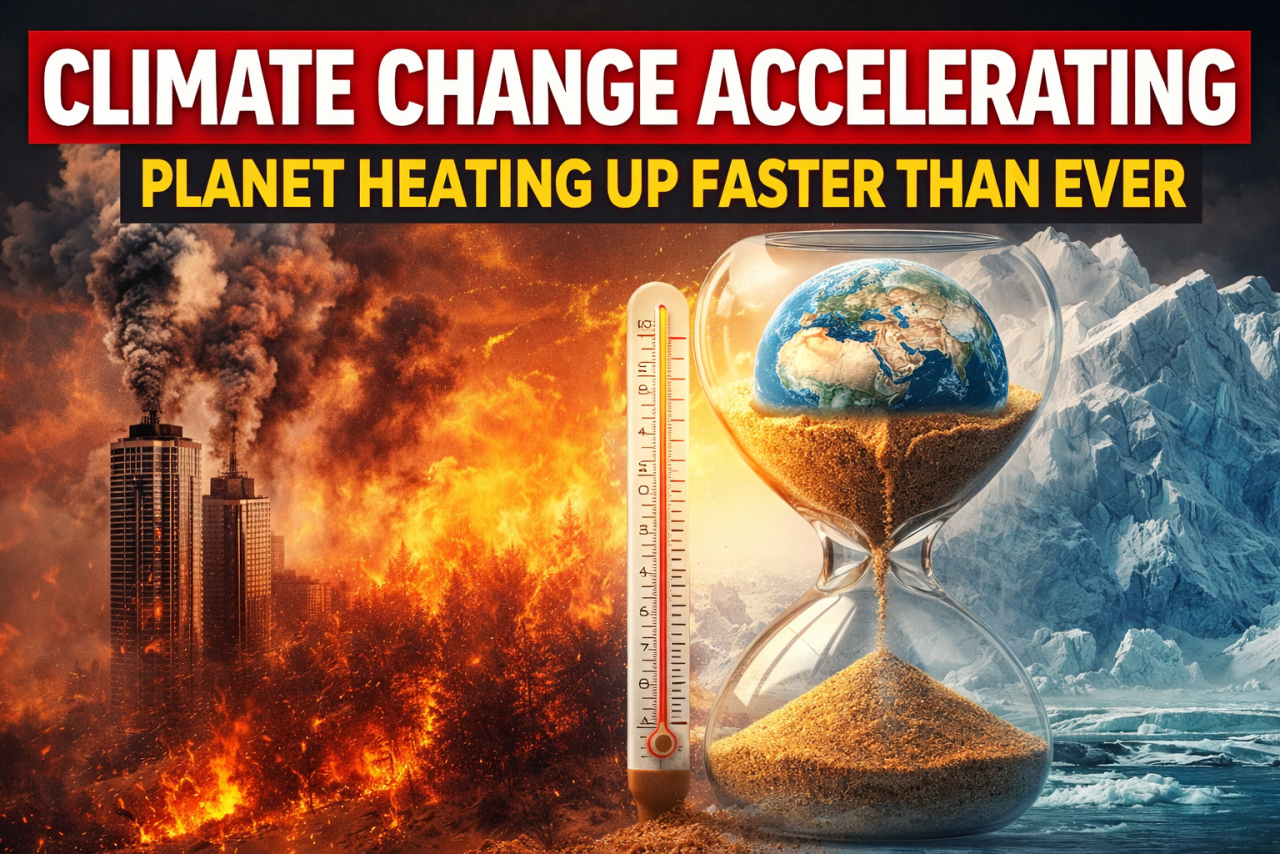
Scientists emphasise that the Paris Agreement assesses global warming using long-term temperature averages rather than year-by-year data. As a result, the recent rise above 1.5°C does not yet amount to a formal breach under the agreement’s rules. Even so, they warn that three consecutive years above the 1.5°C mark provide strong evidence that global warming is accelerating faster than anticipated.
Polar Regions Reflect the Pace of Global Warming
Temperature patterns in 2025 reveal how unevenly global warming is affecting different parts of the Earth. While global land temperatures were the second highest ever recorded, the most striking changes occurred in the polar regions.
Antarctica recorded its warmest year on record, while the Arctic experienced its second warmest year. Scientists have long warned that global warming progresses more rapidly at the poles due to feedback mechanisms such as ice loss and reduced surface reflectivity. As ice melts, darker land and ocean surfaces absorb more heat, further intensifying global warming.
The warming of the oceans has also been a defining feature of recent years. Sea surface temperatures reached unusually high levels across large regions. Because oceans absorb most of the excess heat generated by global warming, elevated ocean temperatures often indicate deep and long-lasting changes within the climate system.
Greenhouse Gases Remain the Central Driver
The primary cause of the current phase of global warming remains the continued accumulation of greenhouse gases, particularly carbon dioxide, in the atmosphere. Despite repeated international commitments, global emissions have not fallen at the pace required to stabilise temperatures.
The WMO has reported that atmospheric concentrations of greenhouse gases continue to rise. This means that even immediate reductions in emissions would not stop global warming instantly, as the climate system responds slowly to changes already locked in.
Researchers at Berkeley Earth, which analyses long-term land temperature data, have noted that the temperature increase observed between 2023 and 2025 appears steeper than the largely linear trend that characterised global warming since the 1970s. This does not contradict climate models, but it does indicate that additional factors are reinforcing the underlying rise in temperatures.
Natural Climate Patterns Add to Human Influence
Natural climate variability has played a supporting role in recent temperature extremes. A strong El Niño event raised global temperatures by warming surface waters in the Pacific Ocean, adding to the heat produced by global warming caused by human activity.
However, scientists point out that El Niño alone cannot explain the persistence of high temperatures. Even as La Niña conditions returned later in 2025, global temperatures remained elevated, reinforcing the conclusion that global warming is now the dominant influence.
Another contributing factor has been changes in aerosol pollution and cloud formation. Reductions in air pollution have decreased the number of particles that reflect sunlight back into space. While beneficial for public health, this has reduced a cooling effect that previously masked some impacts of global warming.
Why Sustained Breaches Matter
Climate scientists stress that individual years above 1.5°C do not automatically signal permanent failure. However, three consecutive years above this level carry clear statistical and physical significance.
Sustained global warming at this level increases the likelihood of extreme heat events, intensified rainfall, prolonged droughts, rising sea levels, and disruptions to food and water systems. These impacts are already visible in many parts of the world, particularly in regions with limited capacity to adapt.
The WMO has repeatedly stated that global warming continues regardless of political priorities or economic uncertainty. Delaying action increases both human and financial costs.
A Narrowing Path Forward
European climate agencies have underlined the need for stronger climate monitoring systems, improved forecasting, and faster implementation of emission-reduction policies. Accurate and timely data, they argue, is essential for managing the risks posed by advancing global warming.
The three-year breach of the 1.5°C threshold marks a defining phase in the global warming trajectory. Whether this period remains a warning or becomes a long-term reality will depend on decisions taken in the immediate future.
The scientific evidence is clear. The remaining question is whether global action will match the scale and urgency of the challenge posed by global warming.
























Leave a Comment