
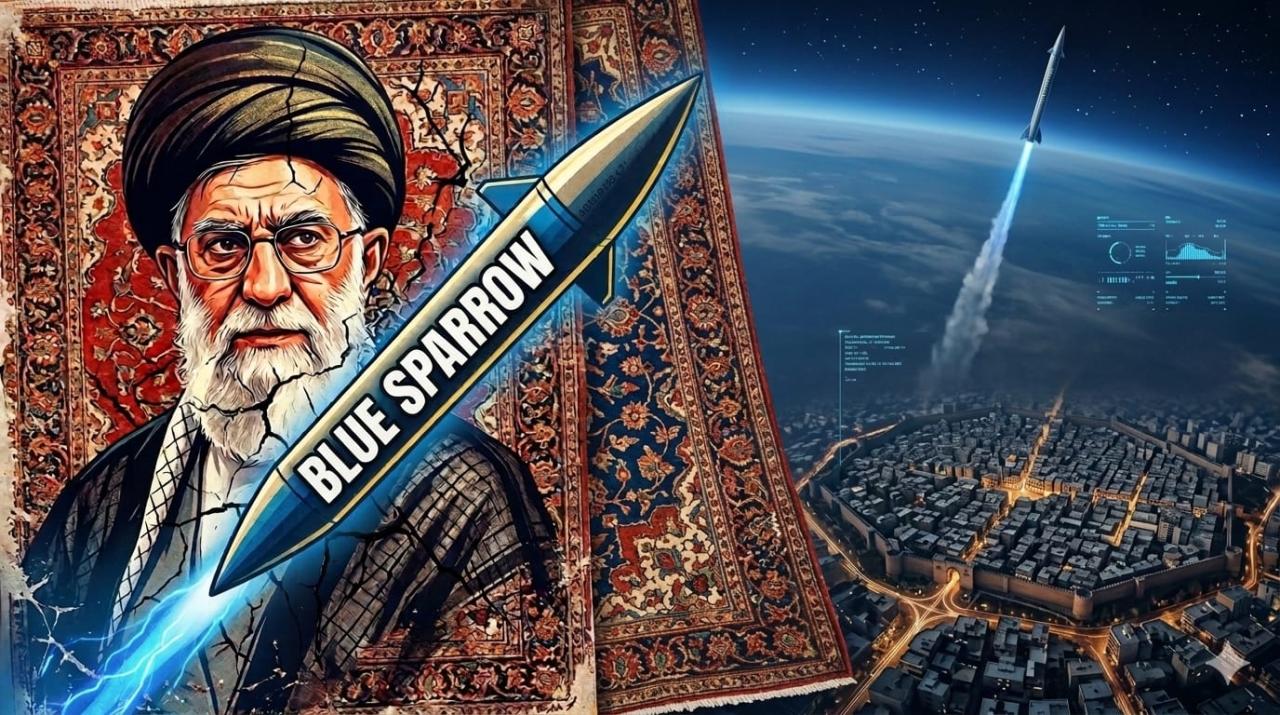
A missile that rose toward the edge of space before plunging into Tehran has become the center of one of the most dramatic strikes in modern Middle Eastern history.
In the early hours of February 28, 2026, an event unfolded that sent shockwaves through the geopolitical landscape of the Middle East. Iran’s Supreme Leader, Ali Khamenei, the cleric who had dominated the country’s political and ideological life for more than three decades, was killed in a precision strike on a highly secured compound in Tehran.
The operation, swift and meticulously planned, has already become one of the most consequential targeted strikes in modern history. But beyond the political ramifications lies another story — one about a weapon system that represents a new era of warfare. At the center of the operation was Israel’s Blue Sparrow missile, a high-speed system capable of striking targets from near-space altitudes with extraordinary precision.
For military analysts around the world, the strike revealed how advanced missile technology and intelligence coordination are redefining the limits of modern warfare.
The Ghost in the Sky: Understanding the Blue Sparrow
The Blue Sparrow is part of Israel’s “Sparrow” missile family — a series of systems originally developed not as weapons, but as sophisticated target missiles used to simulate ballistic threats during defense testing.
Developed by the Israeli defense company Rafael Advanced Defense Systems, the Sparrow series — including the Black Sparrow, Blue Sparrow, and Silver Sparrow — was primarily designed to help test Israel’s advanced missile defense network, particularly the Arrow missile defense system.
These missiles mimic the flight characteristics of hostile ballistic missiles, allowing defense systems to train against realistic threats.
Over time, however, the technology evolved. The same design that once simulated incoming attacks could also be adapted into a powerful long-range strike platform capable of hitting heavily defended targets with remarkable precision.
Key Technical Specifications
Military analysts estimate the Blue Sparrow has the following characteristics:
- Length: Around 6.5 meters
- Weight: Approximately 1.9 tonnes
- Estimated Range: Up to 2,000 kilometers
- Launch Platform: Air-launched from aircraft such as the F-15 Eagle fighter jet
By launching the missile from an aircraft at a stand-off distance, the attacking aircraft can remain far outside enemy air-defense zones while the missile continues toward its target.
This capability significantly reduces the risk to pilots while extending the effective strike range.
From Near Space to Target: A Difficult Missile to Stop
What truly sets the Blue Sparrow apart is its quasi-ballistic trajectory — a flight path that combines elements of both ballistic and cruise missile behavior.
Once released from a fighter aircraft, the missile’s booster rocket propels it sharply upward, sending it toward the upper layers of Earth’s atmosphere.
From this near-space altitude, the missile separates into a re-entry vehicle that begins a steep, near-vertical descent toward its target.
This trajectory offers several advantages:
- Extreme speed: As the missile descends, gravity accelerates it to extremely high velocities, approaching hypersonic levels.
- Reduced detection window: Ground-based radar systems often detect such threats only moments before impact.
- Difficult interception: Conventional air defense systems struggle to track and intercept targets descending at such steep angles.
Systems such as the S-300 missile system and Iran’s domestically developed Bavar-373 air defense system are designed to intercept incoming threats, but a missile approaching from high altitude and extreme speed significantly reduces reaction time.
The Strike on Tehran
According to multiple reports and defense analyses, the missile was used in a coordinated strike targeting a heavily fortified leadership compound in Tehran where Khamenei was believed to be present during a high-level meeting.
The compound, located near Pasteur Street — an area associated with Iran’s top leadership offices — was protected by layered security and underground facilities designed to withstand conventional attacks.
Yet the precision of the missile strike appears to have overcome those defenses.
Intelligence sources suggest the operation relied on months of surveillance and analysis to determine a rare window in which several senior officials were gathered in one location.
Once the opportunity emerged, the strike was reportedly launched from aircraft operating at a distance. Within minutes, the missile had completed its high-altitude arc and descended onto the target.
Iranian authorities confirmed the death of the Supreme Leader the following day, triggering nationwide mourning and sending the region into a new phase of political uncertainty.
Intelligence and Modern Precision Warfare
While the missile itself played a crucial role, analysts emphasize that such operations are rarely the result of technology alone.
Precision strikes of this scale typically rely on a complex network of intelligence gathering — including satellite monitoring, signals intelligence, and long-term surveillance.
Coordination between intelligence agencies and military planners allows such weapons to be deployed at precisely the right moment, when the likelihood of mission success is highest.
In this case, the combination of advanced intelligence and long-range precision weaponry appears to have produced one of the most significant targeted strikes of the century.
A Turning Point in Military Strategy
The strike that killed Ali Khamenei may ultimately be remembered as more than a dramatic moment in Middle Eastern politics.
It highlights a broader shift in modern warfare — one where long-range precision weapons, near-space trajectories, and intelligence-driven targeting combine to create unprecedented strike capabilities.
Weapons like the Blue Sparrow blur the traditional boundaries between air-launched missiles and ballistic weapons. Their ability to travel vast distances, evade defenses, and strike with pinpoint accuracy suggests that future conflicts will increasingly rely on similar technologies.
For the Middle East, the political consequences of the strike are still unfolding. But from a technological perspective, the operation has already demonstrated something profound: in the age of advanced missile systems, distance and fortification alone may no longer guarantee safety.
What once seemed like the realm of science fiction — a precision strike descending from the edge of space — has now become a stark reality of modern warfare.

























Leave a Comment