
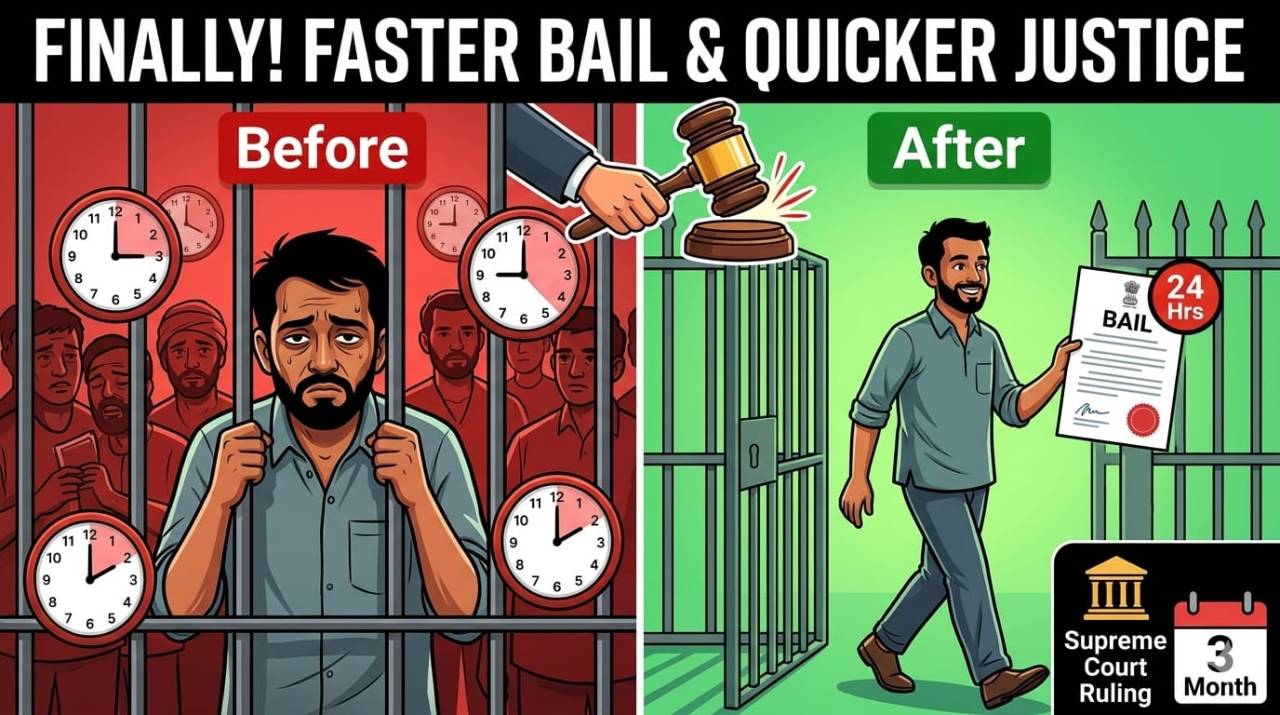
Can someone lose months of freedom simply because a court delays writing its order? The Supreme Court's new bail rules seek to ensure that justice delayed no longer becomes liberty denied.
For millions of Indians, navigating the legal system has often meant enduring a painful reality: justice delayed is justice denied. Court backlogs, procedural delays, and prolonged waiting periods have left many citizens trapped in legal limbo, particularly those awaiting bail while still presumed innocent under the law.
In a landmark move to protect personal liberty, the Supreme Court has introduced a set of binding directions aimed at ensuring that bail decisions and reserved judgments are delivered without unnecessary delay. The ruling, delivered by a bench comprising Chief Justice of India Surya Kant and Justice Joymalya Bagchi, could significantly reshape how courts handle bail matters across the country.
Invoking Article 142 of the Constitution, which empowers the Supreme Court to pass orders necessary for “complete justice,” the bench established strict timelines and accountability mechanisms designed to make the judicial process faster, more transparent, and more citizen-friendly.
When Delay Becomes Punishment
One of the biggest problems in India's justice system is prolonged pretrial detention. Many undertrials—people who have not been convicted of any crime—spend months or even years in overcrowded prisons while their cases move slowly through the courts.
A major contributor to this problem is the practice of reserving judgments. After hearing arguments from both sides, judges sometimes reserve their orders to prepare detailed written decisions. While reasonable in principle, reserved judgments have often remained pending for extended periods.
For someone seeking bail, such delays can effectively turn the legal process itself into a punishment, undermining the constitutional guarantee of life and personal liberty under Article 21.
New Timelines for High Courts
To eliminate uncertainty and reduce delays, the Supreme Court has prescribed clear timelines for High Courts across India.
Same-Day Bail Orders
Bail applications should ordinarily be decided and uploaded on the same day the hearing concludes. If that is not possible, the order must be uploaded within 24 hours.
Next-Day Limit for Reserved Bail Orders
If a judge decides to reserve a bail order, the decision must be pronounced and uploaded on the very next day.
Three-Month Deadline for Reserved Judgments
For all other cases, including civil matters and criminal appeals, reserved judgments must be delivered within a maximum period of three months from the date they were reserved.
Immediate Release After Bail
The Court has also addressed administrative delays that often occur after bail is granted. Bail orders must be communicated to prison authorities immediately, and the release of the individual should take place on the same day or, at the latest, the following day.
Building Accountability Into the System
The significance of this ruling lies not only in setting deadlines but also in creating mechanisms to enforce them.
Automated Monitoring of Delayed Judgments
Every month, High Courts will generate lists of reserved judgments that remain pending. Any case crossing the three-month limit will automatically come to the attention of the Chief Justice of the concerned High Court.
The concerned bench will then be given a limited period to pronounce the judgment.
Power to Reassign Cases
Perhaps the most significant reform is the provision allowing the Chief Justice to reassign a case if a reserved judgment continues to remain pending.
In such situations, the matter can be transferred to another bench for a fresh hearing, ensuring that no case remains indefinitely stalled.
Citizens Can Seek Early Pronouncement
The ruling also empowers litigants directly. If a reserved judgment remains pending beyond three months, parties can file an application requesting early pronouncement.
The court registry is required to place such applications before the concerned bench within two working days, giving citizens a meaningful remedy against prolonged delays.
Why This Matters
The decision represents an important shift in judicial thinking. Traditionally, the focus has been on ensuring that courts hear cases. The Supreme Court has now emphasized that timely delivery of judgments is equally essential.
For undertrials, every additional day spent in prison before conviction carries enormous personal, financial, and emotional costs. By introducing strict timelines and accountability measures, the Court has reinforced the principle that liberty cannot be held hostage to administrative inefficiency.
The Road Ahead
While the ruling is a major step forward, much of India's criminal justice burden is handled by district courts, where the majority of bail applications are filed.
Extending similar standards to the district judiciary could further strengthen access to justice. Technology-driven tracking systems, transparent case-monitoring dashboards, and stricter controls on unnecessary adjournments may also help ensure that delays do not continue to undermine the rights of ordinary citizens.
At a Glance: What Has Changed?
Legal Process
Earlier Situation
New Supreme Court Rule
Bail decision after hearing
Often delayed for days or weeks
Same day or within 24 hours
Reserved bail orders
No fixed timeline
Must be delivered the next day
Reserved judgments in other cases
Could remain pending for months or years
Maximum three-month limit
Release after grant of bail
Delayed by paperwork
Same day or next day
Delay beyond prescribed timeline
Limited remedies available
Monitoring, intervention, and possible case reassignment
Final Take
The Supreme Court’s ruling marks a significant milestone in the protection of personal liberty. By imposing strict timelines on bail decisions and reserved judgments, the Court has sent a clear message that justice must not only be fair but also timely.
For ordinary citizens, the judgment offers something increasingly valuable in India's crowded legal system: the assurance that their freedom will not depend on endless waiting.
For millions of Indians, navigating the legal system has often meant enduring a painful reality: justice delayed is justice denied. Court backlogs, procedural delays, and prolonged waiting periods have left many citizens trapped in legal limbo, particularly those awaiting bail while still presumed innocent under the law.
In a landmark move to protect personal liberty, the Supreme Court has introduced a set of binding directions aimed at ensuring that bail decisions and reserved judgments are delivered without unnecessary delay. The ruling, delivered by a bench comprising Chief Justice of India Surya Kant and Justice Joymalya Bagchi, could significantly reshape how courts handle bail matters across the country.
Invoking Article 142 of the Constitution, which empowers the Supreme Court to pass orders necessary for “complete justice,” the bench established strict timelines and accountability mechanisms designed to make the judicial process faster, more transparent, and more citizen-friendly.
When Delay Becomes Punishment
One of the biggest problems in India's justice system is prolonged pretrial detention. Many undertrials—people who have not been convicted of any crime—spend months or even years in overcrowded prisons while their cases move slowly through the courts.
A major contributor to this problem is the practice of reserving judgments. After hearing arguments from both sides, judges sometimes reserve their orders to prepare detailed written decisions. While reasonable in principle, reserved judgments have often remained pending for extended periods.
For someone seeking bail, such delays can effectively turn the legal process itself into a punishment, undermining the constitutional guarantee of life and personal liberty under Article 21.
New Timelines for High Courts
To eliminate uncertainty and reduce delays, the Supreme Court has prescribed clear timelines for High Courts across India.
Same-Day Bail Orders
Bail applications should ordinarily be decided and uploaded on the same day the hearing concludes. If that is not possible, the order must be uploaded within 24 hours.
Next-Day Limit for Reserved Bail Orders
If a judge decides to reserve a bail order, the decision must be pronounced and uploaded on the very next day.
Three-Month Deadline for Reserved Judgments
For all other cases, including civil matters and criminal appeals, reserved judgments must be delivered within a maximum period of three months from the date they were reserved.
Immediate Release After Bail
The Court has also addressed administrative delays that often occur after bail is granted. Bail orders must be communicated to prison authorities immediately, and the release of the individual should take place on the same day or, at the latest, the following day.
Building Accountability Into the System
The significance of this ruling lies not only in setting deadlines but also in creating mechanisms to enforce them.
Automated Monitoring of Delayed Judgments
Every month, High Courts will generate lists of reserved judgments that remain pending. Any case crossing the three-month limit will automatically come to the attention of the Chief Justice of the concerned High Court.
The concerned bench will then be given a limited period to pronounce the judgment.
Power to Reassign Cases
Perhaps the most significant reform is the provision allowing the Chief Justice to reassign a case if a reserved judgment continues to remain pending.
In such situations, the matter can be transferred to another bench for a fresh hearing, ensuring that no case remains indefinitely stalled.
Citizens Can Seek Early Pronouncement
The ruling also empowers litigants directly. If a reserved judgment remains pending beyond three months, parties can file an application requesting early pronouncement.
The court registry is required to place such applications before the concerned bench within two working days, giving citizens a meaningful remedy against prolonged delays.
Why This Matters
The decision represents an important shift in judicial thinking. Traditionally, the focus has been on ensuring that courts hear cases. The Supreme Court has now emphasized that timely delivery of judgments is equally essential.
For undertrials, every additional day spent in prison before conviction carries enormous personal, financial, and emotional costs. By introducing strict timelines and accountability measures, the Court has reinforced the principle that liberty cannot be held hostage to administrative inefficiency.
The Road Ahead
While the ruling is a major step forward, much of India's criminal justice burden is handled by district courts, where the majority of bail applications are filed.
Extending similar standards to the district judiciary could further strengthen access to justice. Technology-driven tracking systems, transparent case-monitoring dashboards, and stricter controls on unnecessary adjournments may also help ensure that delays do not continue to undermine the rights of ordinary citizens.
At a Glance: What Has Changed?
|
Legal Process |
Earlier Situation |
New Supreme Court Rule |
|
Bail decision after hearing |
Often delayed for days or weeks |
Same day or within 24 hours |
|
Reserved bail orders |
No fixed timeline |
Must be delivered the next day |
|
Reserved judgments in other cases |
Could remain pending for months or years |
Maximum three-month limit |
|
Release after grant of bail |
Delayed by paperwork |
Same day or next day |
|
Delay beyond prescribed timeline |
Limited remedies available |
Monitoring, intervention, and possible case reassignment |
Final Take
The Supreme Court’s ruling marks a significant milestone in the protection of personal liberty. By imposing strict timelines on bail decisions and reserved judgments, the Court has sent a clear message that justice must not only be fair but also timely.
For ordinary citizens, the judgment offers something increasingly valuable in India's crowded legal system: the assurance that their freedom will not depend on endless waiting.

























Leave a Comment