
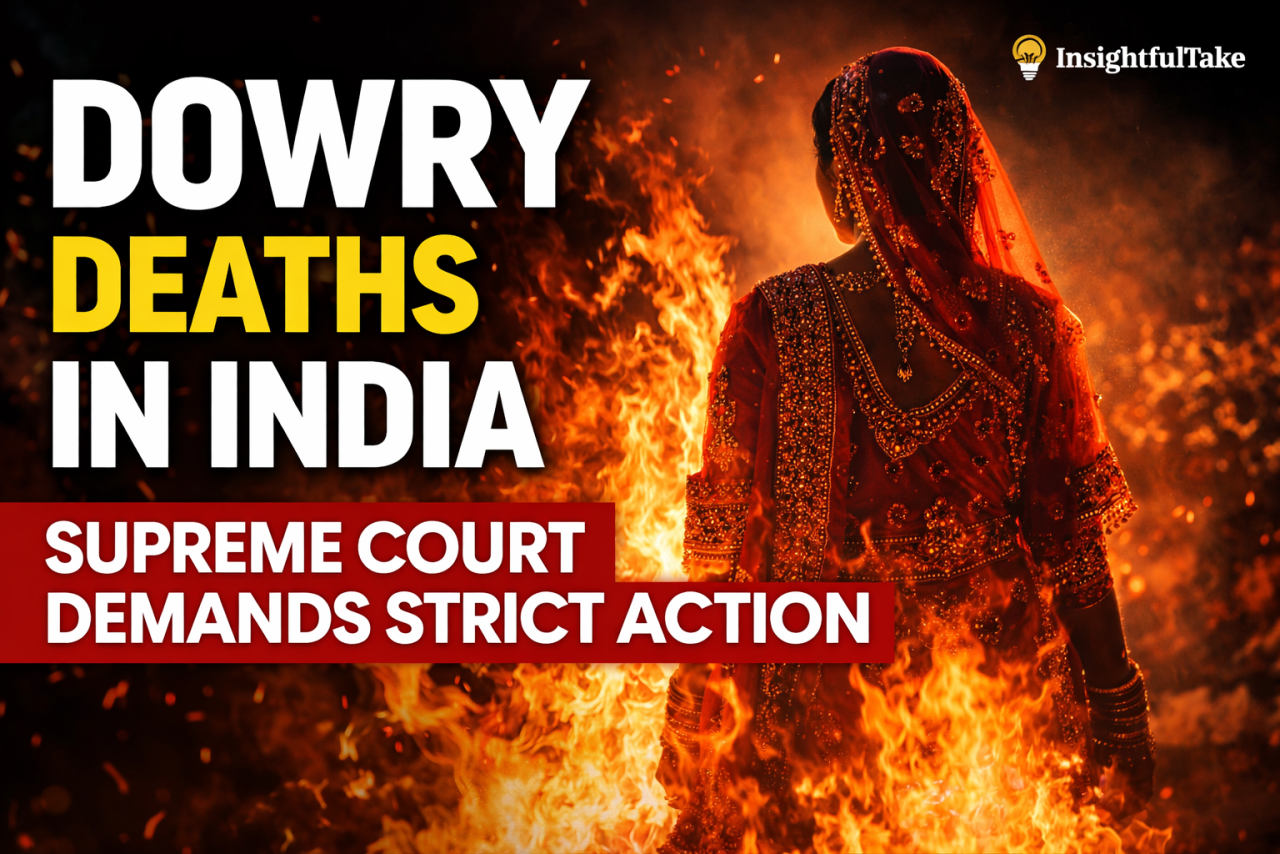
18 women die every day in India due to dowry—now the Supreme Court is demanding strict action.
Dowry-related deaths in India continue to expose a grim reality—one where social practices, economic pressures, and entrenched patriarchy intersect with violence. Recent observations by the Supreme Court have once again brought national attention to the issue, calling it a “severe blot on society” and urging courts to act firmly against such crimes.
According to the latest data from the National Crime Records Bureau (NCRB), India records around 6,000–7,000 dowry deaths annually. In 2022 alone, over 6,500 cases were reported under Section 304B of the Indian Penal Code (IPC), which deals specifically with dowry deaths. This translates to nearly 18–20 women dying every day due to dowry-related violence. Despite legal provisions like the Dowry Prohibition Act, 1961, and stringent criminal laws, the numbers have remained alarmingly consistent over the past decade.
The Supreme Court, in its recent order, highlighted that dowry deaths are not isolated incidents but part of a broader pattern of “greed-driven crimes.” The bench, comprising Justices JB Pardiwala and Vijay Bishnoi, stressed that such acts represent a grave violation of human dignity. The court noted that despite statutory prohibitions, dowry-related violence continues to claim the lives of thousands of women, often through murder or circumstances that drive them to suicide.
The court’s remarks came while setting aside a Patna High Court order that had granted bail to a man accused of killing his wife over dowry demands. Calling the High Court’s decision “wholly unsustainable,” the Supreme Court emphasized that a mechanical approach in granting bail in serious offences like dowry deaths undermines justice. It underlined that courts must carefully assess the gravity of allegations and the material on record before granting relief to the accused.
The case in question involved the death of a woman within one-and-a-half years of her marriage under suspicious circumstances. According to the FIR filed by the victim’s mother, substantial dowry had already been given, including ₹20 lakh in cash and gold, along with silver worth ₹6 lakh. However, the harassment allegedly continued, with further demands made by the husband and his family.
Medical evidence played a crucial role in the case. Reports indicated multiple serious injuries on the victim’s body, with the cause of death identified as haemorrhage and shock due to head injuries. These findings contradicted any claims of accidental death and pointed toward sustained physical abuse.
Taking note of these factors, the Supreme Court cancelled the bail granted to the accused and directed him to surrender within a week. It also instructed the trial court to complete proceedings within six months, stressing the need for expeditious adjudication in such sensitive cases.
Beyond the courtroom, experts point to deeper societal causes behind dowry deaths. The persistence of dowry as a social norm, especially in certain regions, continues to fuel expectations of financial and material transfers during marriage. Economic stress, coupled with societal pressure to maintain status, often leads to escalating demands even after marriage. Women, in many cases, face prolonged harassment, violence, and isolation within marital homes.
Another critical factor is underreporting and weak enforcement. While laws exist, their implementation is often inconsistent. Families may hesitate to file complaints due to social stigma, fear of retaliation, or lack of faith in the legal process. Even when cases are registered, delays in investigation and trial can dilute accountability.
The Supreme Court’s strong stance signals an attempt to address these systemic gaps. By criticizing leniency in bail decisions and calling for stricter judicial scrutiny, the court has reinforced the need for accountability at every level of the justice system.
However, legal action alone may not be sufficient. Addressing dowry deaths requires a broader cultural shift—one that challenges deep-rooted norms and promotes gender equality. Public awareness campaigns, community engagement, and economic empowerment of women are essential components of any long-term solution.
As India continues to grapple with this issue, the message from the judiciary is clear: dowry deaths are not just criminal acts but a reflection of societal failure. Strong enforcement of laws, combined with sustained social reform, remains the only way to curb this persistent and tragic phenomenon.

























Leave a Comment