
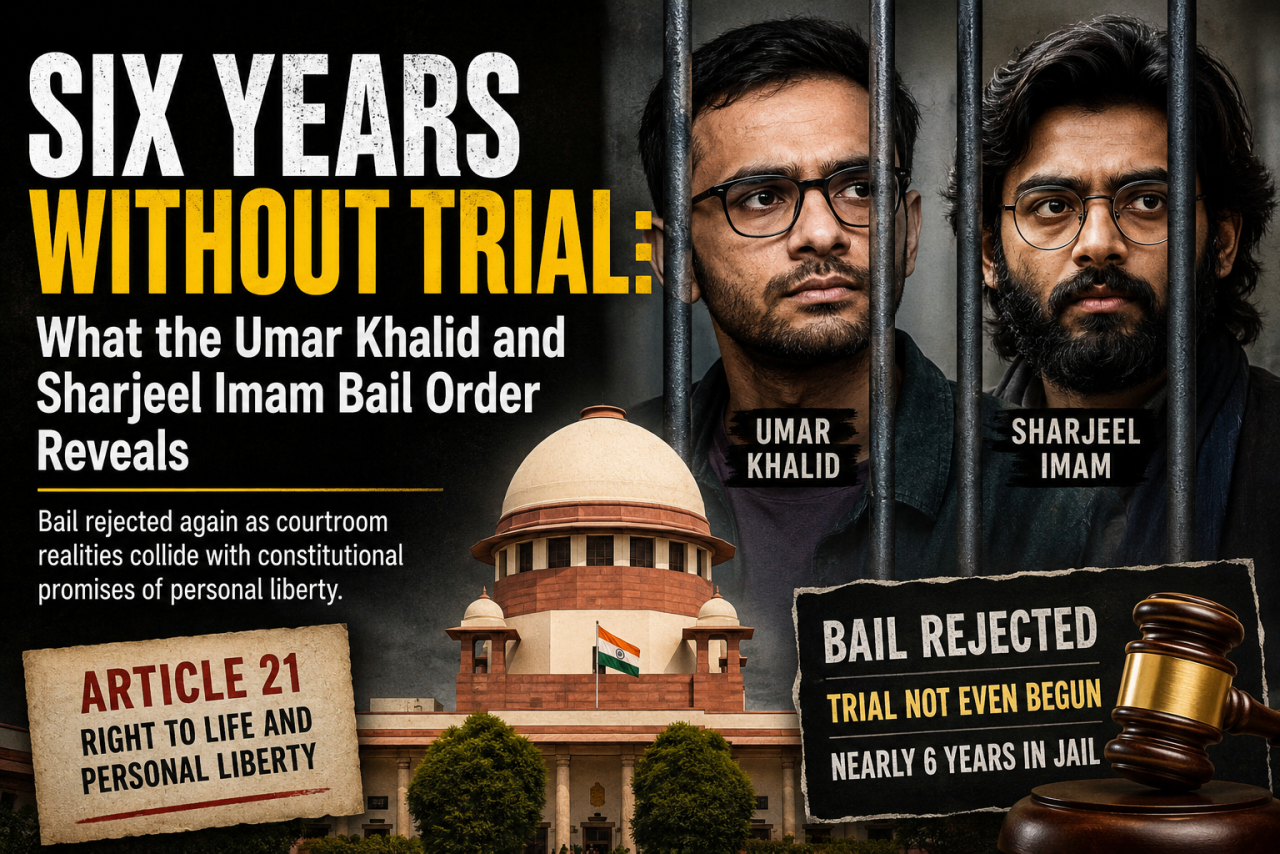
Can constitutional liberty survive if a person spends nearly six years in jail without trial? The latest bail order raises uncomfortable questions about India's justice system.
Delhi's rejection of fresh bail pleas for Umar Khalid and Sharjeel Imam highlights the growing tension between constitutional guarantees of personal liberty and the procedural constraints faced by trial courts.
For the ordinary citizen who has never stepped inside a courtroom, "bail" sounds like a simple word: either you get it, or you don't. What rarely gets explained is why two men who have already spent nearly six years in jail, without their trial even reaching the stage where charges have been framed, still cannot get a court to consider their fresh bail pleas. That is precisely what happened this past weekend at Delhi's Karkardooma Court, raising difficult questions about how India's jurisprudence on personal liberty operates in practice.
On July 4, Additional Sessions Judge Sameer Bajpai dismissed fresh bail applications filed by Umar Khalid and Sharjeel Imam in the Delhi riots larger conspiracy case. The court held that the applications were not maintainable in light of the Supreme Court of India order dated January 5, 2026, which governed their liberty to seek bail afresh. Judge Bajpai noted that the trial court had "no option but to follow" the January order, which had already rejected their earlier bail petitions.
To understand why this matters beyond the fate of two individuals, it is necessary to revisit the Supreme Court's January decision. The Court granted bail to five co-accused—Gulfisha Fatima, Meeran Haider, Shifa-ur-Rehman, Mohammad Saleem Khan and Shadab Ahmad—while denying bail to Khalid and Imam. The Court reasoned that the two occupied a different position in the alleged "hierarchy of participation" among the accused. More significantly, it directed that they could not seek fresh bail until either all protected witnesses had been examined or one year had elapsed, whichever came first.
That direction has now become central to the present legal dispute.
In May, a separate two-judge bench of the Supreme Court, while granting bail in an unrelated anti-terror case, criticised the reasoning reflected in the January order and reiterated a principle the Court has repeatedly affirmed since its landmark ruling in Union of India v. K.A. Najeeb. The Court emphasised that statutory restrictions on bail under Section 43D(5) of the UAPA cannot override the constitutional guarantee of personal liberty under Article 21 where a trial shows no realistic prospect of concluding within a reasonable period.
Relying on that reasoning, Khalid and Imam argued that nearly six years of incarceration without charges even being framed amounted to precisely the kind of prolonged detention that the Supreme Court itself has repeatedly cautioned against.
The trial court, however, found itself bound by the January order. It could not rely on the May observations because the apparent conflict between the two lines of Supreme Court reasoning has already been referred to a larger bench for authoritative resolution. Until that issue is settled, Judge Bajpai held that the January order continues to bind the trial court.
The episode illustrates a broader tension within India's criminal justice system. Over the years, the Supreme Court has repeatedly declared that "bail is the rule and jail the exception," that constitutional liberty cannot be indefinitely curtailed by statutory barriers, and that prolonged incarceration without trial undermines the very idea of justice. Yet trial courts, which make the day-to-day decisions affecting an accused person's liberty, remain bound by case-specific directions even when broader constitutional principles appear to point in a different direction.
For citizens observing the legal system from outside, the debate extends beyond the guilt or innocence of any individual. It raises a larger institutional question: how effectively can constitutional guarantees protect personal liberty when procedural constraints prevent lower courts from applying the Supreme Court's evolving constitutional jurisprudence? Until that question is resolved, the distance between constitutional principle and courtroom reality is likely to remain a defining feature of India's bail law.
Delhi's rejection of fresh bail pleas for Umar Khalid and Sharjeel Imam highlights the growing tension between constitutional guarantees of personal liberty and the procedural constraints faced by trial courts.
For the ordinary citizen who has never stepped inside a courtroom, "bail" sounds like a simple word: either you get it, or you don't. What rarely gets explained is why two men who have already spent nearly six years in jail, without their trial even reaching the stage where charges have been framed, still cannot get a court to consider their fresh bail pleas. That is precisely what happened this past weekend at Delhi's Karkardooma Court, raising difficult questions about how India's jurisprudence on personal liberty operates in practice.
On July 4, Additional Sessions Judge Sameer Bajpai dismissed fresh bail applications filed by Umar Khalid and Sharjeel Imam in the Delhi riots larger conspiracy case. The court held that the applications were not maintainable in light of the Supreme Court of India order dated January 5, 2026, which governed their liberty to seek bail afresh. Judge Bajpai noted that the trial court had "no option but to follow" the January order, which had already rejected their earlier bail petitions.
To understand why this matters beyond the fate of two individuals, it is necessary to revisit the Supreme Court's January decision. The Court granted bail to five co-accused—Gulfisha Fatima, Meeran Haider, Shifa-ur-Rehman, Mohammad Saleem Khan and Shadab Ahmad—while denying bail to Khalid and Imam. The Court reasoned that the two occupied a different position in the alleged "hierarchy of participation" among the accused. More significantly, it directed that they could not seek fresh bail until either all protected witnesses had been examined or one year had elapsed, whichever came first.
That direction has now become central to the present legal dispute.
In May, a separate two-judge bench of the Supreme Court, while granting bail in an unrelated anti-terror case, criticised the reasoning reflected in the January order and reiterated a principle the Court has repeatedly affirmed since its landmark ruling in Union of India v. K.A. Najeeb. The Court emphasised that statutory restrictions on bail under Section 43D(5) of the UAPA cannot override the constitutional guarantee of personal liberty under Article 21 where a trial shows no realistic prospect of concluding within a reasonable period.
Relying on that reasoning, Khalid and Imam argued that nearly six years of incarceration without charges even being framed amounted to precisely the kind of prolonged detention that the Supreme Court itself has repeatedly cautioned against.
The trial court, however, found itself bound by the January order. It could not rely on the May observations because the apparent conflict between the two lines of Supreme Court reasoning has already been referred to a larger bench for authoritative resolution. Until that issue is settled, Judge Bajpai held that the January order continues to bind the trial court.
The episode illustrates a broader tension within India's criminal justice system. Over the years, the Supreme Court has repeatedly declared that "bail is the rule and jail the exception," that constitutional liberty cannot be indefinitely curtailed by statutory barriers, and that prolonged incarceration without trial undermines the very idea of justice. Yet trial courts, which make the day-to-day decisions affecting an accused person's liberty, remain bound by case-specific directions even when broader constitutional principles appear to point in a different direction.
For citizens observing the legal system from outside, the debate extends beyond the guilt or innocence of any individual. It raises a larger institutional question: how effectively can constitutional guarantees protect personal liberty when procedural constraints prevent lower courts from applying the Supreme Court's evolving constitutional jurisprudence? Until that question is resolved, the distance between constitutional principle and courtroom reality is likely to remain a defining feature of India's bail law.


























Leave a Comment