
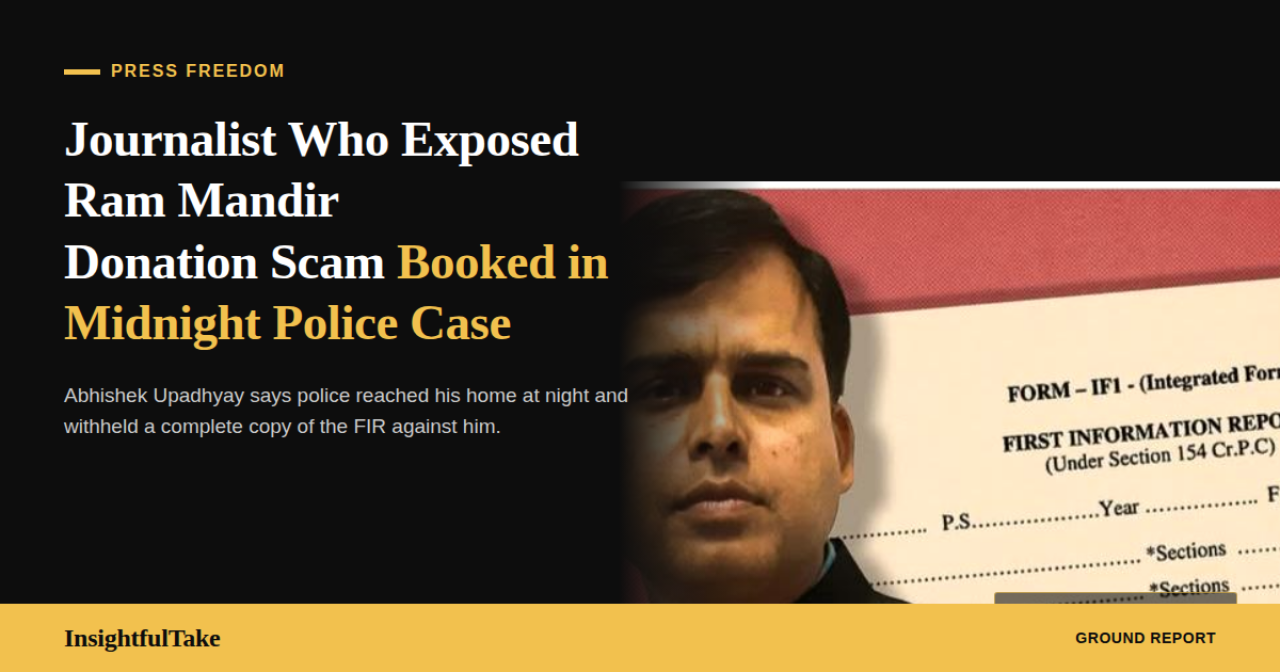
A road incident in Ghaziabad has turned into a larger press freedom controversy after journalist Abhishek Upadhyay alleged that the FIR against him is connected to his reporting on the Ram Mandir donation controversy.
A midnight visit by police to the home of independent journalist Abhishek Upadhyay has reignited concerns over press freedom in Uttar Pradesh, with the reporter alleging that he is being targeted for his coverage of alleged financial irregularities linked to Ram Mandir donations.
Upadhyay, who runs the YouTube channel Top Secret, has built a profile through reporting and commentary on the alleged temple donation controversy. He says a team of police personnel arrived at his residence late Thursday night while he was away. He later learned that an FIR had been registered against him at Ghaziabad's Indirapuram police station.
The police, however, describe the matter differently. According to Indirapuram ACP Suryabali Maurya, the case relates to a road accident involving Upadhyay's car.
A Minor Road Incident Turns Into an FIR
According to Upadhyay's account, posted through a series of messages on X, the incident began on August 18 when a motorcyclist allegedly scraped his car near Shipra Mall.
The motorcyclist subsequently contacted the police emergency helpline. What Upadhyay describes as an ordinary road incident then escalated into a criminal complaint against him.
The journalist has challenged the police version and called for the release of CCTV or other footage from the area. He has argued that the footage would establish what actually happened and has described the sequence of events as unusually convenient.
Newslaundry reported that it could not independently verify the contents of the FIR.
That caveat is important. At this stage, the precise allegations contained in the Ghaziabad case remain a matter of dispute.
The Midnight Paperwork Mystery
What has attracted particular attention is not simply the alleged accident, but what happened when police officers went looking for Upadhyay.
The journalist says that at around 2:45 am, a local police officer sent him a single-page document through WhatsApp. According to Upadhyay, the page did not clearly identify the charges or provide details of the alleged incident.
When he asked for the complete FIR, he says he was instead sent a page from a completely different case.
That earlier FIR was registered against him in Lucknow last year in connection with his reporting on the death of a NEET aspirant in Gorakhpur, the home district of Uttar Pradesh Chief Minister Yogi Adityanath.
Screenshots of the exchange shared publicly by Upadhyay show the officer attributing the mix-up to an automatic error.
Upadhyay questioned how such an error could occur when, according to his account, around a dozen police personnel had arrived at his residence.
The episode has consequently become a second controversy alongside the road accident itself.
Police Say There Was Nothing Procedurally Unusual
The police have rejected the suggestion that Upadhyay was deliberately denied access to the FIR.
Speaking to Newslaundry, Indirapuram ACP Suryabali Maurya said Upadhyay could have obtained a copy of the FIR by going to the police station when officers arrived at his home.
Maurya also pointed out that the police station is located close to Upadhyay's residence.
Since the journalist did not go to the station, the ACP said he would now have to obtain the document through the courts, "as per procedure."
Maurya also confirmed that police had seized Upadhyay's car in connection with the alleged road incident.
That explanation places the case firmly in the category of a traffic-related criminal complaint rather than a case connected to Upadhyay's journalism.
But the journalist sees the timing differently.
Why Upadhyay Sees a Larger Pattern
Upadhyay has argued that the Ghaziabad case cannot be viewed in isolation from his reporting.
He alleges that his coverage of alleged corruption and irregularities involving Ram Mandir donations has made him a target of the Uttar Pradesh government.
According to his account, earlier complaints against him did not establish anything that could stop his reporting. He now believes the road incident is being used as another pretext to put pressure on him.
Those are allegations made by Upadhyay and have not been independently established.
He has also referred to a previous Uttar Pradesh police FIR against him, arguing that the language used in that case reflected an unusually hostile approach towards a journalist critical of the government.
For Upadhyay, therefore, the central question is not simply whether a road accident occurred. It is whether the criminal complaint and the manner in which it was pursued represent legitimate policing or an attempt to intimidate a journalist.
Opposition Sees a Press Freedom Issue
The controversy has already attracted political reactions.
Congress spokesperson and Rajya Sabha MP Pawan Khera accused the Uttar Pradesh government of using the police machinery to harass and silence Upadhyay.
Khera also argued that the administration should be addressing questions surrounding the handling of donations made by millions of devotees rather than pursuing the journalist raising those questions.
Several journalists have also expressed solidarity with Upadhyay online.
The political reaction, however, adds another layer to an already contested episode. Neither opposition allegations nor Upadhyay's claims by themselves establish that the Ghaziabad FIR was filed in retaliation for his journalism.
That question will ultimately depend on the contents of the FIR, the evidence surrounding the road incident and the subsequent legal proceedings.
The Bigger Question Is About Due Process
There are, in fact, two separate questions here.
The first is straightforward. What happened near Shipra Mall on August 18, and does the evidence support the police case against Upadhyay?
The second is more consequential. Was the journalist treated in accordance with due process, and was the police action entirely unrelated to his professional work?
At present, the available accounts do not provide a definitive answer to either question.
What is clear is that Upadhyay has faced multiple legal complaints in recent years, while continuing to publish material critical of powerful political figures.
That does not automatically establish a pattern of harassment. Nor does the existence of a traffic-related FIR automatically disprove one.
But when a journalist facing repeated legal action alleges that policing is being used to intimidate him, the circumstances deserve scrutiny, particularly when questions arise over the communication of the FIR and the paperwork supplied to him.
For now, the Ghaziabad case remains a contested story with two sharply different versions.
The police say it is a road case.
Upadhyay says the road incident is merely the latest vehicle for something else.
The evidence, rather than either side's narrative, will have to determine which version stands.
A midnight visit by police to the home of independent journalist Abhishek Upadhyay has reignited concerns over press freedom in Uttar Pradesh, with the reporter alleging that he is being targeted for his coverage of alleged financial irregularities linked to Ram Mandir donations.
Upadhyay, who runs the YouTube channel Top Secret, has built a profile through reporting and commentary on the alleged temple donation controversy. He says a team of police personnel arrived at his residence late Thursday night while he was away. He later learned that an FIR had been registered against him at Ghaziabad's Indirapuram police station.
The police, however, describe the matter differently. According to Indirapuram ACP Suryabali Maurya, the case relates to a road accident involving Upadhyay's car.
A Minor Road Incident Turns Into an FIR
According to Upadhyay's account, posted through a series of messages on X, the incident began on August 18 when a motorcyclist allegedly scraped his car near Shipra Mall.
The motorcyclist subsequently contacted the police emergency helpline. What Upadhyay describes as an ordinary road incident then escalated into a criminal complaint against him.
The journalist has challenged the police version and called for the release of CCTV or other footage from the area. He has argued that the footage would establish what actually happened and has described the sequence of events as unusually convenient.
Newslaundry reported that it could not independently verify the contents of the FIR.
That caveat is important. At this stage, the precise allegations contained in the Ghaziabad case remain a matter of dispute.
The Midnight Paperwork Mystery
What has attracted particular attention is not simply the alleged accident, but what happened when police officers went looking for Upadhyay.
The journalist says that at around 2:45 am, a local police officer sent him a single-page document through WhatsApp. According to Upadhyay, the page did not clearly identify the charges or provide details of the alleged incident.
When he asked for the complete FIR, he says he was instead sent a page from a completely different case.
That earlier FIR was registered against him in Lucknow last year in connection with his reporting on the death of a NEET aspirant in Gorakhpur, the home district of Uttar Pradesh Chief Minister Yogi Adityanath.
Screenshots of the exchange shared publicly by Upadhyay show the officer attributing the mix-up to an automatic error.
Upadhyay questioned how such an error could occur when, according to his account, around a dozen police personnel had arrived at his residence.
The episode has consequently become a second controversy alongside the road accident itself.
Police Say There Was Nothing Procedurally Unusual
The police have rejected the suggestion that Upadhyay was deliberately denied access to the FIR.
Speaking to Newslaundry, Indirapuram ACP Suryabali Maurya said Upadhyay could have obtained a copy of the FIR by going to the police station when officers arrived at his home.
Maurya also pointed out that the police station is located close to Upadhyay's residence.
Since the journalist did not go to the station, the ACP said he would now have to obtain the document through the courts, "as per procedure."
Maurya also confirmed that police had seized Upadhyay's car in connection with the alleged road incident.
That explanation places the case firmly in the category of a traffic-related criminal complaint rather than a case connected to Upadhyay's journalism.
But the journalist sees the timing differently.
Why Upadhyay Sees a Larger Pattern
Upadhyay has argued that the Ghaziabad case cannot be viewed in isolation from his reporting.
He alleges that his coverage of alleged corruption and irregularities involving Ram Mandir donations has made him a target of the Uttar Pradesh government.
According to his account, earlier complaints against him did not establish anything that could stop his reporting. He now believes the road incident is being used as another pretext to put pressure on him.
Those are allegations made by Upadhyay and have not been independently established.
He has also referred to a previous Uttar Pradesh police FIR against him, arguing that the language used in that case reflected an unusually hostile approach towards a journalist critical of the government.
For Upadhyay, therefore, the central question is not simply whether a road accident occurred. It is whether the criminal complaint and the manner in which it was pursued represent legitimate policing or an attempt to intimidate a journalist.
Opposition Sees a Press Freedom Issue
The controversy has already attracted political reactions.
Congress spokesperson and Rajya Sabha MP Pawan Khera accused the Uttar Pradesh government of using the police machinery to harass and silence Upadhyay.
Khera also argued that the administration should be addressing questions surrounding the handling of donations made by millions of devotees rather than pursuing the journalist raising those questions.
Several journalists have also expressed solidarity with Upadhyay online.
The political reaction, however, adds another layer to an already contested episode. Neither opposition allegations nor Upadhyay's claims by themselves establish that the Ghaziabad FIR was filed in retaliation for his journalism.
That question will ultimately depend on the contents of the FIR, the evidence surrounding the road incident and the subsequent legal proceedings.
The Bigger Question Is About Due Process
There are, in fact, two separate questions here.
The first is straightforward. What happened near Shipra Mall on August 18, and does the evidence support the police case against Upadhyay?
The second is more consequential. Was the journalist treated in accordance with due process, and was the police action entirely unrelated to his professional work?
At present, the available accounts do not provide a definitive answer to either question.
What is clear is that Upadhyay has faced multiple legal complaints in recent years, while continuing to publish material critical of powerful political figures.
That does not automatically establish a pattern of harassment. Nor does the existence of a traffic-related FIR automatically disprove one.
But when a journalist facing repeated legal action alleges that policing is being used to intimidate him, the circumstances deserve scrutiny, particularly when questions arise over the communication of the FIR and the paperwork supplied to him.
For now, the Ghaziabad case remains a contested story with two sharply different versions.
The police say it is a road case.
Upadhyay says the road incident is merely the latest vehicle for something else.
The evidence, rather than either side's narrative, will have to determine which version stands.



















Leave a Comment