
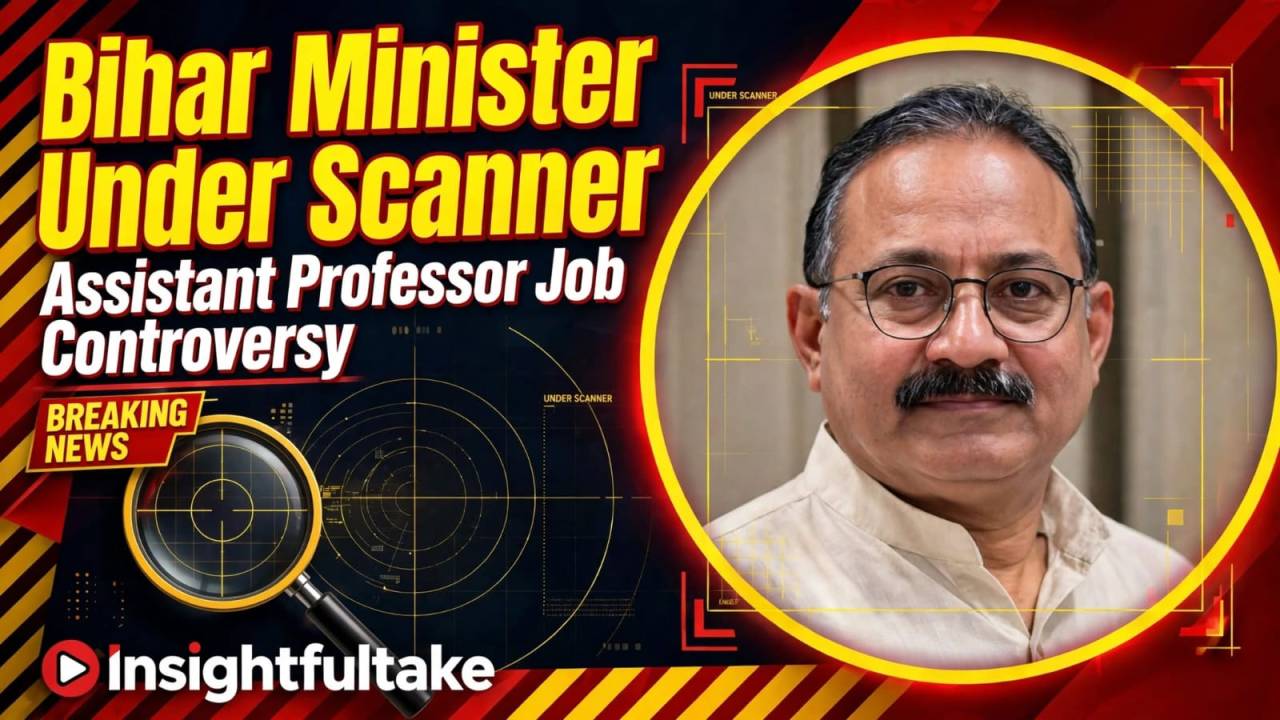
Bihar presents two contrasting realities: while the powerful access positions at home, millions of ordinary people leave the state in search of jobs and a better future.
Bihar has two queues, and they rarely meet. One is inside the corridors of power, where influential people can access positions and opportunities. The other stretches across railway platforms, reservation counters and crowded bus terminals, where ordinary people struggle to find a way home.
Two developments around the Diwali and Chhath season have brought this contrast into focus. One concerns a sitting minister joining a university as an assistant professor. The other concerns thousands of migrant workers struggling to return to Bihar for its most important festival.
They may appear to be unrelated stories. Together, however, they raise an uncomfortable question: who gets access to opportunity in Bihar, and who is forced to search for it elsewhere?
The First Queue: A Minister, a University Post and a Legal Question
In February 2026, Bihar minister and Legislative Council member Ashok Choudhary joined A N College under Patliputra University as an assistant professor of political science. A day after joining, he sought lien, or leave without pay, to continue his political responsibilities.
The university's Syndicate rejected his request on August 19, citing provisions of the Bihar State Universities Act, 1976. The matter was subsequently referred to the Governor's Secretariat for clarification. A note from the Lok Bhawan reportedly questioned his eligibility for lien during probation and raised the issue of whether the teaching position constituted an office of profit. The matter has since been referred to Advocate General S D Sanjay for legal opinion.
Choudhary has defended his decision, arguing that there was no prohibition on legislators applying for the post and that he followed the prescribed selection process and obtained the necessary clearances. He has also questioned the motivation behind the scrutiny. No final legal determination should be presumed while the matter remains under examination.
But the controversy raises a question that goes beyond the technicalities of constitutional and university law.
Why does a sitting minister, already holding an influential public office, need to occupy a salaried academic position when thousands of qualified young people are waiting for an opportunity to enter the teaching profession?
There is no suggestion that a university position should be denied to someone merely because of their political identity. Selection rules must apply equally to everyone. But public institutions also carry a responsibility to ensure that their limited opportunities are accessible through transparent and credible processes.
For a young researcher with a PhD, years of preparation and repeated recruitment delays, the episode inevitably raises questions about fairness.
Bihar's graduates have seen recruitment examinations delayed, vacancies remain unfilled and selection processes become entangled in litigation. Against this background, the controversy surrounding a minister's university appointment has acquired a significance beyond one individual's career.
The issue is not simply whether the appointment is legally permissible. It is whether public institutions inspire equal confidence among those who depend on them.
The Second Queue: The Annual Struggle to Reach Home
Now consider the other queue.
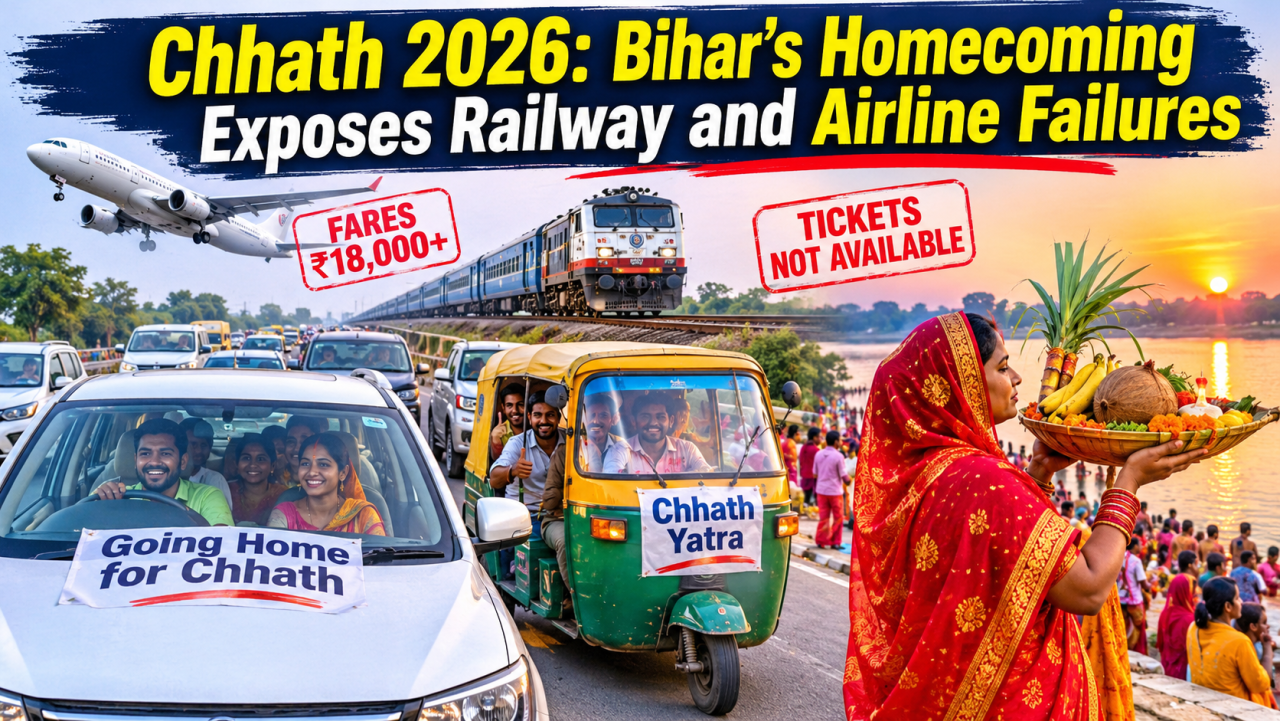
Every year, as Diwali and Chhath approach, thousands of workers and professionals employed outside Bihar begin planning their journey home. They live in Delhi, Mumbai, Surat, Bengaluru, Hyderabad and Chennai because employment opportunities are concentrated elsewhere.
For many, Chhath is not merely another festival. It is an emotional connection with family, village, community and cultural identity. Returning home is a deeply personal commitment.
Yet the journey increasingly comes with a financial and logistical burden.
During the 2026 festive season, passengers faced severe pressure on railway reservations and sharply elevated airfares on several Bihar-bound routes. A November 12 fare analysis by HappyFares found that the median lowest one-way fare from Delhi to Patna around Diwali was Rs 11,988, compared with Rs 5,608 on normal days, an increase of 114 per cent. Delhi-Darbhanga fares also rose substantially during the festive period.
Special trains were announced to manage the rush, including additional services connecting Delhi with Patna, Darbhanga and other Bihar destinations. These measures provided additional capacity, but the scale of seasonal demand continued to put pressure on available transport.
For a migrant worker supporting a family on a modest salary, even a few thousand rupees in additional travel costs can be significant.
The problem is not that people want to celebrate Chhath. The problem is that millions must leave their home state to earn a living and then pay a premium to return for a few days.
This annual rush is predictable. It follows a familiar calendar. Yet adequate transport capacity and affordable travel remain recurring concerns.
Two Queues, One Underlying Question
The minister's university appointment and the migrant worker's journey home are not legally or administratively identical issues. Nor can one appointment explain Bihar's long history of migration.
But the two developments expose a shared concern about the distribution of opportunity.
On one side are young people competing for a limited number of government and academic positions. On the other are workers who have moved hundreds or thousands of kilometres because local employment cannot provide them with a sustainable livelihood.
The contrast becomes difficult to ignore when public employment itself appears caught in questions of access, transparency and institutional accountability.
For Bihar, migration is not simply a matter of people choosing to work elsewhere. It reflects deeper structural challenges involving industrial development, investment, agricultural productivity, education and the availability of stable employment.
When local opportunities remain limited, migration becomes an economic necessity rather than an individual preference.
And when recruitment processes are delayed or questioned, the frustration of educated young people grows.
This is where the two queues meet, even if the people standing in them never do.
The larger concern is not that one person has pursued two professional identities. It is whether Bihar's institutions can assure ordinary citizens that opportunity is governed by transparent rules rather than proximity to power.
Privilege does not always operate through direct corruption or an exchange of money. Sometimes, the public perception of unequal access is enough to weaken confidence in institutions.
What Bihar Needs to Change
Bihar needs institutional reforms that address both the employment crisis and the recurring migration burden.
First, the state must establish clear and publicly accessible rules governing whether sitting legislators and ministers can hold paid academic positions. Such rules should remove ambiguity and prevent individual controversies from becoming prolonged institutional disputes.
Second, university recruitment must become predictable. Vacancies, selection criteria, examination schedules and appointment timelines should be publicly disclosed. Recruitment agencies must be held accountable for avoidable delays.
Third, Bihar needs a stronger employment strategy built around manufacturing, food processing, agriculture-based industries, infrastructure and small businesses. Investment announcements must translate into functioning enterprises and local jobs.
Finally, the Railways and aviation authorities must treat the Diwali-Chhath travel rush as a recurring public transport challenge. Better advance planning, additional capacity and transparent monitoring of passenger fares would help reduce the burden on migrant families.
The Other Side of the Argument
A balanced assessment must also consider the arguments made in defence of Ashok Choudhary. His supporters maintain that he went through the prescribed selection process, that no explicit legal prohibition prevented him from applying and that the scrutiny may be politically motivated.
The question of whether the academic position constitutes an office of profit, and whether he was entitled to lien, requires a proper legal determination. The final decision on any question of disqualification belongs to the competent constitutional authority.
Similarly, Bihar's migration cannot be attributed to political appointments or individual controversies. Land constraints, population pressure, limited industrialisation and the historical concentration of employment in other states are major factors. Festival airfares also rise on other high-demand routes across India.
These arguments deserve consideration. But they do not remove the larger questions about institutional transparency, employment generation and the cost of migration.
One appointment does not explain an entire state's employment crisis. One festival rush does not capture the full complexity of migration. Yet both offer an opportunity to examine the systems that shape people's access to jobs and public services.
The Real Test of Bihar's Progress
A state's progress should not be measured only by the number of people holding public office, the announcements made by its government or the construction of new infrastructure.
It should also be measured by whether a young graduate can find meaningful work without leaving home, whether a qualified teacher can compete for a university position with confidence, and whether a migrant worker can afford to return for Chhath without exhausting a month's savings.
Bihar's challenge is not simply to reduce migration or resolve one appointment controversy. It is to build institutions and an economy in which opportunity is not determined by influence and leaving home is not the price of earning a livelihood.
Until that happens, the two queues will continue to tell the same story: some will wait for positions, while millions will keep waiting for trains.





















Leave a Comment