
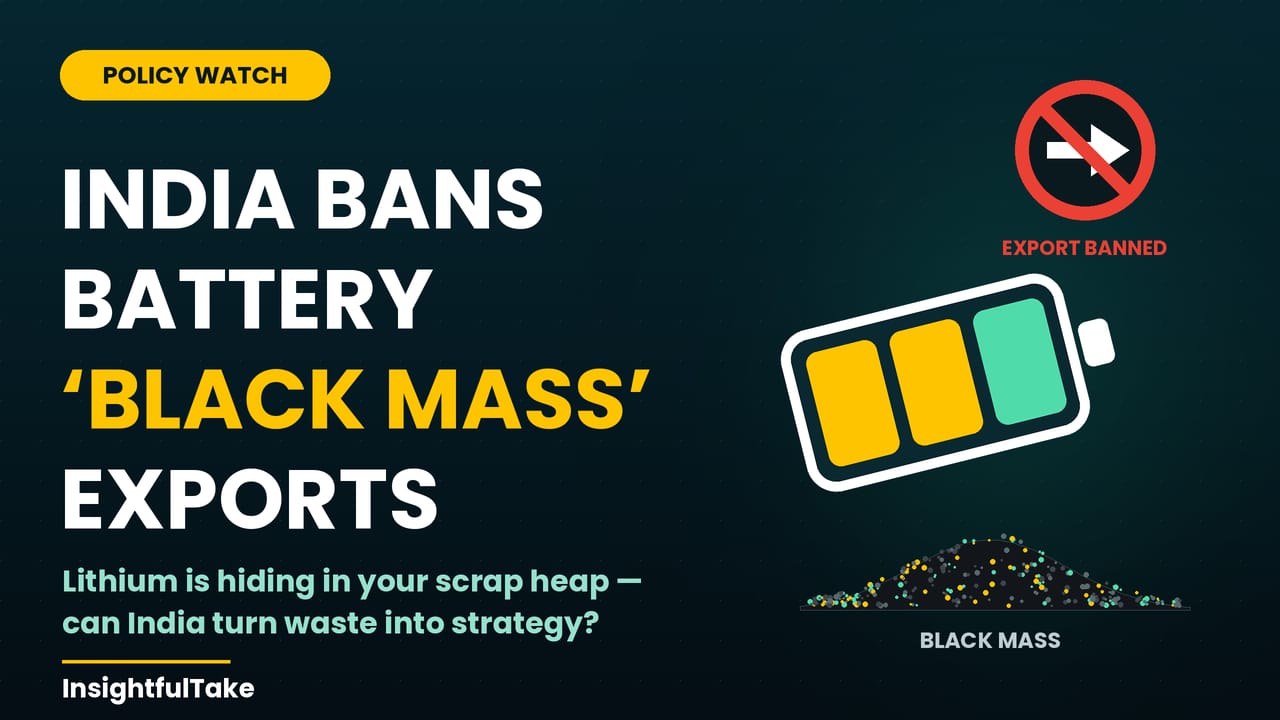
India wants to turn battery waste into a strategic resource. But retaining black mass is easier than building the recycling industry to unlock its value.
Every phone that dies in a drawer and every electric vehicle battery that reaches the end of its life contains metals that industries across the world are scrambling to secure. India has now decided it will no longer allow that value to leave its shores without restriction.
On November 10, the Directorate General of Foreign Trade (DGFT) moved lithium-ion battery black mass, the dark powder obtained after used batteries are shredded, from the "Free" export category to "Prohibited", with immediate effect and until further orders.
The decision signals a shift in India's approach to critical minerals. Instead of allowing valuable battery waste to leave the country, the government wants to retain it as a resource for domestic recycling and manufacturing.
But stopping exports is only the first step. The bigger challenge is building an industry capable of extracting and reusing these valuable materials.
What Exactly Is Being Protected?
Black mass is not ordinary waste. Depending on the chemistry of the battery, it contains recoverable quantities of lithium, nickel, cobalt and manganese. These are essential materials used in electric vehicle batteries, energy storage systems and several other industrial applications.
Whoever develops the capacity to recover and refine these metals gains access to valuable resources without having to depend entirely on fresh mining.
This is where the global competition becomes important.
China dominates the battery recycling supply chain, accounting for roughly three-quarters of the world's pre-treatment capacity and around nine-tenths of its refining capacity.
Europe has also moved to protect its resources. Since March 2025, it has classified black mass as hazardous waste, introducing restrictions that help retain the material within its own economic and regulatory framework.
India's latest decision reflects a similar understanding: battery waste is not merely an environmental problem. It is also an industrial and strategic resource.
An Economic Contradiction That Needed Fixing
Until now, India's approach contained an obvious contradiction.
Domestic black mass could be exported even as Indian recycling facilities struggled to secure sufficient raw material. The Ministry of Commerce had acknowledged that several domestic recycling plants were operating below capacity because of inadequate feedstock. Some recyclers were even importing material to keep their operations running.
In effect, India was allowing valuable battery materials to leave the country while its own recycling industry faced shortages.
The government had already recognised the need to develop domestic capacity. In September 2025, the Union Cabinet approved a ₹1,500 crore scheme to strengthen battery recycling and related capabilities.
However, subsidising recycling plants while allowing their essential raw material to flow overseas made little economic sense.
The export restriction addresses this gap. It gives domestic recyclers a better opportunity to access used battery material and develop a local supply chain for recovered minerals.
Why an Export Ban Is Not a Magic Wand
The policy has a clear economic rationale, but restrictions alone cannot guarantee industrial success. Several challenges remain.
1. Lower prices for battery waste
With overseas buyers excluded, domestic recyclers could gain greater bargaining power over black mass suppliers. This may push procurement prices down.
If collectors and dismantlers receive less money for used batteries, their incentive to collect and channel them into authorised recycling facilities could weaken.
2. The refining capacity challenge
Retaining black mass is one thing. Recovering lithium, nickel and cobalt efficiently is another.
Indian companies must demonstrate that they can process this material at industrial scale, achieve competitive recovery rates and produce metals that meet the quality requirements of battery manufacturers.
Without technological investment and commercial viability, the country could end up accumulating material without extracting its full value.
3. A policy aimed at the future
Reports indicate that India recorded no exports of these items in FY2026. If that figure is accurate, the restriction is less about stopping a major existing export flow and more about establishing a clear direction for the future.
That makes the policy strategically important, but its impact will depend on what follows.
The Bigger Problem Is India's Battery Collection System
The most difficult part of battery recycling does not begin inside a processing plant. It begins with collecting used batteries.
A significant number of discarded batteries never reach licensed recycling facilities. Some remain unused in households, while others enter informal scrap networks where valuable materials may be recovered through unsafe and environmentally damaging methods.
An export ban cannot address batteries that never enter the formal recycling chain.
India needs a collection system that works for ordinary consumers, businesses and informal waste collectors.
This requires:
- Convenient battery collection and drop-off centres.
- Fair prices and incentives for consumers returning used batteries.
- Strict enforcement of Extended Producer Responsibility (EPR) rules.
- Formal integration of informal waste collectors and dismantlers.
- Investment in safe storage, transportation and recycling infrastructure.
The challenge will become larger as electric vehicle adoption increases and the country generates growing volumes of end-of-life batteries.
The International Energy Agency has estimated that the recycling capacity announced in India so far would be sufficient to handle only around one-tenth of the country's battery waste by 2040.
That gap raises an important question about whether investment, technology and collection infrastructure are developing quickly enough to match the coming demand.
What Would Success Look Like?
The success of India's battery waste export restriction should not be measured by the notification issued by the DGFT.
It should be measured by what happens over the next few years.
Are domestic recycling plants operating closer to their full capacity? Are collection volumes increasing? Are Indian companies recovering lithium, nickel and cobalt efficiently? Can these recovered materials return to domestic battery manufacturers at commercially viable prices?
These are the indicators that will determine whether the policy delivers its intended economic and environmental benefits.
India has drawn a line around its urban mine. The next challenge is to develop the technology, infrastructure and industrial capacity to make the most of it.
Keeping battery waste within the country may be a strategic decision. Turning that waste into an industrial advantage will be the real test.


















Leave a Comment