
Tesla’s flying Roadster promises rocket-like stunts and extreme performance, but can its most ambitious features become legal and practical on public roads?
Tesla has once again captured global attention with a spectacle that blurs the line between science fiction and engineering demonstration. The long-awaited second-generation Roadster, first teased in 2017, has re-emerged not merely as a high-performance electric sports car but as a vehicle claimed to be capable of hovering, driving upside down and performing mid-air flips.
The recent showcase in Texas offered a glimpse of technology that Tesla claims can generate powerful downward suction, deploy cold-gas thrusters and achieve rocket-like trajectories. For many observers, it felt more like a stunt show than a conventional product launch. Yet beneath the spectacle lies a serious conversation about what this technology could mean for the future of mobility, regulation and public expectations.
From Electric Sports Car to Rocket-Powered Vision
The original vision for the second-generation Roadster included a “SpaceX Option Package” that promised around ten small rocket thrusters to dramatically improve acceleration and cornering. Nearly a decade later, Elon Musk has expanded that idea into something far more ambitious: a hover-capable prototype drawing on SpaceX technology.
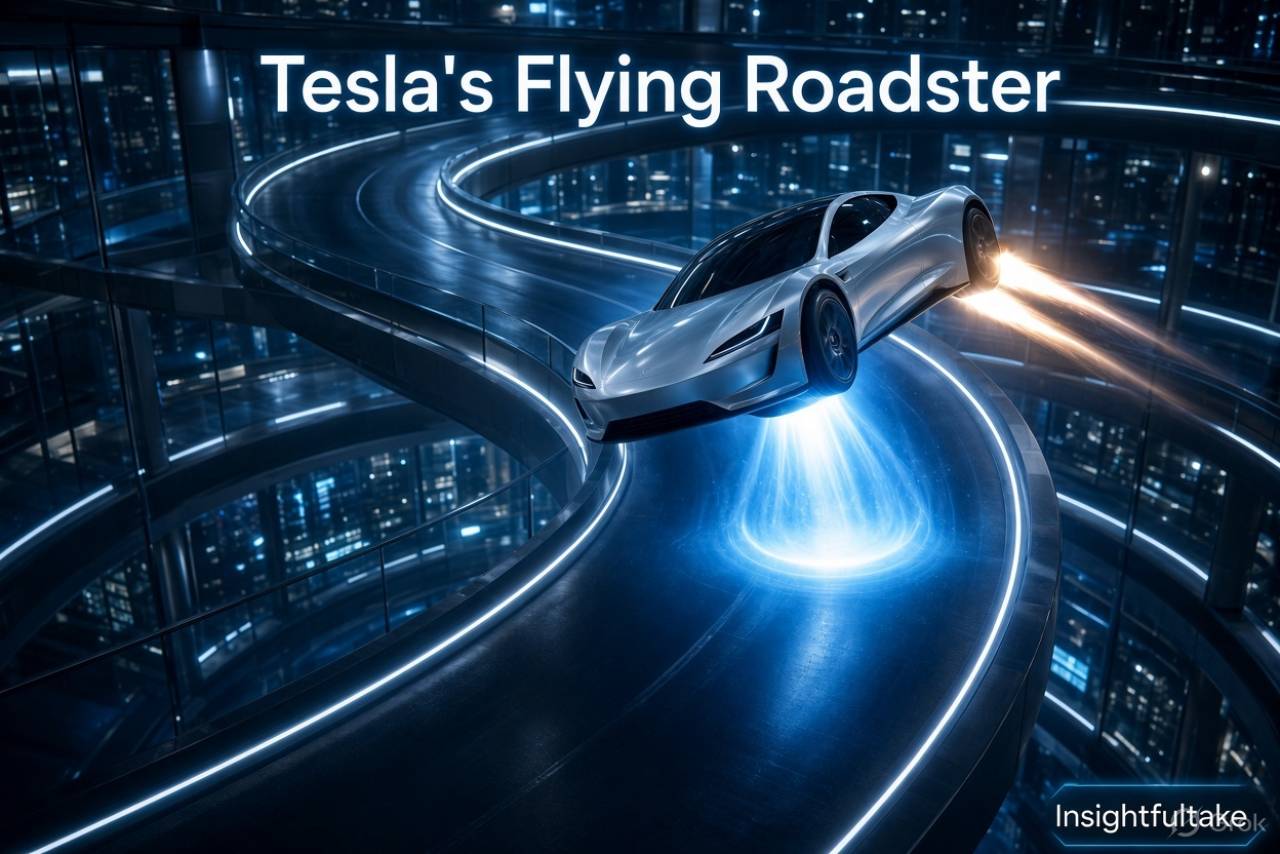
In the latest demonstration, the car climbed a multi-storey curved ramp, used intense downward suction to cling to the surface as it drove vertically, flipped over the top and employed thrusters to return gently to the ground.
A fan-based suction system mounted on the underside is said to generate up to two Gs of force, while the rear wing provides high-drag and downforce modes familiar from motorsport. Attitude-control and main thrusters toward the rear of the vehicle enable what Musk has described as the ability to “fly like a rocket” and perform “crazy gymnastics.”
These claims are extraordinary. A production car that can briefly hover, travel upside down and leap over other vehicles would challenge conventional assumptions about what road vehicles can do.
The performance figures being discussed are equally striking. The ability to accelerate from 0 to 60 km/h in one second, for example, would place the Roadster far beyond the performance of conventional sports cars.
Tesla Roadster: Pricing and Pre-Bookings in India
Tesla has also opened pre-bookings in India, with three distinct packages. The proposed variants differ in their performance features and the extent of their experimental technology.
- Performance: Described as a road-ready version with seating for two, active aerodynamics and a multi-mode suction system. The listed price is ₹45,05,000.
- Thrust: Adds acceleration thrusters to the Performance package and is listed at ₹2,45,24,000.
- Rocket: Includes the Performance and Thrust features, along with a “full flight system.” Its price has not been disclosed.
Payments can reportedly be made by credit card or UPI, suggesting that Tesla is seeking interest from Indian buyers for this ultra-premium vehicle.
However, these prices, booking arrangements and specifications should be independently verified through official Tesla channels before any payment is made. A pre-booking offer does not, by itself, establish that a vehicle has completed development, received regulatory approval or secured a confirmed delivery schedule.
The Gap Between Demonstration and Everyday Reality
The first-generation Roadster was sold between 2008 and 2012. The second generation has remained in development for years without entering production. Current estimates point towards 2028 as a possible start of series production, meaning the car could have spent roughly a decade in the public imagination before customers receive deliveries.
More importantly, many of the most dramatic capabilities reportedly associated with the Texas demonstration, including sustained upside-down driving, mid-air flips and rocket-style flight, are unlikely to receive road-legal approval in most countries without substantial technical and regulatory scrutiny.
Safety regulators would need to examine the suction system, thruster reliability, energy management and the vehicle's behaviour if any critical system failed. They would also have to consider the risks posed to passengers, pedestrians and other road users.
Features that score “11 out of 10 on the fun meter,” as Musk has put it, may never be permitted on public roads in their most extreme form.
This tension between ambition and regulation is at the heart of the story. Tesla has long positioned itself as a company willing to challenge established limits. The Roadster concept continues that tradition by combining electric propulsion, advanced aerodynamics and aerospace-inspired thruster technology.
The design language itself reportedly draws inspiration from aircraft such as the Lockheed SR-71 Blackbird and the F-35 fighter. These machines were engineered for specialised, demanding operating conditions rather than ordinary road use.
The result is a vehicle concept that promises manoeuvres that appear almost impossible under controlled conditions. Whether those manoeuvres can be made safe, reliable and certifiable for public use is an entirely different question.
What the Technology Could Mean for Future Mobility
For the public, the development raises several important considerations.
First, there is the question of managing expectations. Spectacular videos and live demonstrations can generate excitement, but they can also create unrealistic expectations about when and how a technology will reach ordinary drivers.
Consumers considering pre-orders should understand that delivery timelines may change and regulatory clearance for advanced features is far from guaranteed. The distinction between a demonstration vehicle, a production prototype and a certified road car is crucial.
Second, the technology invites a broader discussion about the future of personal mobility. If suction systems and thrusters can be refined and made safe, some of the underlying engineering principles might eventually find applications in specialised transport, industrial systems or emergency-response equipment.
However, these possibilities remain speculative. The energy demands, noise levels, maintenance requirements and potential failure modes of such systems would need careful, independent evaluation before practical applications could be considered.
A technology that works during a controlled demonstration may behave very differently in rain, dust, high temperatures or unpredictable traffic conditions.
Can the Tesla Roadster Succeed on Indian Roads?
The Indian pricing and booking process also highlights the growing importance of emerging markets in the global electric-vehicle industry.
With proposed packages starting at around ₹45 lakh and the higher-specification Thrust version listed at more than ₹2.45 crore, the Roadster is being positioned as an ultra-premium product. Buyers would need to weigh its technological novelty and performance against the practical realities of Indian roads, charging infrastructure, servicing facilities and insurance costs.
The regulatory question is equally important. Any vehicle intended for public roads in India must comply with the applicable vehicle safety, certification and homologation requirements. Experimental suction and flight systems would introduce additional questions about roadworthiness and public safety.
Even if the vehicle eventually reaches production, its most spectacular features may not be approved for ordinary road use.
A prudent approach for prospective Indian buyers would be to treat pre-booking as an expression of interest until Tesla provides clearer information about final specifications, delivery schedules, refund conditions and the vehicle's regulatory status.
Electric Vehicles Have Come a Long Way
The Roadster also serves as a reminder of how far electric vehicles have progressed and how much further the industry may yet travel.
When Tesla introduced the original Roadster, the idea of a high-performance, all-electric sports car was itself radical. The conversation has since shifted from whether electric cars can be fast to whether they can hover, flip and fly.
That shift reflects genuine progress in electric motors, battery technology, software, materials and vehicle control systems. It also demonstrates the industry's willingness to explore ambitious engineering concepts, even when their commercial viability remains uncertain.
But public awareness benefits from separating engineering achievements from marketing spectacle.
A demonstration of a particular manoeuvre does not establish that the same system can operate safely and consistently in everyday traffic, across varying weather conditions and under the scrutiny of different national safety agencies.
History offers several examples of advanced mobility concepts that struggled to make the transition from prototype to practical product. Personal hovercraft and flying-car projects have repeatedly encountered challenges involving cost, reliability, infrastructure, safety and regulation.
The Tesla Roadster must overcome similar barriers if its most ambitious features are to become more than demonstrations.
Innovation Must Meet Safety Standards
As Tesla continues development towards a possible 2028 production target, the coming years will test whether the company can translate showmanship into certified, road-legal performance.
Independent testing, transparent safety data and constructive engagement with regulators will be essential. Clear communication about what has been demonstrated, what remains experimental and what customers can realistically expect will also matter.
For prospective buyers and technology enthusiasts, the most useful approach is informed curiosity. The engineering ambition deserves attention, but production timelines, performance claims and booking terms should be examined critically. The most dramatic features may remain restricted to closed courses and demonstration events for the foreseeable future.
Ultimately, Tesla's flying Roadster is less a finished product than a statement of intent. It challenges the boundaries of what a car might eventually do. Whether that vision produces a vehicle that ordinary people can buy, insure and drive on public roads will depend as much on engineering validation, regulatory science and safety standards as on rocket thrusters and suction fans.
The spectacle may capture the imagination, but turning that vision into a practical and responsible vehicle will be the real test of Tesla's innovation.
Tesla has once again captured global attention with a spectacle that blurs the line between science fiction and engineering demonstration. The long-awaited second-generation Roadster, first teased in 2017, has re-emerged not merely as a high-performance electric sports car but as a vehicle claimed to be capable of hovering, driving upside down and performing mid-air flips.
The recent showcase in Texas offered a glimpse of technology that Tesla claims can generate powerful downward suction, deploy cold-gas thrusters and achieve rocket-like trajectories. For many observers, it felt more like a stunt show than a conventional product launch. Yet beneath the spectacle lies a serious conversation about what this technology could mean for the future of mobility, regulation and public expectations.
From Electric Sports Car to Rocket-Powered Vision
The original vision for the second-generation Roadster included a “SpaceX Option Package” that promised around ten small rocket thrusters to dramatically improve acceleration and cornering. Nearly a decade later, Elon Musk has expanded that idea into something far more ambitious: a hover-capable prototype drawing on SpaceX technology.
In the latest demonstration, the car climbed a multi-storey curved ramp, used intense downward suction to cling to the surface as it drove vertically, flipped over the top and employed thrusters to return gently to the ground.
A fan-based suction system mounted on the underside is said to generate up to two Gs of force, while the rear wing provides high-drag and downforce modes familiar from motorsport. Attitude-control and main thrusters toward the rear of the vehicle enable what Musk has described as the ability to “fly like a rocket” and perform “crazy gymnastics.”
These claims are extraordinary. A production car that can briefly hover, travel upside down and leap over other vehicles would challenge conventional assumptions about what road vehicles can do.
The performance figures being discussed are equally striking. The ability to accelerate from 0 to 60 km/h in one second, for example, would place the Roadster far beyond the performance of conventional sports cars.
Tesla Roadster: Pricing and Pre-Bookings in India
Tesla has also opened pre-bookings in India, with three distinct packages. The proposed variants differ in their performance features and the extent of their experimental technology.
- Performance: Described as a road-ready version with seating for two, active aerodynamics and a multi-mode suction system. The listed price is ₹45,05,000.
- Thrust: Adds acceleration thrusters to the Performance package and is listed at ₹2,45,24,000.
- Rocket: Includes the Performance and Thrust features, along with a “full flight system.” Its price has not been disclosed.
Payments can reportedly be made by credit card or UPI, suggesting that Tesla is seeking interest from Indian buyers for this ultra-premium vehicle.
However, these prices, booking arrangements and specifications should be independently verified through official Tesla channels before any payment is made. A pre-booking offer does not, by itself, establish that a vehicle has completed development, received regulatory approval or secured a confirmed delivery schedule.
The Gap Between Demonstration and Everyday Reality
The first-generation Roadster was sold between 2008 and 2012. The second generation has remained in development for years without entering production. Current estimates point towards 2028 as a possible start of series production, meaning the car could have spent roughly a decade in the public imagination before customers receive deliveries.
More importantly, many of the most dramatic capabilities reportedly associated with the Texas demonstration, including sustained upside-down driving, mid-air flips and rocket-style flight, are unlikely to receive road-legal approval in most countries without substantial technical and regulatory scrutiny.
Safety regulators would need to examine the suction system, thruster reliability, energy management and the vehicle's behaviour if any critical system failed. They would also have to consider the risks posed to passengers, pedestrians and other road users.
Features that score “11 out of 10 on the fun meter,” as Musk has put it, may never be permitted on public roads in their most extreme form.
This tension between ambition and regulation is at the heart of the story. Tesla has long positioned itself as a company willing to challenge established limits. The Roadster concept continues that tradition by combining electric propulsion, advanced aerodynamics and aerospace-inspired thruster technology.
The design language itself reportedly draws inspiration from aircraft such as the Lockheed SR-71 Blackbird and the F-35 fighter. These machines were engineered for specialised, demanding operating conditions rather than ordinary road use.
The result is a vehicle concept that promises manoeuvres that appear almost impossible under controlled conditions. Whether those manoeuvres can be made safe, reliable and certifiable for public use is an entirely different question.
What the Technology Could Mean for Future Mobility
For the public, the development raises several important considerations.
First, there is the question of managing expectations. Spectacular videos and live demonstrations can generate excitement, but they can also create unrealistic expectations about when and how a technology will reach ordinary drivers.
Consumers considering pre-orders should understand that delivery timelines may change and regulatory clearance for advanced features is far from guaranteed. The distinction between a demonstration vehicle, a production prototype and a certified road car is crucial.
Second, the technology invites a broader discussion about the future of personal mobility. If suction systems and thrusters can be refined and made safe, some of the underlying engineering principles might eventually find applications in specialised transport, industrial systems or emergency-response equipment.
However, these possibilities remain speculative. The energy demands, noise levels, maintenance requirements and potential failure modes of such systems would need careful, independent evaluation before practical applications could be considered.
A technology that works during a controlled demonstration may behave very differently in rain, dust, high temperatures or unpredictable traffic conditions.
Can the Tesla Roadster Succeed on Indian Roads?
The Indian pricing and booking process also highlights the growing importance of emerging markets in the global electric-vehicle industry.
With proposed packages starting at around ₹45 lakh and the higher-specification Thrust version listed at more than ₹2.45 crore, the Roadster is being positioned as an ultra-premium product. Buyers would need to weigh its technological novelty and performance against the practical realities of Indian roads, charging infrastructure, servicing facilities and insurance costs.
The regulatory question is equally important. Any vehicle intended for public roads in India must comply with the applicable vehicle safety, certification and homologation requirements. Experimental suction and flight systems would introduce additional questions about roadworthiness and public safety.
Even if the vehicle eventually reaches production, its most spectacular features may not be approved for ordinary road use.
A prudent approach for prospective Indian buyers would be to treat pre-booking as an expression of interest until Tesla provides clearer information about final specifications, delivery schedules, refund conditions and the vehicle's regulatory status.
Electric Vehicles Have Come a Long Way
The Roadster also serves as a reminder of how far electric vehicles have progressed and how much further the industry may yet travel.
When Tesla introduced the original Roadster, the idea of a high-performance, all-electric sports car was itself radical. The conversation has since shifted from whether electric cars can be fast to whether they can hover, flip and fly.
That shift reflects genuine progress in electric motors, battery technology, software, materials and vehicle control systems. It also demonstrates the industry's willingness to explore ambitious engineering concepts, even when their commercial viability remains uncertain.
But public awareness benefits from separating engineering achievements from marketing spectacle.
A demonstration of a particular manoeuvre does not establish that the same system can operate safely and consistently in everyday traffic, across varying weather conditions and under the scrutiny of different national safety agencies.
History offers several examples of advanced mobility concepts that struggled to make the transition from prototype to practical product. Personal hovercraft and flying-car projects have repeatedly encountered challenges involving cost, reliability, infrastructure, safety and regulation.
The Tesla Roadster must overcome similar barriers if its most ambitious features are to become more than demonstrations.
Innovation Must Meet Safety Standards
As Tesla continues development towards a possible 2028 production target, the coming years will test whether the company can translate showmanship into certified, road-legal performance.
Independent testing, transparent safety data and constructive engagement with regulators will be essential. Clear communication about what has been demonstrated, what remains experimental and what customers can realistically expect will also matter.
For prospective buyers and technology enthusiasts, the most useful approach is informed curiosity. The engineering ambition deserves attention, but production timelines, performance claims and booking terms should be examined critically. The most dramatic features may remain restricted to closed courses and demonstration events for the foreseeable future.
Ultimately, Tesla's flying Roadster is less a finished product than a statement of intent. It challenges the boundaries of what a car might eventually do. Whether that vision produces a vehicle that ordinary people can buy, insure and drive on public roads will depend as much on engineering validation, regulatory science and safety standards as on rocket thrusters and suction fans.
The spectacle may capture the imagination, but turning that vision into a practical and responsible vehicle will be the real test of Tesla's innovation.













Leave a Comment