
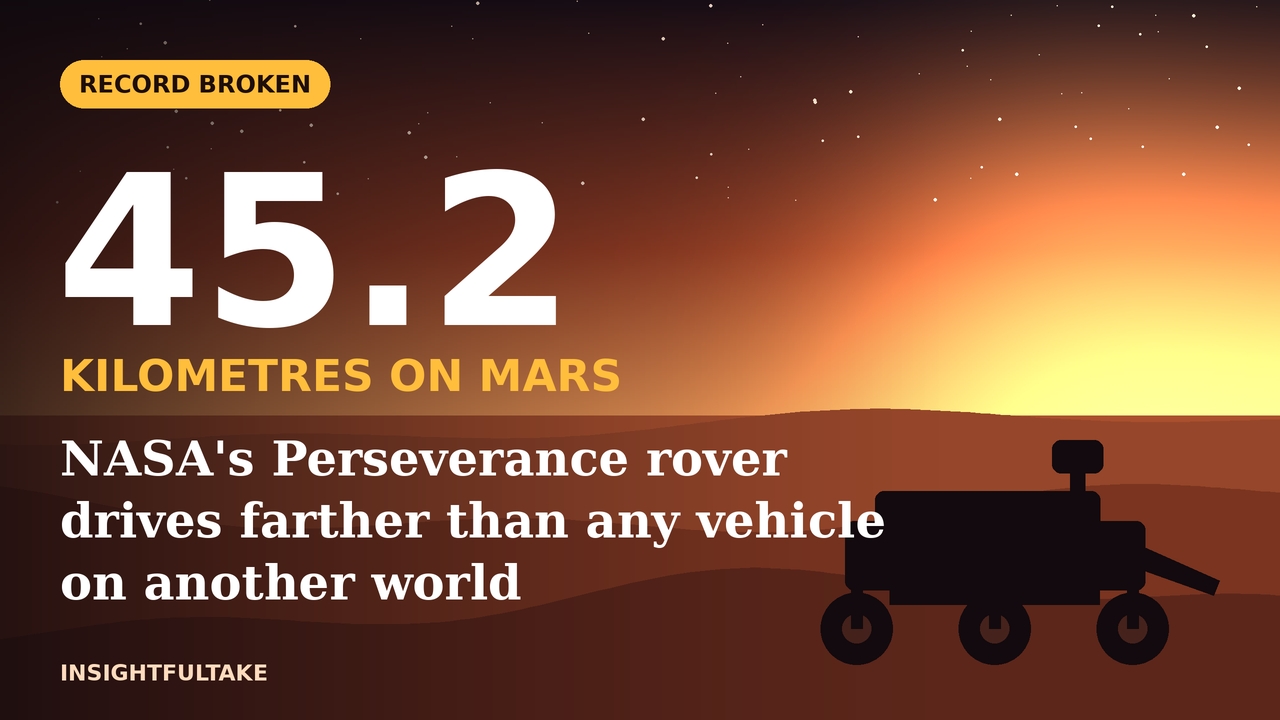
NASA’s car-sized rover has driven 45.2 kilometres on the Red Planet, surpassing a record held by another Mars explorer for more than two decades
No human has ever set foot on Mars. Yet robotic explorers have been travelling across its surface for decades, helping scientists understand the planet’s history and search for signs of life. Now, NASA’s Perseverance rover has reached a new milestone, covering 45.2 kilometres since landing on Mars in February 2021.
The achievement puts Perseverance ahead of every other vehicle to have driven on a world beyond Earth, marking another milestone in robotic space exploration.
A Record That Stood for Years
The previous record belonged to Opportunity, another NASA rover that explored Mars from 2004 until 2018. During its mission, Opportunity travelled approximately 45.16 kilometres, holding the distance record for more than two decades.
Perseverance has now edged past that achievement in roughly five and a half years of operations.
Both Mars rovers have also travelled farther than any rover operated on the Moon. The Soviet Union’s Lunokhod 2, which explored the lunar surface in 1973, covered approximately 39 kilometres.
The record highlights the remarkable progress of robotic exploration. Machines designed to operate millions of kilometres from Earth have demonstrated an ability to travel across unfamiliar terrain for years, often well beyond their original mission expectations.
NASA said Perseverance reached the milestone on a Sunday. The rover landed on Mars on February 18, 2021.
Inside NASA’s Perseverance Rover
Perseverance is a six-wheeled robotic explorer roughly the size of a car. It carries an array of scientific instruments, including cameras, a robotic arm and specialised tools that allow scientists to examine rocks and soil.
Unlike earlier solar-powered Mars rovers, Perseverance relies on a radioisotope power system that generates electricity and heat from the natural decay of plutonium-238. This helps the rover operate through Mars’ cold conditions and periods when sunlight is limited.
Driving on Mars presents challenges that are very different from those faced by drivers on Earth.
Radio signals take several minutes to travel between Earth and Mars, depending on the planets’ positions. Engineers cannot control the rover in real time. Instead, they send instructions in advance, while the rover uses onboard cameras and autonomous navigation software to identify obstacles and plan safe routes.
Every kilometre requires careful planning, reliable engineering and the ability to respond to unexpected terrain.
Why Perseverance Is Exploring Mars
The distance record is impressive, but it is not the mission’s primary objective. Perseverance is exploring Mars to investigate whether the planet once supported microbial life.
Scientists believe Mars was warmer and wetter billions of years ago. Evidence suggests that liquid water once flowed across parts of its surface, forming rivers, lakes and other features that look very different from the cold, dry landscape seen today.
Perseverance landed in Jezero Crater, a location scientists selected because it appears to have hosted an ancient lake and a river delta. On Earth, such environments can preserve evidence of past microbial life, making them valuable places to investigate when searching for signs of ancient organisms.
Since 2021, the rover has been examining rock formations, studying geological layers and looking for chemical and physical clues about the planet’s past.
Its growing travel distance allows scientists to investigate a broader range of terrain and geological features. Different rocks can preserve different records of Mars’ environmental history, helping researchers build a more complete picture of the planet.
However, finding evidence of ancient life remains a scientific challenge. Geological features and chemical signatures must be examined carefully before scientists can determine what they reveal about Mars’ past.
Samples That Could One Day Reach Earth
Perseverance is also collecting samples of Martian rock and regolith, the loose material covering the planet’s surface. The rover stores selected samples in sealed tubes for potential return to Earth through a future sample-return mission.
Bringing these samples home would allow scientists to examine them using advanced laboratory equipment that cannot be carried aboard a rover. Researchers could study their mineral composition, chemical signatures and microscopic features in far greater detail.
Such analysis could help answer questions that robotic instruments alone cannot fully resolve, including whether ancient Mars ever supported microbial life.
However, returning the samples remains a major challenge. A future mission would need to retrieve the stored tubes, launch them from the Martian surface and transport them safely back to Earth. The original sample-return plans have faced technical and budgetary challenges, and a successful return is not guaranteed.
For now, the samples remain on Mars, waiting for a possible journey that could transform our understanding of the planet.
What the Distance Record Really Means
A rover travelling 45.2 kilometres may seem like a modest achievement compared with the distances covered by vehicles on Earth. On Mars, however, the milestone represents years of engineering, navigation and scientific work under harsh conditions.
Perseverance has operated through extreme cold, dust and rugged terrain without the possibility of routine human maintenance. Its continued performance demonstrates the value of designing robotic systems that can function reliably in remote environments.
Opportunity offers an equally striking example. Originally designed for a mission lasting about 90 Martian days, it continued operating for nearly 15 years on Earth before its mission ended in 2018.
Perseverance is building on that legacy while carrying more advanced scientific instruments and pursuing a different set of research goals.
Final Take
Perseverance’s journey is far from over. The rover will continue exploring the Martian landscape, examining rocks, collecting samples and sending scientific data back to Earth.
Every new discovery adds another piece to the puzzle of Mars’ geological history. The distance record is a measure of how far the rover has travelled, but the greater achievement lies in what it may help scientists discover.
Human beings have yet to reach Mars. Until that happens, robotic explorers such as Perseverance will continue to investigate the planet, test technologies and prepare the ground for future missions.
No human has ever set foot on Mars. Yet robotic explorers have been travelling across its surface for decades, helping scientists understand the planet’s history and search for signs of life. Now, NASA’s Perseverance rover has reached a new milestone, covering 45.2 kilometres since landing on Mars in February 2021.
The achievement puts Perseverance ahead of every other vehicle to have driven on a world beyond Earth, marking another milestone in robotic space exploration.
A Record That Stood for Years
The previous record belonged to Opportunity, another NASA rover that explored Mars from 2004 until 2018. During its mission, Opportunity travelled approximately 45.16 kilometres, holding the distance record for more than two decades.
Perseverance has now edged past that achievement in roughly five and a half years of operations.
Both Mars rovers have also travelled farther than any rover operated on the Moon. The Soviet Union’s Lunokhod 2, which explored the lunar surface in 1973, covered approximately 39 kilometres.
The record highlights the remarkable progress of robotic exploration. Machines designed to operate millions of kilometres from Earth have demonstrated an ability to travel across unfamiliar terrain for years, often well beyond their original mission expectations.
NASA said Perseverance reached the milestone on a Sunday. The rover landed on Mars on February 18, 2021.
Inside NASA’s Perseverance Rover
Perseverance is a six-wheeled robotic explorer roughly the size of a car. It carries an array of scientific instruments, including cameras, a robotic arm and specialised tools that allow scientists to examine rocks and soil.
Unlike earlier solar-powered Mars rovers, Perseverance relies on a radioisotope power system that generates electricity and heat from the natural decay of plutonium-238. This helps the rover operate through Mars’ cold conditions and periods when sunlight is limited.
Driving on Mars presents challenges that are very different from those faced by drivers on Earth.
Radio signals take several minutes to travel between Earth and Mars, depending on the planets’ positions. Engineers cannot control the rover in real time. Instead, they send instructions in advance, while the rover uses onboard cameras and autonomous navigation software to identify obstacles and plan safe routes.
Every kilometre requires careful planning, reliable engineering and the ability to respond to unexpected terrain.
Why Perseverance Is Exploring Mars
The distance record is impressive, but it is not the mission’s primary objective. Perseverance is exploring Mars to investigate whether the planet once supported microbial life.
Scientists believe Mars was warmer and wetter billions of years ago. Evidence suggests that liquid water once flowed across parts of its surface, forming rivers, lakes and other features that look very different from the cold, dry landscape seen today.
Perseverance landed in Jezero Crater, a location scientists selected because it appears to have hosted an ancient lake and a river delta. On Earth, such environments can preserve evidence of past microbial life, making them valuable places to investigate when searching for signs of ancient organisms.
Since 2021, the rover has been examining rock formations, studying geological layers and looking for chemical and physical clues about the planet’s past.
Its growing travel distance allows scientists to investigate a broader range of terrain and geological features. Different rocks can preserve different records of Mars’ environmental history, helping researchers build a more complete picture of the planet.
However, finding evidence of ancient life remains a scientific challenge. Geological features and chemical signatures must be examined carefully before scientists can determine what they reveal about Mars’ past.
Samples That Could One Day Reach Earth
Perseverance is also collecting samples of Martian rock and regolith, the loose material covering the planet’s surface. The rover stores selected samples in sealed tubes for potential return to Earth through a future sample-return mission.
Bringing these samples home would allow scientists to examine them using advanced laboratory equipment that cannot be carried aboard a rover. Researchers could study their mineral composition, chemical signatures and microscopic features in far greater detail.
Such analysis could help answer questions that robotic instruments alone cannot fully resolve, including whether ancient Mars ever supported microbial life.
However, returning the samples remains a major challenge. A future mission would need to retrieve the stored tubes, launch them from the Martian surface and transport them safely back to Earth. The original sample-return plans have faced technical and budgetary challenges, and a successful return is not guaranteed.
For now, the samples remain on Mars, waiting for a possible journey that could transform our understanding of the planet.
What the Distance Record Really Means
A rover travelling 45.2 kilometres may seem like a modest achievement compared with the distances covered by vehicles on Earth. On Mars, however, the milestone represents years of engineering, navigation and scientific work under harsh conditions.
Perseverance has operated through extreme cold, dust and rugged terrain without the possibility of routine human maintenance. Its continued performance demonstrates the value of designing robotic systems that can function reliably in remote environments.
Opportunity offers an equally striking example. Originally designed for a mission lasting about 90 Martian days, it continued operating for nearly 15 years on Earth before its mission ended in 2018.
Perseverance is building on that legacy while carrying more advanced scientific instruments and pursuing a different set of research goals.
Final Take
Perseverance’s journey is far from over. The rover will continue exploring the Martian landscape, examining rocks, collecting samples and sending scientific data back to Earth.
Every new discovery adds another piece to the puzzle of Mars’ geological history. The distance record is a measure of how far the rover has travelled, but the greater achievement lies in what it may help scientists discover.
Human beings have yet to reach Mars. Until that happens, robotic explorers such as Perseverance will continue to investigate the planet, test technologies and prepare the ground for future missions.

























Leave a Comment