
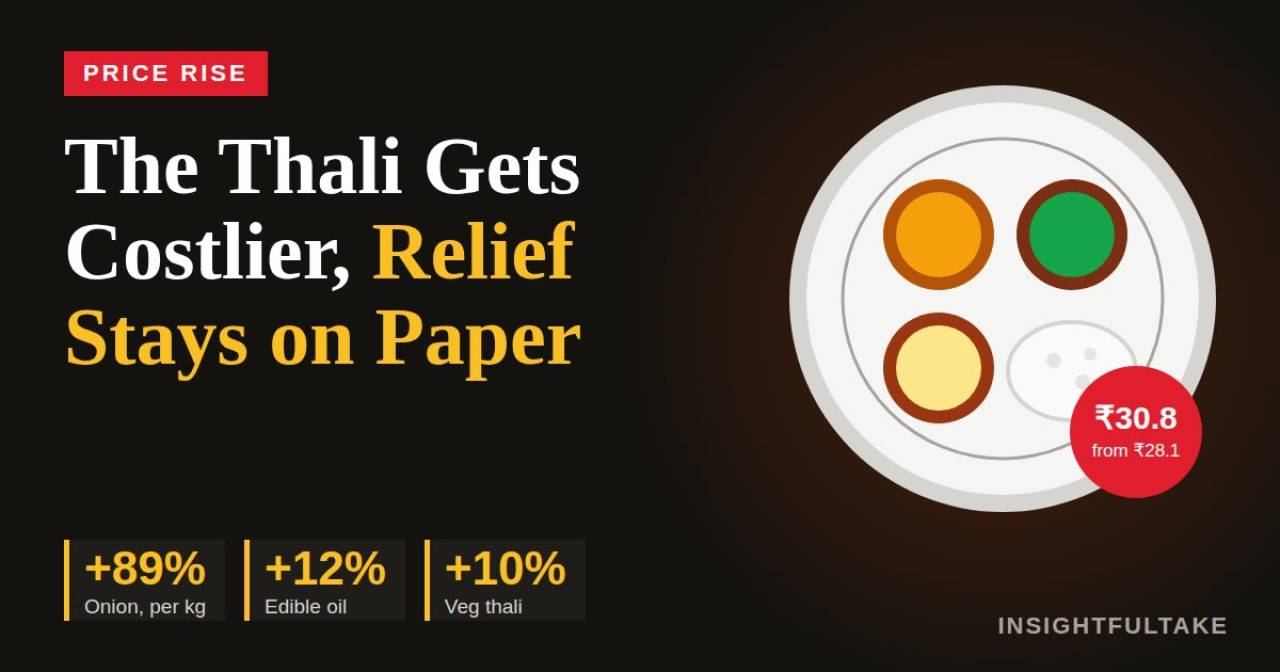
A home-cooked thali now costs 10% more than a year ago. For millions of Indian families, the real crisis is finding room in an already stretched budget.
Every Indian household runs a quiet budget in the kitchen. When onion, cooking oil, rice and cooking gas become more expensive together, nobody needs an economist to explain the problem. The monthly budget simply stops adding up.
The latest Crisil data on the cost of a home-cooked thali shows what families have been experiencing for months. In September, a vegetarian thali cost ₹30.8, up 10% from ₹28.1 a year earlier. A non-vegetarian thali cost ₹59.5, compared with ₹56 a year ago. Even month-on-month, the cost of a vegetarian thali rose 4%, while a non-vegetarian thali became 3% more expensive.
These are not luxury items. This is dal, rice, roti, sabzi and curd. It is the daily meal of a worker, a student, a small shopkeeper and a family that already counts every rupee.
Onion, Again
Onion is the clearest example of the pressure on household budgets. Its price jumped 89% over the previous year, from ₹28 a kg to ₹53. Crisil attributes the surge to tightening rabi stocks and their liquidation. Prices are expected to remain high through the first half of October.
Onion prices have made Indian governments nervous for decades. The pattern is familiar. Stocks run low, prices spike and the government steps in after consumers have already begun feeling the pain. Inadequate storage, supply-chain weaknesses and delays in intervention leave farmers struggling to secure stable returns while consumers pay more.
The question is unavoidable. After so many onion crises, why does the system continue to be caught off guard?
Rice, Pulses and Oil
Rice prices rose 8% in September. Crisil expects paddy production to decline by 5–6% because of lower acreage and weaker yields. For a country where rice is a staple for hundreds of millions of people, this is a serious warning.
Pulses present another concern. Crisil has flagged tur and Bengal gram as vulnerable to supply pressures. During the pre-harvest period, the market depends heavily on imports, while global prices remain firm. Tur imports attract zero duty, whereas Bengal gram faces a 10% import duty.
Edible oil offers an equally troubling example. Vegetable oil prices rose 12% year-on-year despite a reduction in the basic customs duty on crude palm oil. If a duty cut fails to bring prices down, the government must examine whether the benefit is reaching consumers. Tax relief means little to a household if the retail price remains stubbornly high.
Liquefied petroleum gas (LPG) prices are also 10% higher than a year ago. That adds to the burden on almost every household, regardless of what is being cooked.
The Relief That Does Not Arrive
Here lies the central criticism of the government's approach. Responses often come after prices have already climbed. Import duties are adjusted, stock limits are discussed and imports are permitted, only for another vegetable or pulse to emerge as the next source of distress.
The pattern looks more like firefighting than planning.
Crisil's outlook offers little immediate comfort. Its director, Pushan Sharma, has warned that seasonal festive demand and higher input costs could add to the pressure, keeping thali costs elevated in the near term. Tomato prices could strengthen because of delayed kharif arrivals, while potato prices may rise as cold-storage stocks run down.
In other words, further pressure is possible, while a clear plan to protect household budgets remains difficult to see.
The weather has added to the challenge. June rainfall was 40% below the long-period average. Weather risks are neither new nor entirely predictable, but their consequences can be reduced through preparation. A government that sets ambitious economic targets should also ensure adequate buffer stocks, better cold-storage facilities and timely import decisions. These measures need to be ready before supply shortages push prices up, not introduced as a response to an unfolding crisis.
Who Pays the Price?
Rising food prices do not affect everyone equally. A well-off family may complain about higher grocery bills and carry on. A poor household often has no such cushion.
When food becomes more expensive, families begin cutting back. There may be less dal, fewer vegetables and smaller portions. Meals become more dependent on cheaper carbohydrates, while the nutritional value of the household diet suffers.
The damage is often gradual and difficult to measure. Women and children can be particularly vulnerable when families reduce food spending to make ends meet.
Wages, meanwhile, have not necessarily kept pace with the rising cost of living. Many workers in the unorganised sector have limited bargaining power and little scope to increase their earnings quickly. When the cost of a thali rises 10% but household income remains unchanged, the difference has to come from somewhere. It may come out of savings, healthcare spending, education expenses or the quality of food itself.
That is why food inflation cannot be dismissed as a routine economic indicator. It affects how people live, what they eat and how much security they can afford.
What People Are Entitled to Ask
Citizens are not asking the government to control every price or eliminate every market fluctuation. They are asking for basic competence and timely action.
Better storage and logistics: Repeated price swings in onions, potatoes and tomatoes expose weaknesses in storage, transport and supply management. Better infrastructure can reduce losses and soften the impact of sudden shortages.
Earlier decisions on imports: Policies on pulses and edible oils should respond to credible signs of a supply shortfall before prices become unaffordable. Delayed intervention leaves consumers paying the cost of indecision.
Relief that reaches households: The public distribution system can help protect vulnerable families from food inflation. Subsidised staples must remain accessible, reliable and responsive to the needs of low-income households.
Honest communication: Officials should explain the causes of price increases, the limits of government intervention and the steps being taken to ease the burden. Describing inflation as temporary does little for families facing higher bills every week.
These measures will not eliminate every price shock. They can, however, make the difference between a temporary disruption and a prolonged squeeze on household finances.
The Other Side of the Argument
To be fair, the government's defenders have a point. Weather disruptions, global supply pressures and seasonal demand can raise food prices, and no government can control all these factors. The reduction in crude palm oil import duty also shows that some steps have been taken to ease costs.
Officials expect fresh kharif arrivals to improve supply later in the season. Crisil, too, indicates that pressure could ease as new crops reach the market.
But the existence of a possible solution is not the same as relief reaching consumers. The crucial questions are when prices will fall, how much they will decline and whether the improvement will come soon enough to help families already under pressure.
Government policy should be judged not only by the measures announced but also by the results visible in household budgets.
Until then, the thali on the plate is losing value even as its price rises. For millions of Indian families, that is the measure of inflation that matters most. And it is the measure by which the government's response will ultimately be judged.
Every Indian household runs a quiet budget in the kitchen. When onion, cooking oil, rice and cooking gas become more expensive together, nobody needs an economist to explain the problem. The monthly budget simply stops adding up.
The latest Crisil data on the cost of a home-cooked thali shows what families have been experiencing for months. In September, a vegetarian thali cost ₹30.8, up 10% from ₹28.1 a year earlier. A non-vegetarian thali cost ₹59.5, compared with ₹56 a year ago. Even month-on-month, the cost of a vegetarian thali rose 4%, while a non-vegetarian thali became 3% more expensive.
These are not luxury items. This is dal, rice, roti, sabzi and curd. It is the daily meal of a worker, a student, a small shopkeeper and a family that already counts every rupee.
Onion, Again
Onion is the clearest example of the pressure on household budgets. Its price jumped 89% over the previous year, from ₹28 a kg to ₹53. Crisil attributes the surge to tightening rabi stocks and their liquidation. Prices are expected to remain high through the first half of October.
Onion prices have made Indian governments nervous for decades. The pattern is familiar. Stocks run low, prices spike and the government steps in after consumers have already begun feeling the pain. Inadequate storage, supply-chain weaknesses and delays in intervention leave farmers struggling to secure stable returns while consumers pay more.
The question is unavoidable. After so many onion crises, why does the system continue to be caught off guard?
Rice, Pulses and Oil
Rice prices rose 8% in September. Crisil expects paddy production to decline by 5–6% because of lower acreage and weaker yields. For a country where rice is a staple for hundreds of millions of people, this is a serious warning.
Pulses present another concern. Crisil has flagged tur and Bengal gram as vulnerable to supply pressures. During the pre-harvest period, the market depends heavily on imports, while global prices remain firm. Tur imports attract zero duty, whereas Bengal gram faces a 10% import duty.
Edible oil offers an equally troubling example. Vegetable oil prices rose 12% year-on-year despite a reduction in the basic customs duty on crude palm oil. If a duty cut fails to bring prices down, the government must examine whether the benefit is reaching consumers. Tax relief means little to a household if the retail price remains stubbornly high.
Liquefied petroleum gas (LPG) prices are also 10% higher than a year ago. That adds to the burden on almost every household, regardless of what is being cooked.
The Relief That Does Not Arrive
Here lies the central criticism of the government's approach. Responses often come after prices have already climbed. Import duties are adjusted, stock limits are discussed and imports are permitted, only for another vegetable or pulse to emerge as the next source of distress.
The pattern looks more like firefighting than planning.
Crisil's outlook offers little immediate comfort. Its director, Pushan Sharma, has warned that seasonal festive demand and higher input costs could add to the pressure, keeping thali costs elevated in the near term. Tomato prices could strengthen because of delayed kharif arrivals, while potato prices may rise as cold-storage stocks run down.
In other words, further pressure is possible, while a clear plan to protect household budgets remains difficult to see.
The weather has added to the challenge. June rainfall was 40% below the long-period average. Weather risks are neither new nor entirely predictable, but their consequences can be reduced through preparation. A government that sets ambitious economic targets should also ensure adequate buffer stocks, better cold-storage facilities and timely import decisions. These measures need to be ready before supply shortages push prices up, not introduced as a response to an unfolding crisis.
Who Pays the Price?
Rising food prices do not affect everyone equally. A well-off family may complain about higher grocery bills and carry on. A poor household often has no such cushion.
When food becomes more expensive, families begin cutting back. There may be less dal, fewer vegetables and smaller portions. Meals become more dependent on cheaper carbohydrates, while the nutritional value of the household diet suffers.
The damage is often gradual and difficult to measure. Women and children can be particularly vulnerable when families reduce food spending to make ends meet.
Wages, meanwhile, have not necessarily kept pace with the rising cost of living. Many workers in the unorganised sector have limited bargaining power and little scope to increase their earnings quickly. When the cost of a thali rises 10% but household income remains unchanged, the difference has to come from somewhere. It may come out of savings, healthcare spending, education expenses or the quality of food itself.
That is why food inflation cannot be dismissed as a routine economic indicator. It affects how people live, what they eat and how much security they can afford.
What People Are Entitled to Ask
Citizens are not asking the government to control every price or eliminate every market fluctuation. They are asking for basic competence and timely action.
Better storage and logistics: Repeated price swings in onions, potatoes and tomatoes expose weaknesses in storage, transport and supply management. Better infrastructure can reduce losses and soften the impact of sudden shortages.
Earlier decisions on imports: Policies on pulses and edible oils should respond to credible signs of a supply shortfall before prices become unaffordable. Delayed intervention leaves consumers paying the cost of indecision.
Relief that reaches households: The public distribution system can help protect vulnerable families from food inflation. Subsidised staples must remain accessible, reliable and responsive to the needs of low-income households.
Honest communication: Officials should explain the causes of price increases, the limits of government intervention and the steps being taken to ease the burden. Describing inflation as temporary does little for families facing higher bills every week.
These measures will not eliminate every price shock. They can, however, make the difference between a temporary disruption and a prolonged squeeze on household finances.
The Other Side of the Argument
To be fair, the government's defenders have a point. Weather disruptions, global supply pressures and seasonal demand can raise food prices, and no government can control all these factors. The reduction in crude palm oil import duty also shows that some steps have been taken to ease costs.
Officials expect fresh kharif arrivals to improve supply later in the season. Crisil, too, indicates that pressure could ease as new crops reach the market.
But the existence of a possible solution is not the same as relief reaching consumers. The crucial questions are when prices will fall, how much they will decline and whether the improvement will come soon enough to help families already under pressure.
Government policy should be judged not only by the measures announced but also by the results visible in household budgets.
Until then, the thali on the plate is losing value even as its price rises. For millions of Indian families, that is the measure of inflation that matters most. And it is the measure by which the government's response will ultimately be judged.



















Leave a Comment