
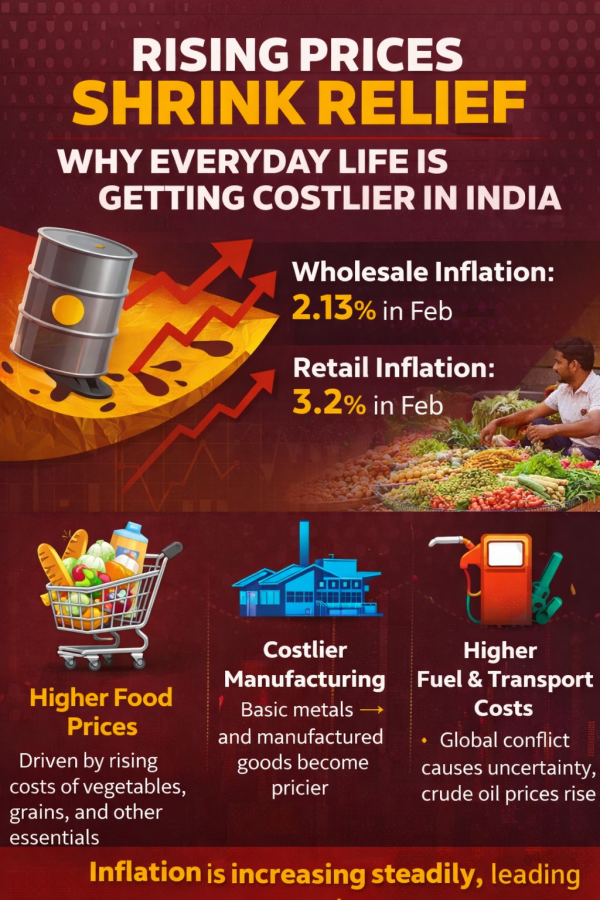
Your grocery bill is rising. Your fuel tank costs more. And slowly, quietly, your monthly budget is shrinking — this is how inflation is tightening its grip on everyday life in India.
India is once again seeing a steady rise in prices. The latest data shows that both wholesale and retail inflation moved up in February. This means that costs are rising at both the production level and the consumer level. For ordinary citizens, this often translates into higher bills for food, transport, and daily essentials.
Wholesale inflation, measured by the Wholesale Price Index (WPI), rose to 2.13% in February. It was 1.81% in January. This rise may look small, but it signals a broader trend. It shows that producers are paying more for raw materials and goods. When producers pay more, they usually pass on the cost to consumers.
The increase in wholesale inflation is mainly due to higher prices in manufacturing and food items. Basic metals like copper, aluminium, zinc, and nickel have become costlier. These metals are widely used in industries. When their prices go up, the cost of many finished goods also rises. This affects sectors like construction, electronics, and automobiles.
Food prices also played a key role in pushing inflation higher. Food inflation at the wholesale level increased as the earlier base effect faded. A base effect happens when past prices were low, making current prices look higher in comparison. As that effect weakens, the real price pressure becomes visible.
At the same time, there was some relief from fuel prices. Fuel and power remained in deflation. This means their prices were lower compared to last year. However, this relief was not strong enough to offset the rise in food and manufacturing costs.
Retail inflation, which reflects the prices that consumers actually pay, also increased. It reached 3.2% in February. It was higher than the previous month. This rise was mainly driven by food prices. Food and beverages carry a large weight in the consumer price index. So even a small increase in food prices can push overall inflation higher.
Vegetables, grains, and other daily food items saw price increases. This directly affects households. Food is a basic need. When food prices rise, people feel the pressure immediately. Lower-income families are hit the hardest because they spend a larger share of their income on food.
Even though retail inflation is still below the Reserve Bank of India’s target of 4%, the trend is important. Inflation had remained below 2% for several months in 2025. The recent rise shows that price pressures are building again.
Another major concern is the global situation. The ongoing conflict in West Asia is creating uncertainty in energy markets. Crude oil prices have started to rise. India depends heavily on imported oil. So any increase in global oil prices affects the domestic economy.
Higher oil prices can lead to higher transport costs. This affects the price of almost everything. Goods need to be transported from farms to markets and from factories to shops. When fuel costs rise, transport becomes more expensive. This cost is then added to the final price paid by consumers.
There is also uncertainty about how oil marketing companies will respond. They may absorb some of the cost increase. This can protect consumers in the short term. However, it can hurt their profits. In the long run, these costs may still be passed on to consumers or covered by government support.
Experts say that the full impact of rising global oil prices is not yet visible in the current inflation data. This means inflation could rise further in the coming months. The longer the global conflict continues, the higher the risk to India’s economy.
Another factor is supply disruption. Global tensions can affect shipping routes and supply chains. This can lead to shortages of key goods. When supply falls and demand stays the same, prices go up. This is basic economics, but its impact is felt strongly in everyday life.
Manufactured products are also becoming slightly more expensive. This includes items like clothes, packaged goods, and household products. Even a small increase in these prices adds to the overall burden on consumers.
The situation is not alarming yet, but it is a warning sign. Inflation is not very high, but it is rising steadily. If food and fuel prices continue to increase, inflation may cross comfortable levels.
For households, this means tighter budgets. People may need to cut back on spending. Savings may also be affected. For businesses, higher input costs can reduce profits. This can slow down investment and growth.
For policymakers, the challenge is to balance growth and inflation. The government may need to manage fuel prices carefully. It may also need to ensure that food supply remains stable. The central bank may watch inflation closely before taking any decision on interest rates.
In simple terms, the cost of living in India is rising again. The increase is gradual, but it is real. Food prices are the biggest driver. Global factors like oil prices are adding to the pressure. The coming months will be crucial in deciding whether this trend continues or stabilizes.
For now, consumers should stay cautious. The economy is showing signs of strain. And for many families, the pinch of rising prices is already being felt.



















Leave a Comment