
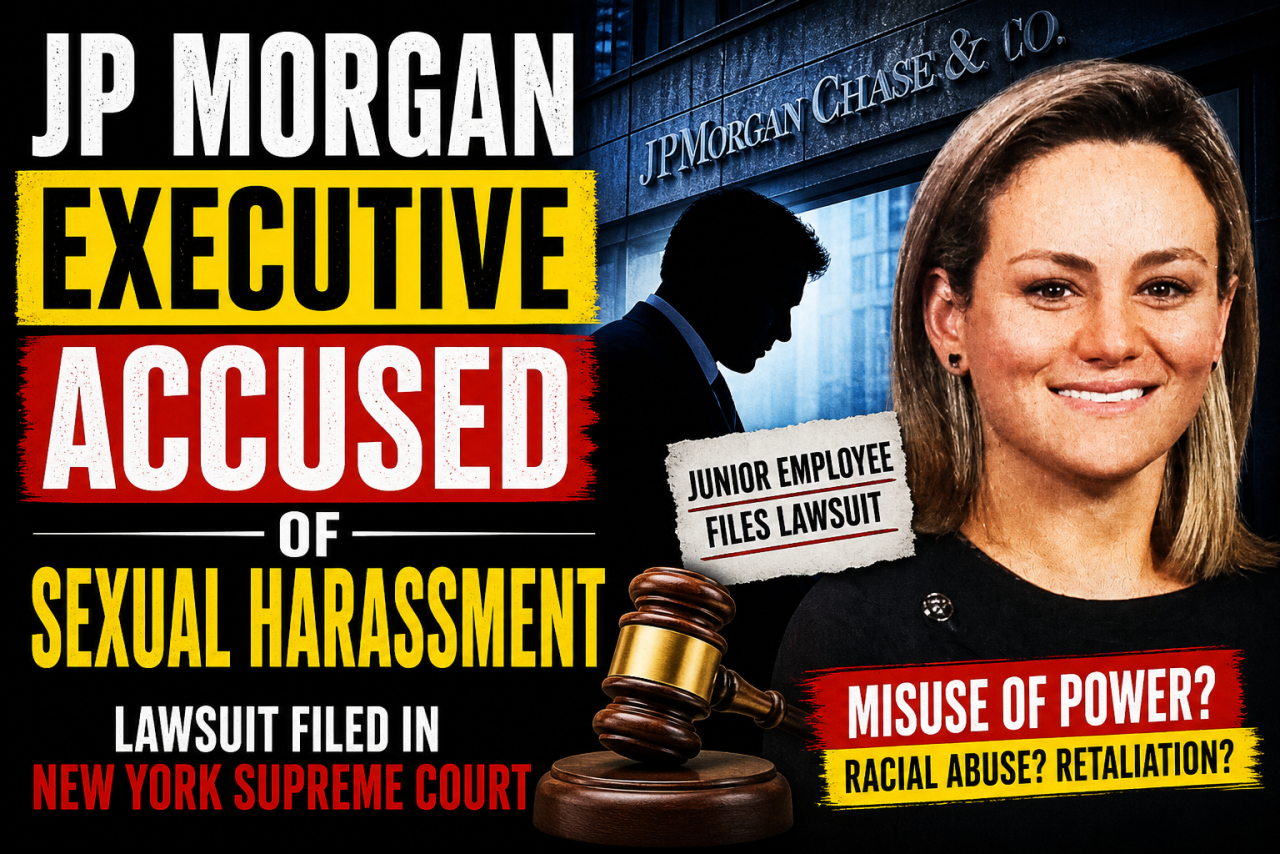
What happens when power crosses the line in one of the world’s biggest banks? A shocking lawsuit against a JP Morgan executive is raising urgent questions.
A lawsuit filed in the New York County Supreme Court has brought serious allegations against a senior executive at JP Morgan Chase, once again placing the spotlight on workplace misconduct, power imbalance, and corporate accountability in global financial institutions.
According to reports, Lorna Hajdini, a 37-year-old executive director in the firm’s leveraged finance division, has been accused of sexually harassing and abusing a junior Indian male employee. The allegations are part of a lawsuit filed by the employee, who has chosen to remain anonymous under the name “John Doe,” citing safety concerns after reportedly receiving threats.
The lawsuit outlines a disturbing pattern of alleged behavior. The complainant claims that Hajdini subjected him to repeated sexual advances and coercion, which escalated into what he describes as “non-consensual and humiliating sex acts.” The complaint further alleges that these incidents occurred despite his clear resistance and repeated requests for the behavior to stop.
Beyond sexual misconduct, the lawsuit also raises concerns of racial abuse and professional intimidation. The employee alleges that he faced racial discrimination and that his career was threatened when he refused Hajdini’s advances. Such claims, if proven, point toward a broader issue of systemic vulnerability faced by junior employees, especially those working far from their home countries in highly competitive corporate environments.
Another serious allegation involves misuse of authority and access. The complainant claims that Hajdini used her executive position to gain unauthorized access to his bank account, allegedly to monitor his activities. While this claim adds a layer of complexity to the case, it underscores concerns about how power within organizations can potentially be exploited beyond professional boundaries.
The timeline presented in the lawsuit indicates that the complainant joined the company as a senior VP/director in March 2024, with Hajdini joining the same team shortly afterward in a senior capacity. The alleged abuse reportedly began soon after they started working together.
In May last year, the employee formally filed a complaint with JP Morgan Chase, detailing allegations of sexual harassment, discrimination, and what he termed a pattern of severe abuse. However, the aftermath of this complaint raises further questions. According to the lawsuit, within days of filing, the complainant was reprimanded, locked out of company systems, and placed on involuntary leave.
This sequence of events, as described in the filing, could suggest potential retaliation—an issue that has increasingly come under scrutiny in corporate whistleblower and harassment cases worldwide.
JP Morgan Chase, however, has strongly denied the allegations. A company spokesperson stated that an internal investigation found no merit in the claims. This response reflects a common tension in such cases, where internal reviews often clash with external legal proceedings, leaving the truth to be determined through judicial processes.
The case is particularly significant because it challenges conventional narratives around workplace harassment, which often focus on male perpetrators and female victims. Here, the gender dynamic is reversed, highlighting that abuse of power is not confined to any one gender and that workplace protections must be inclusive and unbiased.
More broadly, the lawsuit raises pressing questions about how multinational corporations handle sensitive complaints, especially those involving cross-cultural dynamics and hierarchical power structures. For employees working in high-pressure environments like global finance, the fear of retaliation or career damage can often discourage reporting, making robust and transparent grievance mechanisms essential.
As the case unfolds in court, it will not only determine the fate of those directly involved but may also influence how corporations reassess their policies on workplace conduct, internal investigations, and employee protection.
In an era where corporate ethics are under increasing scrutiny, this lawsuit serves as a stark reminder: policies alone are not enough—accountability and trust are what ultimately define a safe and equitable workplace.
A lawsuit filed in the New York County Supreme Court has brought serious allegations against a senior executive at JP Morgan Chase, once again placing the spotlight on workplace misconduct, power imbalance, and corporate accountability in global financial institutions.
According to reports, Lorna Hajdini, a 37-year-old executive director in the firm’s leveraged finance division, has been accused of sexually harassing and abusing a junior Indian male employee. The allegations are part of a lawsuit filed by the employee, who has chosen to remain anonymous under the name “John Doe,” citing safety concerns after reportedly receiving threats.
The lawsuit outlines a disturbing pattern of alleged behavior. The complainant claims that Hajdini subjected him to repeated sexual advances and coercion, which escalated into what he describes as “non-consensual and humiliating sex acts.” The complaint further alleges that these incidents occurred despite his clear resistance and repeated requests for the behavior to stop.
Beyond sexual misconduct, the lawsuit also raises concerns of racial abuse and professional intimidation. The employee alleges that he faced racial discrimination and that his career was threatened when he refused Hajdini’s advances. Such claims, if proven, point toward a broader issue of systemic vulnerability faced by junior employees, especially those working far from their home countries in highly competitive corporate environments.
Another serious allegation involves misuse of authority and access. The complainant claims that Hajdini used her executive position to gain unauthorized access to his bank account, allegedly to monitor his activities. While this claim adds a layer of complexity to the case, it underscores concerns about how power within organizations can potentially be exploited beyond professional boundaries.
The timeline presented in the lawsuit indicates that the complainant joined the company as a senior VP/director in March 2024, with Hajdini joining the same team shortly afterward in a senior capacity. The alleged abuse reportedly began soon after they started working together.
In May last year, the employee formally filed a complaint with JP Morgan Chase, detailing allegations of sexual harassment, discrimination, and what he termed a pattern of severe abuse. However, the aftermath of this complaint raises further questions. According to the lawsuit, within days of filing, the complainant was reprimanded, locked out of company systems, and placed on involuntary leave.
This sequence of events, as described in the filing, could suggest potential retaliation—an issue that has increasingly come under scrutiny in corporate whistleblower and harassment cases worldwide.
JP Morgan Chase, however, has strongly denied the allegations. A company spokesperson stated that an internal investigation found no merit in the claims. This response reflects a common tension in such cases, where internal reviews often clash with external legal proceedings, leaving the truth to be determined through judicial processes.
The case is particularly significant because it challenges conventional narratives around workplace harassment, which often focus on male perpetrators and female victims. Here, the gender dynamic is reversed, highlighting that abuse of power is not confined to any one gender and that workplace protections must be inclusive and unbiased.
More broadly, the lawsuit raises pressing questions about how multinational corporations handle sensitive complaints, especially those involving cross-cultural dynamics and hierarchical power structures. For employees working in high-pressure environments like global finance, the fear of retaliation or career damage can often discourage reporting, making robust and transparent grievance mechanisms essential.
As the case unfolds in court, it will not only determine the fate of those directly involved but may also influence how corporations reassess their policies on workplace conduct, internal investigations, and employee protection.
In an era where corporate ethics are under increasing scrutiny, this lawsuit serves as a stark reminder: policies alone are not enough—accountability and trust are what ultimately define a safe and equitable workplace.

.jpeg)


















Leave a Comment