
What happens when worker welfare becomes a strategy for economic growth? Uttar Pradesh’s latest Labour Day projects may offer a new answer.
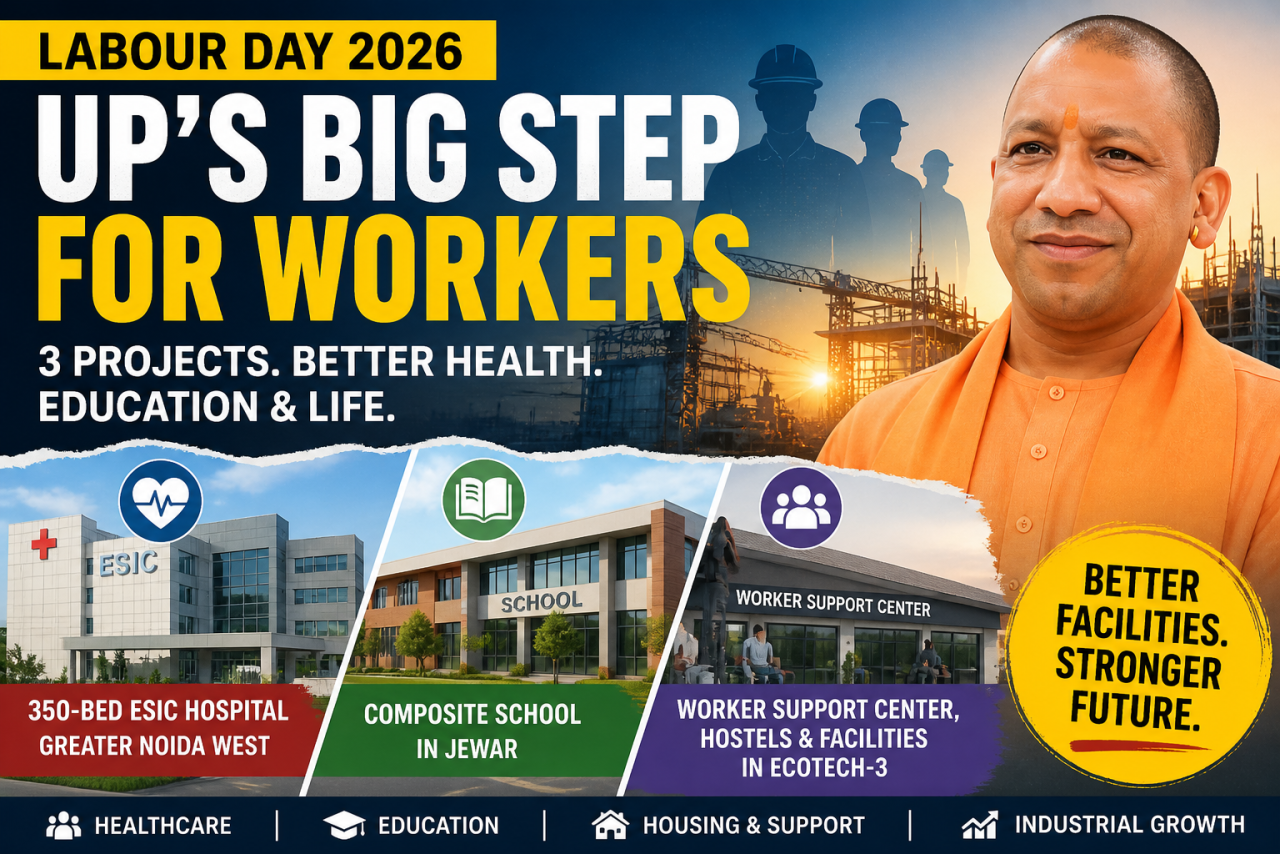
On Labour Day, Uttar Pradesh Chief Minister Yogi Adityanath announced three major projects aimed at improving the lives of workers in Greater Noida and nearby regions. These include a new ESIC hospital, a composite school, and a worker support center. While such announcements are often seen as routine government initiatives, a deeper look suggests that this move could reflect a broader change in how industrial growth and worker welfare are being connected in rapidly developing regions.
The first project, a 350-bed ESIC hospital in Greater Noida West, directly addresses a major issue faced by industrial workers: access to affordable healthcare. Workers in industrial zones often depend on private hospitals, which are costly, or distant government facilities that may not meet their needs. By setting up a dedicated hospital close to workplaces, the government aims to reduce both financial pressure and health risks. This is not only beneficial for workers but also for industries, as a healthier workforce leads to higher productivity and fewer disruptions.
The second project, a Mukhyamantri Composite School in Jewar, focuses on the education of workers’ children. For many labour families, especially those who migrate from rural areas, providing continuous and quality education is a challenge. Frequent relocation, financial constraints, and lack of access to good schools often affect children's learning. By building a modern school with improved facilities, the government is attempting to ensure that the next generation has better opportunities. This shows an understanding that worker welfare goes beyond wages and includes long-term social mobility.
The third initiative, a worker support center in Ecotech-3, is designed to offer essential services and assistance to labourers. These centers are expected to help workers access government schemes, complete documentation, and receive basic support. In addition, there are plans to build hostels, affordable canteens, and housing facilities near industrial areas. Such measures could significantly improve daily life for workers by reducing long commutes and providing better living conditions.
The timing of these projects is important. They come after recent labour unrest in certain parts of the state, where workers raised concerns about wages and working conditions. In this context, the announcements can be seen as more than symbolic gestures. They suggest an attempt to address deeper structural issues rather than just offering short-term solutions. This indicates a shift toward more planned and long-term thinking in labour policy.
However, the key question remains whether these projects will be implemented effectively. In India, many well-planned initiatives face delays, lack of maintenance, or poor execution. The success of these projects will depend on how quickly they are completed, how well they are managed, and whether workers can easily access their benefits. Without proper execution, even the best ideas may fail to create real change.
Another important factor is the role of private companies. If these projects lead to improved worker satisfaction and productivity, industries may be encouraged to invest more in employee welfare. This could create a positive cycle where both the government and private sector work together to improve working conditions. Such cooperation is essential for sustainable industrial growth.
There is also an economic perspective to consider. Areas like Greater Noida are competing to attract investments and expand industrial activity. Providing better facilities for workers makes these regions more attractive to companies. A stable and supported workforce is a major advantage for any industrial hub. In this way, worker welfare becomes part of a larger economic strategy rather than just a social responsibility.
At the same time, it is important to recognize the limitations of these initiatives. While infrastructure and support services are valuable, they cannot replace the need for fair wages, job security, and safe working environments. Strong policies and strict enforcement are still necessary to protect workers' rights. Welfare projects can support workers, but they cannot solve all challenges on their own.
In conclusion, the three projects announced on Labour Day represent more than just new infrastructure. They reflect an effort to connect worker welfare with industrial development and long-term economic planning. If implemented properly, they could bring meaningful change and set an example for other states. However, their real success will depend on execution and the actual impact on workers' everyday lives.
On Labour Day, Uttar Pradesh Chief Minister Yogi Adityanath announced three major projects aimed at improving the lives of workers in Greater Noida and nearby regions. These include a new ESIC hospital, a composite school, and a worker support center. While such announcements are often seen as routine government initiatives, a deeper look suggests that this move could reflect a broader change in how industrial growth and worker welfare are being connected in rapidly developing regions.
The first project, a 350-bed ESIC hospital in Greater Noida West, directly addresses a major issue faced by industrial workers: access to affordable healthcare. Workers in industrial zones often depend on private hospitals, which are costly, or distant government facilities that may not meet their needs. By setting up a dedicated hospital close to workplaces, the government aims to reduce both financial pressure and health risks. This is not only beneficial for workers but also for industries, as a healthier workforce leads to higher productivity and fewer disruptions.
The second project, a Mukhyamantri Composite School in Jewar, focuses on the education of workers’ children. For many labour families, especially those who migrate from rural areas, providing continuous and quality education is a challenge. Frequent relocation, financial constraints, and lack of access to good schools often affect children's learning. By building a modern school with improved facilities, the government is attempting to ensure that the next generation has better opportunities. This shows an understanding that worker welfare goes beyond wages and includes long-term social mobility.
The third initiative, a worker support center in Ecotech-3, is designed to offer essential services and assistance to labourers. These centers are expected to help workers access government schemes, complete documentation, and receive basic support. In addition, there are plans to build hostels, affordable canteens, and housing facilities near industrial areas. Such measures could significantly improve daily life for workers by reducing long commutes and providing better living conditions.
The timing of these projects is important. They come after recent labour unrest in certain parts of the state, where workers raised concerns about wages and working conditions. In this context, the announcements can be seen as more than symbolic gestures. They suggest an attempt to address deeper structural issues rather than just offering short-term solutions. This indicates a shift toward more planned and long-term thinking in labour policy.
However, the key question remains whether these projects will be implemented effectively. In India, many well-planned initiatives face delays, lack of maintenance, or poor execution. The success of these projects will depend on how quickly they are completed, how well they are managed, and whether workers can easily access their benefits. Without proper execution, even the best ideas may fail to create real change.
Another important factor is the role of private companies. If these projects lead to improved worker satisfaction and productivity, industries may be encouraged to invest more in employee welfare. This could create a positive cycle where both the government and private sector work together to improve working conditions. Such cooperation is essential for sustainable industrial growth.
There is also an economic perspective to consider. Areas like Greater Noida are competing to attract investments and expand industrial activity. Providing better facilities for workers makes these regions more attractive to companies. A stable and supported workforce is a major advantage for any industrial hub. In this way, worker welfare becomes part of a larger economic strategy rather than just a social responsibility.
At the same time, it is important to recognize the limitations of these initiatives. While infrastructure and support services are valuable, they cannot replace the need for fair wages, job security, and safe working environments. Strong policies and strict enforcement are still necessary to protect workers' rights. Welfare projects can support workers, but they cannot solve all challenges on their own.
In conclusion, the three projects announced on Labour Day represent more than just new infrastructure. They reflect an effort to connect worker welfare with industrial development and long-term economic planning. If implemented properly, they could bring meaningful change and set an example for other states. However, their real success will depend on execution and the actual impact on workers' everyday lives.



















Leave a Comment