
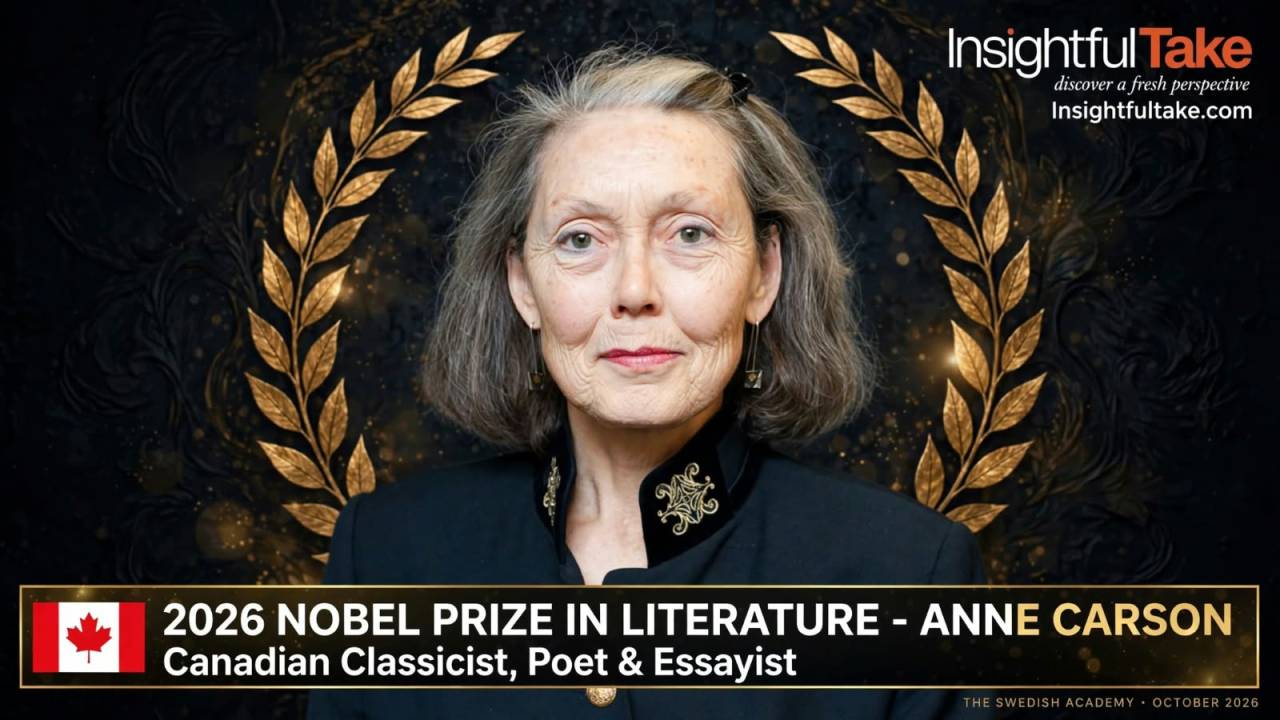
Anne Carson has won the 2026 Nobel Prize in Literature, bringing experimental writing and ancient Greek classics into the global spotlight.
The Swedish Academy has awarded the 2026 Nobel Prize in Literature to Canadian classicist, poet and essayist Anne Carson. In its citation, the Academy praised Carson “for her bold and inventive oeuvre that, in playful dialogue with the classical tradition, has created new forms for contemporary literature.”
The announcement marks an important moment in contemporary literature. Carson, the 19th woman to receive the prize and only the second Canadian laureate after Alice Munro, has spent decades challenging conventional ideas about what literature can be. Her work brings together classical scholarship, poetry, translation, essays and experimental storytelling in ways that have influenced writers around the world.
A Scholar Who Made Ancient Texts Feel New
Born in Toronto in 1950, Carson’s literary journey began with the study of ancient Greek language and literature. She taught at institutions including McGill University, the University of Michigan and New York University, immersing herself in the works of Homer, Sappho, Euripides and Thucydides.
But Carson did more than interpret classical texts. She treated them as living conversations that could illuminate modern questions about love, memory, grief and identity.
Her early work, Eros the Bittersweet (1986), explored ancient Greek ideas of desire through a blend of literary criticism, philosophy and poetic prose. The book established a style that would define her career: combining rigorous scholarship with imaginative writing to bridge the distance between the ancient and the modern world.
Breaking Literary Boundaries
Anne Carson’s work is difficult to place within a single category. She writes poetry, criticism, translations and essays, often blending them into entirely new forms.
Her best-known book, Autobiography of Red (1998), is described as a novel in verse. Inspired by fragments from the ancient poet Stesichorus, it reimagines the mythological figures Herakles and Geryon as contemporary characters in a deeply human story about love, desire and loss.
Carson’s experiments with form extend far beyond conventional books.
In Nox (2010), written after the death of her estranged brother, she created an accordion-style work presented in a box. The project combined photographs, collages, translations and personal reflections, turning grief into an archive rather than a straightforward narrative.
Her translations of Greek tragedies by Euripides, Sophocles and Aeschylus are equally distinctive. Carson avoids overly formal language and instead uses direct, contemporary expression to recover the emotional force and urgency of the original texts.
Books such as Men in the Off Hours and Wrong Norma move freely between poetry, essays, dramatic fragments and reflections on art, demonstrating her willingness to experiment with literary form.
Speaking about her creative process, Carson once remarked, “There is a restlessness. There are a lot of forms to try.”
Why This Nobel Prize Matters
The Swedish Academy’s choice reflects a broader shift in modern literature, where the boundaries between criticism, poetry, translation and storytelling are becoming increasingly fluid.
Carson’s work suggests that literature does not have to fit neatly into established categories. It can combine scholarship with imagination, the ancient with the contemporary, and intellectual inquiry with emotional depth.
At a time when much popular writing favours realism and autobiography, Carson reminds readers that experimentation can also reveal profound truths about human experience. Her work explores universal themes such as desire, time, language, memory and loss, while continually asking how stories themselves can be reshaped.
According to reports, Carson received the news of the Nobel Prize while in Iceland and responded with characteristic simplicity, saying she was “listening to the wind.”
For readers across the world, Anne Carson’s Nobel Prize is more than a recognition of an individual writer. It is also an acknowledgment that literature remains a space for innovation, curiosity and new ways of understanding both the past and the present.
The Swedish Academy has awarded the 2026 Nobel Prize in Literature to Canadian classicist, poet and essayist Anne Carson. In its citation, the Academy praised Carson “for her bold and inventive oeuvre that, in playful dialogue with the classical tradition, has created new forms for contemporary literature.”
The announcement marks an important moment in contemporary literature. Carson, the 19th woman to receive the prize and only the second Canadian laureate after Alice Munro, has spent decades challenging conventional ideas about what literature can be. Her work brings together classical scholarship, poetry, translation, essays and experimental storytelling in ways that have influenced writers around the world.
A Scholar Who Made Ancient Texts Feel New
Born in Toronto in 1950, Carson’s literary journey began with the study of ancient Greek language and literature. She taught at institutions including McGill University, the University of Michigan and New York University, immersing herself in the works of Homer, Sappho, Euripides and Thucydides.
But Carson did more than interpret classical texts. She treated them as living conversations that could illuminate modern questions about love, memory, grief and identity.
Her early work, Eros the Bittersweet (1986), explored ancient Greek ideas of desire through a blend of literary criticism, philosophy and poetic prose. The book established a style that would define her career: combining rigorous scholarship with imaginative writing to bridge the distance between the ancient and the modern world.
Breaking Literary Boundaries
Anne Carson’s work is difficult to place within a single category. She writes poetry, criticism, translations and essays, often blending them into entirely new forms.
Her best-known book, Autobiography of Red (1998), is described as a novel in verse. Inspired by fragments from the ancient poet Stesichorus, it reimagines the mythological figures Herakles and Geryon as contemporary characters in a deeply human story about love, desire and loss.
Carson’s experiments with form extend far beyond conventional books.
In Nox (2010), written after the death of her estranged brother, she created an accordion-style work presented in a box. The project combined photographs, collages, translations and personal reflections, turning grief into an archive rather than a straightforward narrative.
Her translations of Greek tragedies by Euripides, Sophocles and Aeschylus are equally distinctive. Carson avoids overly formal language and instead uses direct, contemporary expression to recover the emotional force and urgency of the original texts.
Books such as Men in the Off Hours and Wrong Norma move freely between poetry, essays, dramatic fragments and reflections on art, demonstrating her willingness to experiment with literary form.
Speaking about her creative process, Carson once remarked, “There is a restlessness. There are a lot of forms to try.”
Why This Nobel Prize Matters
The Swedish Academy’s choice reflects a broader shift in modern literature, where the boundaries between criticism, poetry, translation and storytelling are becoming increasingly fluid.
Carson’s work suggests that literature does not have to fit neatly into established categories. It can combine scholarship with imagination, the ancient with the contemporary, and intellectual inquiry with emotional depth.
At a time when much popular writing favours realism and autobiography, Carson reminds readers that experimentation can also reveal profound truths about human experience. Her work explores universal themes such as desire, time, language, memory and loss, while continually asking how stories themselves can be reshaped.
According to reports, Carson received the news of the Nobel Prize while in Iceland and responded with characteristic simplicity, saying she was “listening to the wind.”
For readers across the world, Anne Carson’s Nobel Prize is more than a recognition of an individual writer. It is also an acknowledgment that literature remains a space for innovation, curiosity and new ways of understanding both the past and the present.




























Leave a Comment