
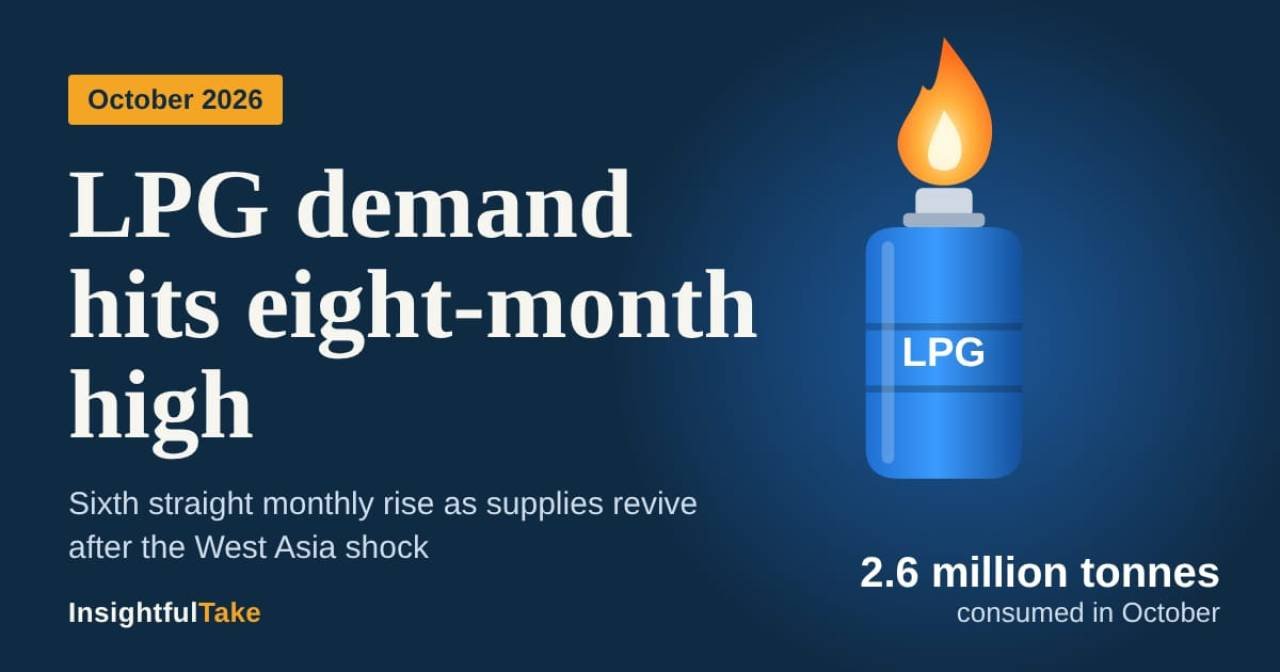
US, Algeria and Angola shipments help restore supplies as India's cooking gas consumption reaches 2.6 million tonnes in October
India's liquefied petroleum gas (LPG) consumption reached 2.6 million tonnes in October, its highest level in eight months, signalling a steady recovery in cooking gas supplies after disruptions caused by the West Asia conflict. Two officials from oil marketing companies expect the upward trend to continue through November, December and January as supply conditions improve.
Data from the Petroleum Planning and Analysis Cell (PPAC) show that October marked the sixth consecutive month of growth in LPG consumption. The last time India recorded higher consumption was in February, when demand stood at 2.8 million tonnes, shortly before the conflict disrupted energy shipments from West Asia.
The latest figures suggest that India is approaching its pre-conflict consumption levels, although the recovery is not yet complete. More importantly, the country has begun reshaping its LPG import strategy by turning to suppliers outside its traditional Gulf market.
Why India's LPG Supply Chain Was Vulnerable
India's dependence on West Asian suppliers exposed its cooking gas market to disruptions in international shipping routes.
Before the US-Iran conflict, more than 90 per cent of India's LPG imports originated from West Asia, according to commodity tracking firm Kpler. The slowdown in shipping through the Strait of Hormuz severely affected this supply network, leaving Indian buyers with limited alternatives.
India is the world's second-largest consumer of LPG for domestic cooking and imports up to 65 per cent of its annual requirement. Any disruption in international supplies can therefore affect millions of households.
The scale of this dependence is evident from the country's consumer base. By the end of August, India had approximately 330 million domestic LPG consumers, according to PPAC data. For a large proportion of these households, cooking gas remains the primary source of fuel.
A prolonged supply disruption can translate into delayed cylinder deliveries, uncertainty over refills and additional pressure on household budgets.
India Turns to the US, Algeria and Angola
The most significant development in recent months has been the diversification of India's LPG import sources.
Indian buyers increased purchases from the United States and Algeria to compensate for reduced shipments from traditional West Asian suppliers. Angola has also emerged as another regular source of imports.
The United States now accounts for more than half of the LPG arriving in India, according to the available commodity-tracking data.
This represents a major shift in India's energy procurement strategy. A country that previously sourced almost nine out of every ten imported LPG cargoes from one region is now building a wider international supply network.
Diversification does not eliminate the risks associated with global energy markets. However, it reduces the possibility that a disruption in one geographical region or shipping corridor will affect the entire supply chain.
The shift also reflects India's growing need to balance energy security with the availability and cost of international supplies.
Demand Recovery Expected to Continue
Officials from oil marketing companies expect LPG consumption to increase further over the coming months as supplies return to normal.
An executive of an oil marketing company indicated that the recovery was gaining momentum, although restoring consumption fully to pre-conflict levels could take additional time.
Kpler's assessment also points towards a recovery in Indian LPG demand during the final quarter of 2026. Festival-season consumption and higher imports are expected to support the improvement.
However, the annual outlook remains more cautious.
Kpler projects that India's LPG demand in 2026 will remain approximately 100,000 barrels per day below its 2025 level. For 2027, the firm expects demand to increase by around 60,000 barrels per day.
These projections indicate that the recent improvement in consumption does not immediately compensate for the losses recorded during the disruption. The market is recovering, but a complete return to its earlier trajectory will require sustained supply stability.
Higher Import Costs Remain a Concern
Although alternative suppliers have helped India restore supplies, the new import pattern also brings logistical and financial challenges.
LPG shipments from the United States and Algeria generally travel longer distances than cargoes originating in the Gulf. Longer shipping routes can increase freight expenses and expose importers to additional transportation delays.
These factors could affect the overall cost of procurement, particularly if international shipping rates rise or geopolitical tensions disrupt major maritime routes.
For India, the challenge will be to maintain a diversified supplier network without allowing higher transportation and import costs to place additional pressure on the domestic energy market.
Queries sent to Indian Oil Corporation, Bharat Petroleum and Hindustan Petroleum remained unanswered at the time of publication. Their latest assessment of supply availability and inventory positions was therefore not available.
What the Recovery Means for Indian Households
The improvement in LPG consumption is encouraging, but the real test will be whether households experience a corresponding improvement in cylinder availability.
For millions of families, reliable access to cooking gas is an essential part of daily life. Even a temporary disruption can affect household routines, particularly in areas where alternative cooking fuels are either expensive or difficult to access.
The next three months will be important. Winter consumption, weddings and seasonal activities are likely to keep demand elevated. The ability of oil marketing companies to maintain adequate stocks and ensure timely cylinder deliveries will determine whether the recovery reaches consumers.
India's experience also highlights the importance of reducing excessive dependence on a single geographical source for essential energy supplies.
The October consumption figures offer a measure of relief after months of uncertainty. Imports are recovering, alternative suppliers are strengthening their presence, and the country's dependence on West Asia is gradually declining.
However, lasting energy security will require more than emergency purchases from alternative markets. India will need a stable and commercially viable import strategy that combines supplier diversification, efficient logistics and reliable domestic distribution.
The recovery in LPG consumption is a positive sign. Its long-term value will depend on whether India can turn the lessons of the West Asia crisis into a more resilient cooking gas supply network.


















Leave a Comment