
India has long invested in oil and gas projects in other countries as part of its energy security strategy. Indian companies hold stakes in producing fields as well as projects that are still under exploration or development.
But production from these overseas assets has been falling.
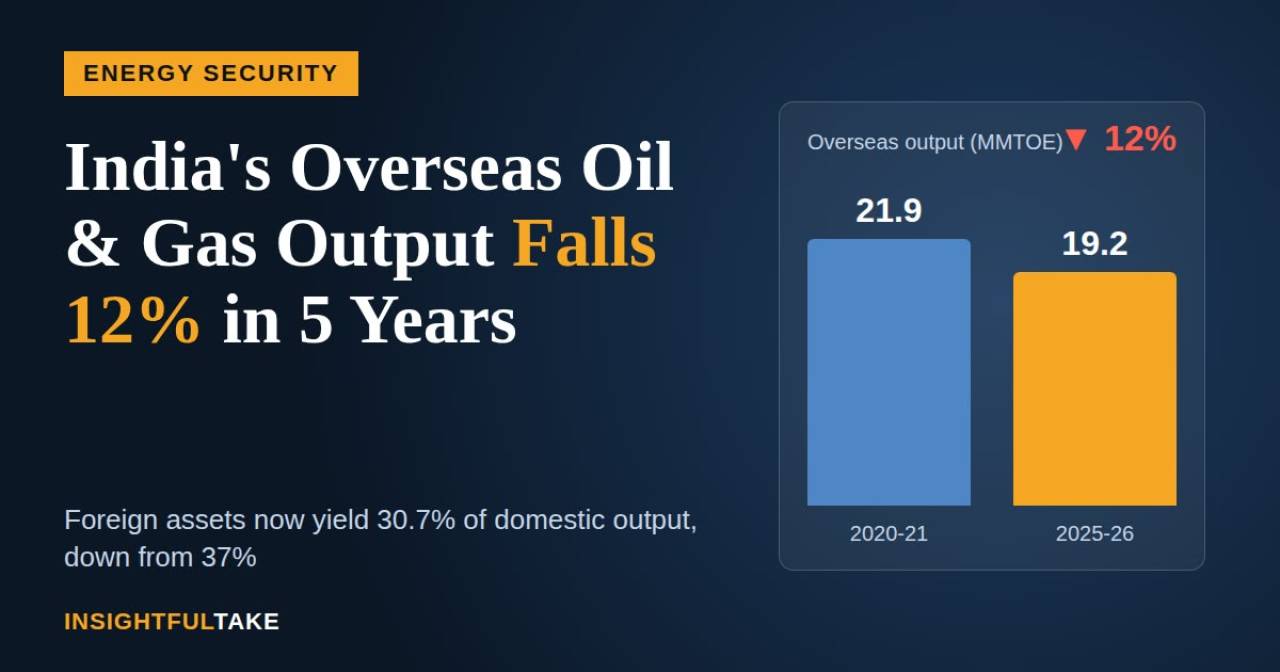
Government data shows that oil and gas production from Indian-owned overseas assets declined from 21.9 million metric tonnes of oil equivalent (MMTOE) in 2020-21 to 19.2 MMTOE in 2025-26. That is a fall of more than 12 percent in five years.
During the same period, India's domestic oil and gas production increased from 59.2 MMTOE to 62.7 MMTOE.
The change has reduced the contribution of overseas assets to India's overall production. In 2020-21, overseas production was about 37 percent of domestic production. By 2025-26, it had fallen to about 30.7 percent.
The decline has also continued into the latest year. Overseas production was around 20.2 MMTOE in 2024-25 before falling to 19.2 MMTOE in 2025-26.
India's overseas energy portfolio is spread across a large number of countries. State-run oil and gas companies currently have interests in 45 assets across 21 countries. Twenty-one of these assets are producing, while 14 are under exploration and seven are under development. Three are pipeline projects.
ONGC Videsh Ltd (OVL), the overseas arm of Oil and Natural Gas Corporation, has the largest presence among Indian state-owned energy companies. Indian Oil Corporation, Bharat Petroleum Corporation, Oil India and GAIL India also have overseas investments.
Indian companies have interests in projects in countries such as Azerbaijan, Brazil, Canada, Colombia, Iraq, Mozambique, Nigeria, Russia, the UAE, the United States, Venezuela and Vietnam.
The spread across countries is large, but production is not evenly distributed across these assets. A few major projects account for a substantial part of the output.
OVL's performance gives an indication of the problem. According to the company's annual report for 2025-26, its oil and gas production fell by about 6 percent during the year, from 10.28 MMTOE to 9.67 MMTOE.
OVL has 30 assets in 14 countries across five continents. Its Russian projects, including Vankor and Sakhalin-I, have been important sources of production. Geopolitical developments and other disruptions affected production during the year, according to industry experts.
This also shows why having assets in many countries does not automatically protect production. If a large share of output comes from a few major projects, problems at those projects can affect the overall numbers.
OVL did not respond to emailed questions about the fall in production.
The decline comes at a time when India remains heavily dependent on imported energy. The country imports more than 88 percent of its crude oil requirement and about half of its natural gas requirement.
This makes overseas production important for more than just the financial returns of Indian companies. Oil and gas produced from projects in which Indian companies have a stake can provide an additional source of supply outside India's own borders.
The issue has also been raised by Parliament's Committee on Estimates. In a recent report on the supply and distribution of natural gas and the challenges facing the sector, the committee said that overseas investment in oil and gas assets is important for India's energy security because the country is a net importer.
The committee also recommended fresh investment in overseas oil and gas assets, including pipeline projects in different countries.
At the same time, India's domestic production has improved. Oil and gas output within the country increased from 59.2 MMTOE in 2020-21 to 62.7 MMTOE in 2025-26.
That is a positive development, but it does not remove India's dependence on imports. The increase in domestic production has happened alongside a fall in overseas production.
For India, the bigger challenge is therefore to increase production at home while ensuring that its overseas investments remain productive.
There are financial and geopolitical risks involved. Overseas oil and gas projects require large investments and often take years to produce returns. Companies also have to deal with political instability, sanctions, changes in regulations and conflicts in producing countries.
Russia is one example of how geopolitical conditions can affect an overseas energy portfolio. Other projects can face different risks, including delays, cost increases and difficulties in developing new fields.
At the same time, reducing overseas investment would also have consequences. Indian companies would have fewer opportunities to secure oil and gas production outside the country.
The next few years will therefore be important for India's overseas energy strategy. Fourteen assets are still under exploration and seven are under development. If these projects begin production, they could add to India's overseas output.
But simply adding more assets will not be enough. The existing projects also need to produce consistently, while the dependence on a small number of major fields needs to be reduced.
India's overseas oil and gas portfolio remains large, but its output has declined over the past five years. With the country still importing most of its crude oil, the performance of these assets will remain an important part of the energy security debate.
The question is no longer only how many oil and gas assets Indian companies own abroad. It is also how much those assets can actually produce.



.jpeg)






















Leave a Comment