
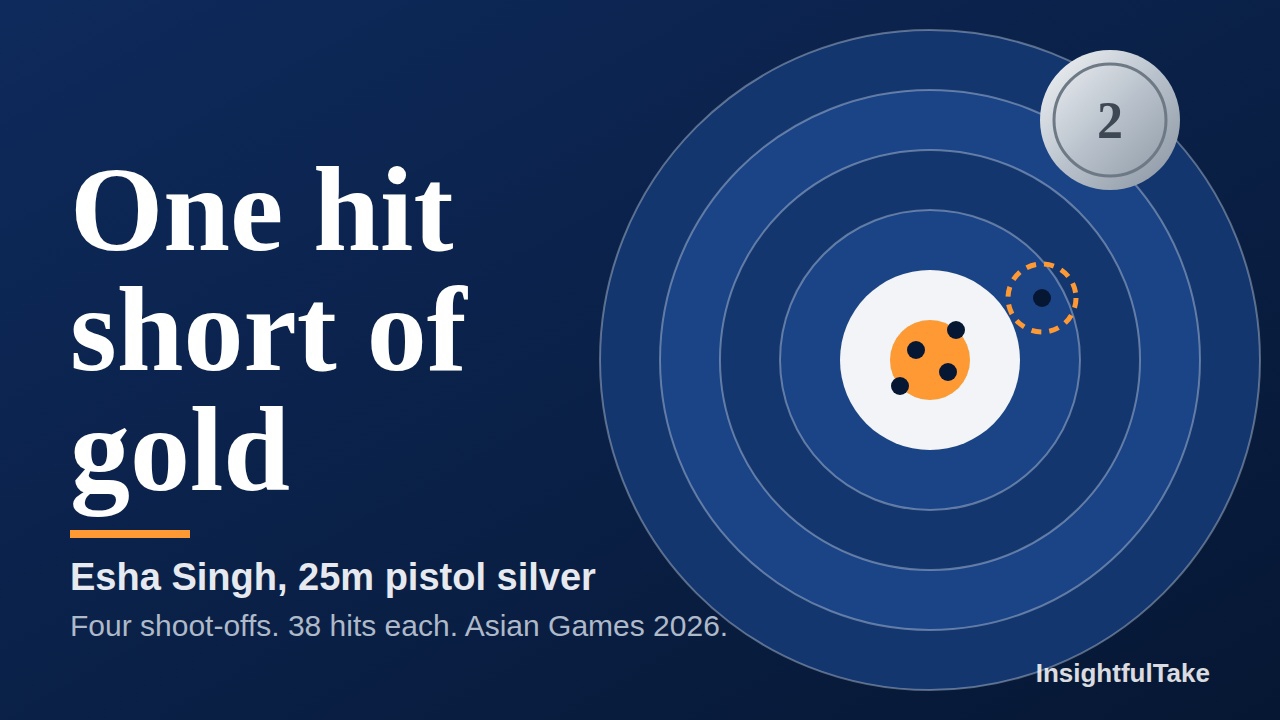
A dramatic 25m pistol final saw India’s Esha Singh survive multiple shoot-offs, recover from the brink of elimination and finish with silver at the Aichi-Nagoya Asian Games.
Silver medals rarely feel satisfying in the moment. For Esha Singh, the disappointment was sharper because gold was just one shot away.
The 21-year-old Indian shooter finished second in the women’s 25m pistol final at the Aichi-Nagoya Asian Games on Monday after losing the gold-medal shoot-off to China’s Xiao Jiaruixuan.
Both shooters finished the regular final with 38 hits, matching the Asian Games record. Xiao eventually prevailed 4+3 to 4+2 in the shoot-off. North Korea’s Kim Hyon Suk won bronze with 34 hits.
For Singh, it was her second consecutive individual silver in the event, after the same result at the Hangzhou Asian Games in 2022.
A final that kept changing direction
The 25m pistol final leaves very little room for recovery. Shooters compete in series of five, with the lowest-ranked competitors eliminated as the final progresses.
Singh began strongly, hitting all five shots in the opening series. She followed that with four hits and remained at the top after 10 shots.
Then came a difficult stretch. She managed only three hits in the third series, allowing Xiao to move ahead. Singh recovered with four hits in the next series and was level with Xiao at 16 after 20 shots.
The pressure increased further in the sixth series. Singh missed twice and dropped outside the medal positions. With 26 hits, she was behind Xiao and Vietnam’s Trinh Thu Vinh.
Her response was immediate.
Facing elimination, Singh produced a perfect five out of five in the next series. That brought her back into medal contention and kept her alive in the final.
Shoot-offs, stoppages and a long night of pressure
The final then became a test of patience as much as shooting skill.
Singh was drawn into multiple shoot-offs with Kim Hyon Suk in the fight for the medal positions. The contest was interrupted by technical and officiating delays, forcing the shooters to repeatedly reset and reload.
Singh eventually came through the battle with Kim and secured her place in the gold-medal contest against Xiao.
By then, the Indian shooter had already survived several elimination moments.
The regular final ended with Singh and Xiao tied at 38. That forced a shoot-off for gold.
Both shooters hit four in the first shoot-off, sending the contest into another tie-breaker. Xiao then edged Singh 3-2 in the decisive round to take gold, while Singh settled for silver.
The preparation behind the comeback
The result becomes more significant when viewed against the preparation that preceded it.
According to Singh’s coach Ronak Pandit, the team deliberately trained her for difficult and unexpected situations. Her preparation included shooting through distractions such as noise, equipment problems and disrupted routines.
The purpose was simple: make pressure and disruption familiar before competition day.
That preparation appeared useful in Nagoya.
Singh lost ground during the final but recovered when elimination was staring at her. She then negotiated a series of shoot-offs and repeated interruptions before reaching the final two.
She had qualified for the final in eighth place with 580-22x, only just making the eight-shooter field.
From the last qualifying position, she finished with an Asian Games silver.
A result that fits her recent record
Singh did not arrive in Nagoya without expectations.
She entered the competition as the world No. 1 in the event and had already established herself among India's leading pistol shooters. Her recent record includes medals at the World Championships and Asian Championships, along with World Cup success.
Her performance in Nagoya also followed a disappointing campaign in the 10m air pistol, where she failed to reach the final.
The 25m pistol event therefore became an opportunity to respond, and she did so by reaching another Asian Games final and securing another individual medal.
A difficult day for India's other pistol shooters
Singh's silver came on a difficult day for India's other women pistol shooters.
Paris Olympics double medallist Manu Bhaker finished 11th in qualification and missed the final. Rahi Sarnobat, the 2018 Asian Games champion, finished 30th.
India also missed out on a medal in the women's 25m pistol team event, finishing fifth.
That made Singh's individual silver India's standout result in the event.
Gold slipped away, but the bigger picture remains
The final shot of a gold-medal shoot-off can dominate the memory of a competition. For Singh, that one shot separated her from the gold.
But the full final tells a broader story.
She started strongly, lost her position, fell outside the medal places, recovered with a perfect series, survived multiple shoot-offs and then pushed the world-class Xiao to a second gold-medal tie-breaker.
At 21, Singh now has two consecutive Asian Games individual silvers in the 25m pistol.
The gold will remain the obvious unfinished part of the story. But the silver also adds another chapter to the career of a shooter who has repeatedly shown that a difficult moment does not necessarily have to be the final one.
Silver medals rarely feel satisfying in the moment. For Esha Singh, the disappointment was sharper because gold was just one shot away.
The 21-year-old Indian shooter finished second in the women’s 25m pistol final at the Aichi-Nagoya Asian Games on Monday after losing the gold-medal shoot-off to China’s Xiao Jiaruixuan.
Both shooters finished the regular final with 38 hits, matching the Asian Games record. Xiao eventually prevailed 4+3 to 4+2 in the shoot-off. North Korea’s Kim Hyon Suk won bronze with 34 hits.
For Singh, it was her second consecutive individual silver in the event, after the same result at the Hangzhou Asian Games in 2022.
A final that kept changing direction
The 25m pistol final leaves very little room for recovery. Shooters compete in series of five, with the lowest-ranked competitors eliminated as the final progresses.
Singh began strongly, hitting all five shots in the opening series. She followed that with four hits and remained at the top after 10 shots.
Then came a difficult stretch. She managed only three hits in the third series, allowing Xiao to move ahead. Singh recovered with four hits in the next series and was level with Xiao at 16 after 20 shots.
The pressure increased further in the sixth series. Singh missed twice and dropped outside the medal positions. With 26 hits, she was behind Xiao and Vietnam’s Trinh Thu Vinh.
Her response was immediate.
Facing elimination, Singh produced a perfect five out of five in the next series. That brought her back into medal contention and kept her alive in the final.
Shoot-offs, stoppages and a long night of pressure
The final then became a test of patience as much as shooting skill.
Singh was drawn into multiple shoot-offs with Kim Hyon Suk in the fight for the medal positions. The contest was interrupted by technical and officiating delays, forcing the shooters to repeatedly reset and reload.
Singh eventually came through the battle with Kim and secured her place in the gold-medal contest against Xiao.
By then, the Indian shooter had already survived several elimination moments.
The regular final ended with Singh and Xiao tied at 38. That forced a shoot-off for gold.
Both shooters hit four in the first shoot-off, sending the contest into another tie-breaker. Xiao then edged Singh 3-2 in the decisive round to take gold, while Singh settled for silver.
The preparation behind the comeback
The result becomes more significant when viewed against the preparation that preceded it.
According to Singh’s coach Ronak Pandit, the team deliberately trained her for difficult and unexpected situations. Her preparation included shooting through distractions such as noise, equipment problems and disrupted routines.
The purpose was simple: make pressure and disruption familiar before competition day.
That preparation appeared useful in Nagoya.
Singh lost ground during the final but recovered when elimination was staring at her. She then negotiated a series of shoot-offs and repeated interruptions before reaching the final two.
She had qualified for the final in eighth place with 580-22x, only just making the eight-shooter field.
From the last qualifying position, she finished with an Asian Games silver.
A result that fits her recent record
Singh did not arrive in Nagoya without expectations.
She entered the competition as the world No. 1 in the event and had already established herself among India's leading pistol shooters. Her recent record includes medals at the World Championships and Asian Championships, along with World Cup success.
Her performance in Nagoya also followed a disappointing campaign in the 10m air pistol, where she failed to reach the final.
The 25m pistol event therefore became an opportunity to respond, and she did so by reaching another Asian Games final and securing another individual medal.
A difficult day for India's other pistol shooters
Singh's silver came on a difficult day for India's other women pistol shooters.
Paris Olympics double medallist Manu Bhaker finished 11th in qualification and missed the final. Rahi Sarnobat, the 2018 Asian Games champion, finished 30th.
India also missed out on a medal in the women's 25m pistol team event, finishing fifth.
That made Singh's individual silver India's standout result in the event.
Gold slipped away, but the bigger picture remains
The final shot of a gold-medal shoot-off can dominate the memory of a competition. For Singh, that one shot separated her from the gold.
But the full final tells a broader story.
She started strongly, lost her position, fell outside the medal places, recovered with a perfect series, survived multiple shoot-offs and then pushed the world-class Xiao to a second gold-medal tie-breaker.
At 21, Singh now has two consecutive Asian Games individual silvers in the 25m pistol.
The gold will remain the obvious unfinished part of the story. But the silver also adds another chapter to the career of a shooter who has repeatedly shown that a difficult moment does not necessarily have to be the final one.

















Leave a Comment