
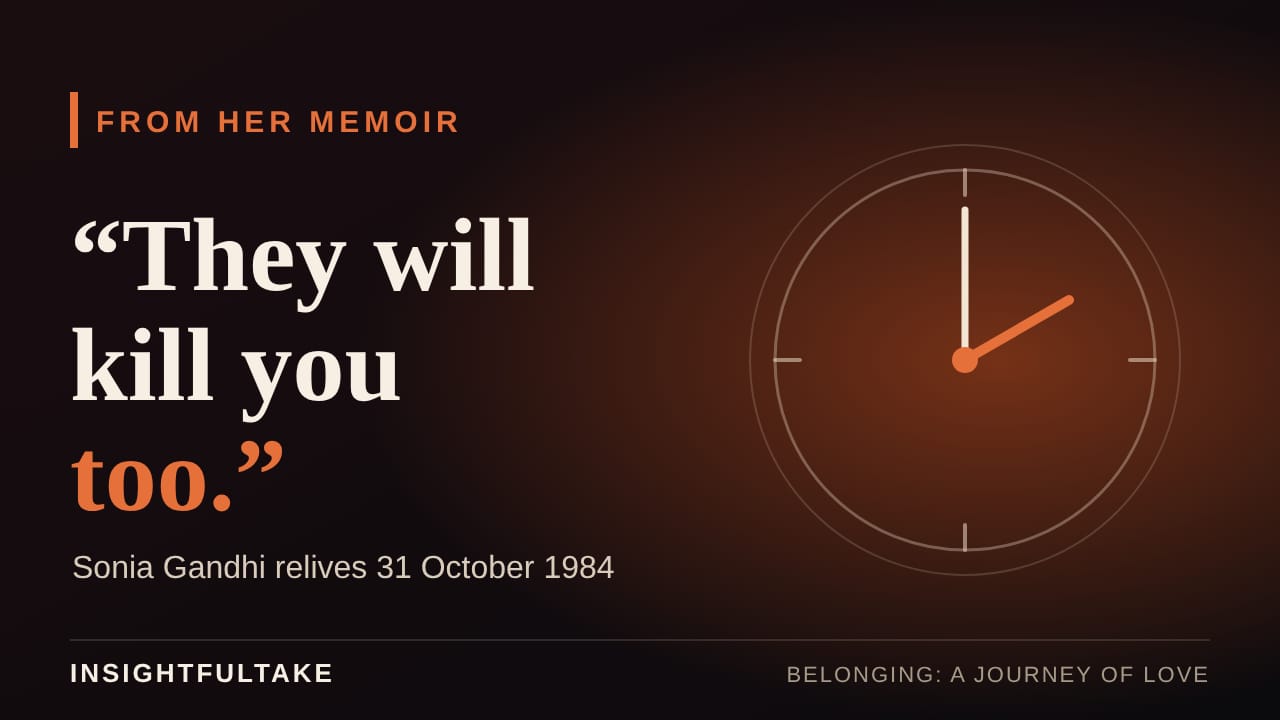
Sonia Gandhi recalls the day gunshots shattered her family, Indira Gandhi died, and she begged Rajiv not to take the prime minister's office.
In her memoir Belonging: A Journey of Love, Sonia Gandhi recounts the horrifying moments of 31 October 1984, when Indira Gandhi was shot by her bodyguards, and recalls pleading with Rajiv Gandhi not to become prime minister.
More than four decades after the assassination of Prime Minister Indira Gandhi, Sonia Gandhi has offered a deeply personal account of the tragedy that changed her family and India's political history.
In her forthcoming memoir, Belonging: A Journey of Love, the former Congress president revisits 31 October 1984, describing the sound of gunfire, the desperate journey to hospital and the emotional turmoil that followed her mother-in-law's death.
The book, published by HarperCollins India and scheduled for release on 10 November, includes an edited extract published by British newspaper The Guardian. At 79, Sonia Gandhi has chosen to revisit one of the most traumatic chapters of her life through an account that reveals the fear and helplessness she experienced that day.
The Sound That Changed Everything
Sonia Gandhi was inside a washroom at the family's residence when she heard several sharp, rapid sounds.
Initially, they reminded her of firecrackers. But something about the noise made her uneasy.
Moments later, the children's nanny, Ongmu, appeared. She was visibly shaken and began gesturing frantically towards the garden, struggling to explain what had happened.
Sonia recalls feeling a heavy pounding in her chest. An intense anger and fear took hold of her as she rushed towards the scene.
There, she encountered a situation that would remain etched in her memory for the rest of her life.
Indira Gandhi had been shot by two of her bodyguards, Satwant Singh and Beant Singh.
A Desperate Journey to the Hospital
The wounded prime minister was lifted into a white Ambassador car. Sonia Gandhi climbed in beside her.
Her memoir describes a disturbing sight. Indira's sari and chest were soaked in blood. Her eyes remained wide open, while her face carried an expression of shock and disbelief.
The journey to the hospital was agonising.
There was no siren to clear the traffic. The car stopped at traffic signals, and passing motorists looked inside without understanding the gravity of the situation.
For Sonia, every passing minute seemed endless.
When they reached the hospital's emergency department, a crowd had already gathered. She also recalls being dissatisfied with the initial response from hospital staff.
Indira Gandhi was placed on a trolley and taken inside. When hospital personnel attempted to move Sonia to a nearby room, she refused.
She wanted to remain beside her mother-in-law. She did not want Indira to be left alone.
Rajiv Gandhi Returns to Delhi
Rajiv Gandhi was away in West Bengal, addressing a political rally, when the assassination took place.
His cavalcade was stopped by a police patrol, and he was informed that an urgent message from Delhi required his immediate return.
He was taken to a helipad, flown to Calcutta and subsequently brought to the national capital.
According to Sonia's account, nobody directly informed Rajiv that his mother had died. However, he understood the gravity of the situation.
He reached Delhi at approximately 3.30 pm and went straight to the hospital, where Sonia was waiting.
She remembers wanting a moment alone with her husband amid the confusion and tragedy.
When they finally embraced, Rajiv began saying something she did not want to hear. A gesture from him confirmed what she had already feared.
Indira Gandhi had been declared dead at around 2 pm.
Later, Sonia was taken home to arrange clothes in which her mother-in-law's body could be dressed.
“Why Does It Have to Be You?”
Perhaps the most emotionally revealing part of Sonia Gandhi's account concerns what happened after Rajiv was asked to take over as prime minister.
Senior Congress leaders wanted him to assume the country's highest executive office without delay.
For Sonia, the suggestion came as another devastating blow. She had barely processed the death of her mother-in-law when the possibility of losing her husband began to haunt her.
She pleaded with Rajiv not to accept the responsibility.
Her argument was rooted in fear for his life and concern for their family. If those who had killed his mother could do so, she feared, they could target him as well.
She questioned who had the authority to place such a responsibility on him at that moment. More importantly, she wanted to know why it had to be Rajiv.
His response, as recalled by Sonia, was deeply unsettling.
He told her that they would kill him anyway.
Sonia writes that she tried to persuade him again, but his decision had already been made.
At approximately 6.30 pm on 31 October 1984, Rajiv Gandhi was sworn in as India's prime minister. His mother's body was still at the family residence.
For Sonia, the decision marked the beginning of another chapter of anxiety. Her account suggests that she feared her husband might eventually meet the same fate as his mother.
That fear would acquire a tragic significance when Rajiv Gandhi was assassinated on 21 May 1991 in Sriperumbudur, Tamil Nadu.
A Personal Account of India's Political History
Sonia Gandhi's recollections offer a perspective on the assassination of Indira Gandhi that goes beyond the familiar political narrative.
The events of 31 October 1984 are usually discussed in terms of national security failures, political consequences, communal violence and the sudden transfer of power.
But Sonia's memoir brings the reader into the private spaces of that day: a family residence, a car carrying a critically wounded prime minister, a crowded hospital and a conversation between a husband and wife facing an uncertain future.
Her account also highlights the personal cost of political leadership. While the country was preparing for a change of government, a family was struggling to absorb an irreversible loss.
The assassination of Indira Gandhi was followed by the anti-Sikh violence of 1984, which left thousands dead and exposed deep failures of governance and public order. Rajiv Gandhi's elevation to the prime minister's office marked the beginning of another consequential period in Indian politics.
Sonia's memoir does not merely revisit these historical events. It recalls how they unfolded for someone who experienced them not as a political observer but as a member of the family at the centre of the crisis.
With the publication of Belonging: A Journey of Love, readers can expect a more personal understanding of the experiences, relationships and fears that shaped Sonia Gandhi's life.
The book is likely to attract considerable attention for its account of a defining moment in modern Indian history and the private emotions behind a public political transition.























Leave a Comment