
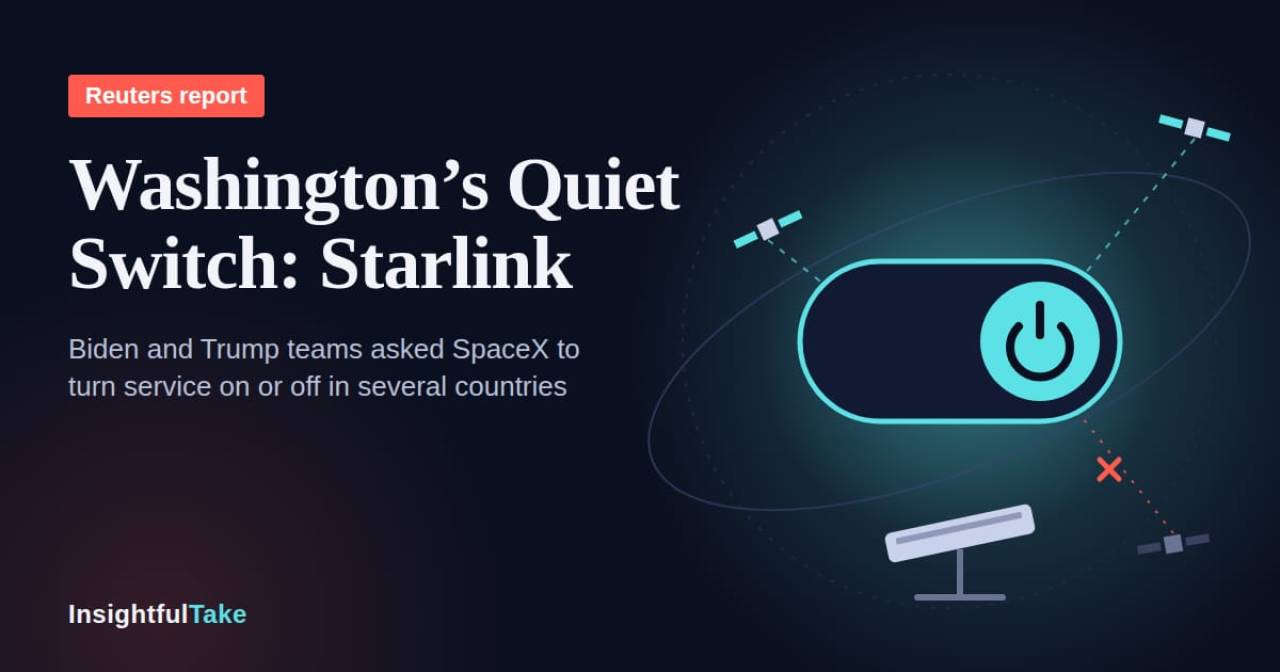
From Ukraine's battlefields to Iran's protests, Starlink has become a powerful US foreign policy tool, raising questions about private control over critical communications.
Successive US administrations reportedly asked SpaceX to activate or restrict satellite internet services in several countries, raising concerns over the growing role of private technology companies in global security and diplomacy.
Starlink, the satellite internet service operated by Elon Musk's SpaceX, has served as an unofficial instrument of American foreign policy for years. According to a Reuters investigation, successive US administrations have asked the company to activate or disable its services in countries where Washington has strategic interests.
Six former senior US officials familiar with the matter said both the Biden and Trump administrations made such requests. The officials spoke on condition of anonymity.
The previously undisclosed requests have come to light amid fresh controversy over restrictions on Ukraine's access to Starlink's military communications services. The developments have raised questions about the relationship between the US government and Musk, whose company operates satellite systems increasingly important to American military operations and those of its allies.
Washington's Efforts to Disrupt Militant Communications
During Joe Biden's presidency, US officials approached SpaceX several times to prevent groups considered hostile to American interests from using Starlink.
Intelligence shared with the company suggested that Iran-backed groups, including the Houthis in Yemen and Hezbollah in Lebanon, had obtained Starlink terminals through intermediaries.
According to two former officials, the administration asked SpaceX to identify these terminals and deactivate them. At least some of the identified devices were subsequently disconnected.
American officials expressed particular concern about the possible use of Starlink during the conflict between Israel and Hezbollah in October 2023. Similar concerns emerged during US military operations against Houthi targets in Yemen in 2024.
The fear was that satellite connectivity could allow armed groups to maintain communications even when conventional telecommunications infrastructure was disrupted.
Starlink's Role in Iran's Protest Movements
Washington also sought to expand Starlink access in countries where governments had restricted internet connectivity.
Following the death of Mahsa Amini in September 2022, widespread protests erupted across Iran. As Iranian authorities imposed restrictions on internet services, the Biden administration approached SpaceX about enabling Starlink connectivity inside the country.
The objective was to provide an alternative communications channel for people affected by the restrictions.
Similar discussions reportedly took place during Donald Trump's presidency.
Following US-Israeli strikes on Iran in June 2025 and again in February 2026, administration officials discussed with Musk and SpaceX ways to bring Starlink terminals into Iran and activate them.
A former senior Trump administration official and another person familiar with the discussions said the effort was intended to help anti-government protesters communicate despite restrictions imposed by Iranian authorities.
These episodes illustrate how access to satellite internet can become part of a government's broader diplomatic and security strategy.
A Private Company at the Centre of Foreign Policy
The reported arrangements placed SpaceX in an unusual position.
Unlike traditional telecommunications infrastructure controlled by governments or regulated national operators, Starlink is a privately owned satellite network with global reach.
Its services can provide connectivity in areas where terrestrial networks are damaged, unavailable or deliberately restricted.
Five former officials said the Biden administration sometimes depended on Musk's cooperation to implement American foreign policy objectives.
The relationship extended beyond efforts to restrict access for hostile groups. Washington also worked with SpaceX to expand connectivity for allies and partners.
However, such cooperation raised a difficult issue. Decisions affecting military communications and international security could depend on the willingness of a private company to act on government requests.
Ukraine Exposes the Risks of Dependence
Ukraine offers one of the clearest examples of Starlink's strategic importance.
After Russia launched its full-scale invasion in February 2022, the Biden administration encouraged SpaceX to expand Starlink services for Ukrainian forces.
The network became an important communications resource for military personnel operating in areas where conventional infrastructure had been damaged or destroyed.
Starlink also helped Ukrainian forces maintain connectivity for battlefield coordination and other military activities.
However, Musk has not always agreed with Ukrainian requests.
He publicly acknowledged refusing a request in 2022 to activate Starlink near Sevastopol, the Russian-controlled port city in Crimea.
Ukraine had sought connectivity to support an attack against Russia's Black Sea Fleet.
Musk said he rejected the request because he feared that enabling the operation could make SpaceX complicit in a major escalation of the war.
The incident demonstrated that decisions about access to essential military communications could involve considerations made outside traditional government command structures.
Fresh Restrictions Raise Concerns in Europe
The latest controversy concerns reported restrictions on Ukraine's access to Starshield, SpaceX's military-focused satellite communications service.
Ukrainian President Volodymyr Zelensky said last week that access had been deliberately restricted, affecting the performance of Ukrainian military drones.
Reuters reported that the order to limit availability originated inside the White House.
The development has alarmed some European officials, who see the episode as evidence of the risks associated with depending heavily on a communications system controlled by an American private company.
Current and former European officials have argued that Europe needs to develop independent military satellite communications capabilities.
However, they acknowledge that replacing Starlink in the short term would be difficult.
Building a comparable system would require substantial investment, technological expertise and time.
What SpaceX and US Authorities Have Said
SpaceX has acknowledged working closely with US government agencies on matters involving export authorisations, national security and foreign policy objectives.
The company said it coordinates with relevant authorities to obtain export permissions where necessary and to protect national security interests.
According to former officials, discussions over Starlink access frequently involved the Pentagon and the White House.
The US Commerce Department's Bureau of Industry and Security and SpaceX did not dispute the broader account presented in the Reuters investigation.
However, the reported cooperation does not establish that SpaceX complied with every government request or that all decisions were made independently by the company.
Why Starlink's Growing Influence Matters
Starlink's importance extends beyond providing internet access in remote locations.
Its satellite network has become relevant to military operations, political protests, emergency communications and international diplomacy.
For Washington, the technology offers a means of supporting allies, maintaining connectivity in politically sensitive regions and restricting communications used by hostile organisations.
For countries relying on the service, however, that dependence creates strategic vulnerabilities.
A government may control its military operations but still rely on a foreign private company for the communications infrastructure supporting them.
The issue also raises questions about accountability. Decisions affecting access to essential communications may involve government officials, corporate executives and national security agencies operating through arrangements that are not always publicly disclosed.
The Reuters investigation highlights how both Republican and Democratic administrations have treated Starlink as a useful foreign policy resource.
As more countries consider developing independent satellite networks, the debate is likely to extend beyond technology and commercial competition.
The central concern is who ultimately controls essential communications during a conflict or political crisis, and how those decisions are made.

























Leave a Comment