
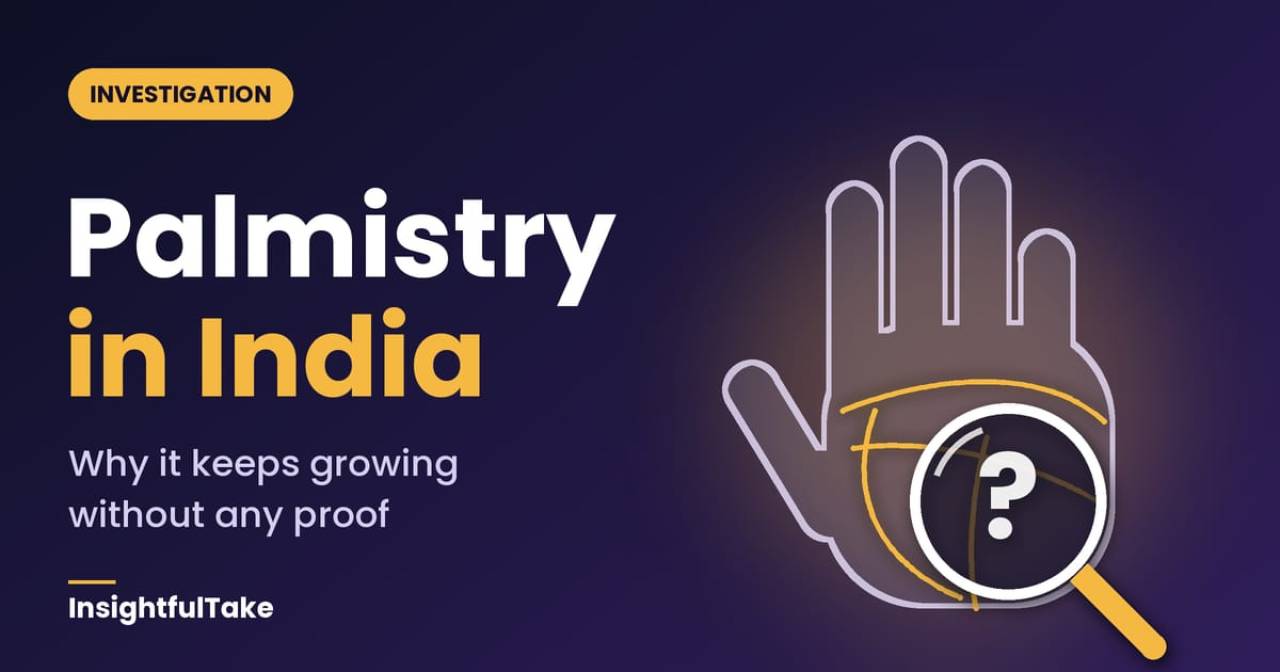
Palmistry promises answers about careers, marriage and wealth, but science remains unconvinced. Why do millions continue trusting the lines on their hands?
Palmistry remains popular in India despite the lack of reliable scientific evidence supporting its predictions. Psychology, cultural traditions and a growing digital business help explain its appeal.
Palmistry has survived centuries of scientific progress without producing convincing evidence that it can predict anyone's future. Still, people continue to consult palm readers about careers, marriages, money and personal problems. In India, the practice has moved beyond roadside stalls and traditional consultations to mobile applications, social media and paid online sessions.
The contradiction deserves attention. Why do people trust predictions that have not been scientifically validated? The answer lies partly in psychology, partly in cultural traditions and partly in the commercial value of offering reassurance during uncertain times.
Does Palmistry Have Any Scientific Basis?
Palmistry claims that the lines, shapes and markings on a person's hands can reveal personality traits, relationships, career prospects and future events. Practitioners commonly interpret the life line, heart line, head line and fate line.
However, there is no reliable scientific evidence that these markings can predict a person's lifespan, marriage, financial success or professional achievements.
The scientific study of hand patterns is different from palmistry. Dermatoglyphics examines fingerprints, palm patterns and their biological development. Certain unusual palm creases may be associated with particular genetic or developmental conditions.
Doctors sometimes consider such features alongside other clinical findings. But identifying a possible medical characteristic is entirely different from predicting someone's future.
A palm crease cannot establish when a person will get married, secure employment or become wealthy. These claims have not been demonstrated through reliable, reproducible scientific testing.
Why Palm Readings Often Feel Accurate
Psychology offers an important explanation for the apparent accuracy of palm readings.
In 1949, American psychologist Bertram Forer conducted an experiment in which students received what they believed were individual personality assessments. In reality, everyone received the same description.
Despite this, participants generally rated the assessments as remarkably accurate.
The experiment demonstrated what became known as the Forer effect, also called the Barnum effect.
Consider a statement such as, "You have considerable potential, but sometimes you doubt your abilities."
It sounds personal. Yet it could describe millions of people.
Palm readers frequently make similarly broad observations about relationships, ambitions, disappointments and family responsibilities. Such statements can feel meaningful because individuals connect them with their own experiences.
Another technique is known as cold reading. A reader may observe someone's age, clothing, behaviour and emotional responses before making increasingly specific statements.
Confirmation bias also plays a role. People tend to remember predictions that appear correct while overlooking those that fail.
A prediction about a major career change, for instance, may remain memorable if someone changes jobs years later. Several inaccurate predictions made during the same consultation may be forgotten.
These psychological processes help explain why an unverified practice can appear convincing.
Why Palmistry Remains Popular in India
India's relationship with palmistry cannot be understood through scientific arguments alone.
Traditional Indian systems of interpreting physical characteristics, including Samudrika Shastra, have existed for centuries. Palm reading is often associated with broader beliefs about astrology, destiny and auspicious events.
Such traditions remain familiar in households where birth charts, marriage compatibility and religious consultations influence important decisions.
However, cultural familiarity is only part of the explanation.
Modern India presents considerable uncertainty for millions of people. Competitive examinations, limited employment opportunities, financial pressures, marriage expectations and career instability can create anxiety about the future.
Palmistry offers something immediately attractive in these circumstances. It provides a narrative about what might happen next.
A student worried about employment may hear that professional success is approaching. Someone experiencing financial difficulties may be told that prosperity will arrive after a particular age.
These statements may have no scientific foundation, but they can provide temporary emotional relief.
This distinction matters. People do not always consult palm readers because they reject science. Some are seeking reassurance, encouragement or a sense of control over circumstances they cannot easily change.
For younger audiences, palmistry can also function as entertainment. Short videos, personality readings and social media predictions circulate widely, sometimes without any serious expectation of accuracy.
The boundaries between belief, curiosity and entertainment have become increasingly blurred.
How Palmistry Became a Digital Business
Palmistry has also adapted to changing technology.
Traditional consultations now compete with astrology applications, online palm readers, social media influencers and digital platforms offering personalised predictions.
Some services allow users to upload photographs of their palms. Others advertise live consultations, automated interpretations or paid conversations with practitioners.
The business model often begins with an inexpensive or free reading.
Additional services may include detailed predictions, compatibility assessments, gemstones, religious rituals or other suggested remedies.
Not every practitioner uses these methods, and not every consultation involves exploitation. However, the commercial risks become serious when predictions are used to create fear.
A person may be told that a relationship will fail, a career opportunity will disappear or a family member will face misfortune unless a particular remedy is purchased.
Such claims can turn personal anxiety into a source of revenue.
Reliable, independently audited figures for India's palmistry market are difficult to establish. Estimates of the broader astrology and spiritual consultation industry should not automatically be treated as figures for palmistry alone.
Nevertheless, digital platforms have made these services easier to advertise, access and monetise.
Social media has also changed how predictions reach audiences. Emotionally powerful claims, especially those promising extraordinary success or warning of danger, can attract attention regardless of their accuracy.
What Indian Law Says About Palmistry
Palm reading is not generally prohibited in India merely because its predictions lack scientific evidence.
The legal position becomes more complicated when practitioners make deceptive claims, demand money through intimidation or exploit vulnerable individuals.
In 2004, the Supreme Court considered the teaching of astrology in universities in P. M. Bhargava v. University Grants Commission, arising from challenges to the introduction of astrology-related courses.
The Court's refusal to interfere with the academic decision did not amount to scientific validation of astrology or palmistry.
States have also enacted legislation addressing certain harmful practices associated with superstition.
Maharashtra's anti-superstition law of 2013 and Karnataka's legislation of 2017 target specified inhuman, exploitative or harmful practices. They do not impose a blanket prohibition on ordinary palm reading.
Depending on the circumstances, fraudulent conduct may also attract provisions of criminal law, consumer protection law or advertising regulations.
The distinction is important. Holding a personal belief is different from deliberately deceiving someone for financial gain.
How to Identify Misleading Palm Readers
People considering a palm reading should distinguish between entertainment, personal belief and claims presented as established facts.
Several warning signs deserve attention.
- Vague predictions: Statements that could apply to almost anyone and cannot be independently verified.
- Fear-based warnings: Claims that illness, death, financial ruin or family tragedy will occur unless immediate action is taken.
- Expensive remedies: Pressure to purchase gemstones, rituals or special services to prevent predicted misfortune.
- Claims of guaranteed success: Promises of employment, marriage, wealth or recovery from illness through palm-based predictions.
- Pressure to decide immediately: Attempts to prevent customers from questioning claims or seeking independent advice.
A consultation becomes particularly concerning when someone is encouraged to replace medical treatment, financial planning or informed personal decisions with predictions.
Why Scientific Evidence Still Matters
Personal experiences can be powerful, but they are not substitutes for scientific evidence.
Someone may remember a palmist correctly predicting a job change or marriage. That experience can strengthen belief, especially when the prediction appears unusually specific.
However, an accurate prediction does not establish that palmistry works.
To demonstrate predictive ability, practitioners would need to make specific predictions under controlled conditions and consistently perform better than chance.
Their results would also need to be independently replicated.
Without such evidence, personal testimonials remain insufficient to establish the validity of palmistry.
This does not mean that every person who consults a palm reader is irrational. Human beings naturally search for patterns, explanations and reassurance.
The problem arises when emotional comfort is presented as proven knowledge.
The Future Cannot Be Read From a Palm
Palmistry's continued popularity reveals something important about human behaviour.
People want to understand what lies ahead, particularly when their lives are shaped by circumstances beyond their immediate control.
A palm reader may offer certainty where employment markets, relationships and financial conditions offer none.
That reassurance can be comforting, but comfort should not be confused with accuracy.
India's long cultural association with palmistry deserves historical understanding. Its commercial expansion deserves scrutiny. Its predictive claims deserve scientific examination.
There is room to respect personal beliefs without accepting unsupported claims as facts.
The lines on a person's palm are physical features, not a verified map of destiny. Careers develop through opportunities, decisions, skills and circumstances. Relationships depend on human behaviour. Financial security requires planning, resources and sometimes good fortune.
Palmistry may offer a story about the future. It has not demonstrated that it can reveal what the future holds.















Leave a Comment