

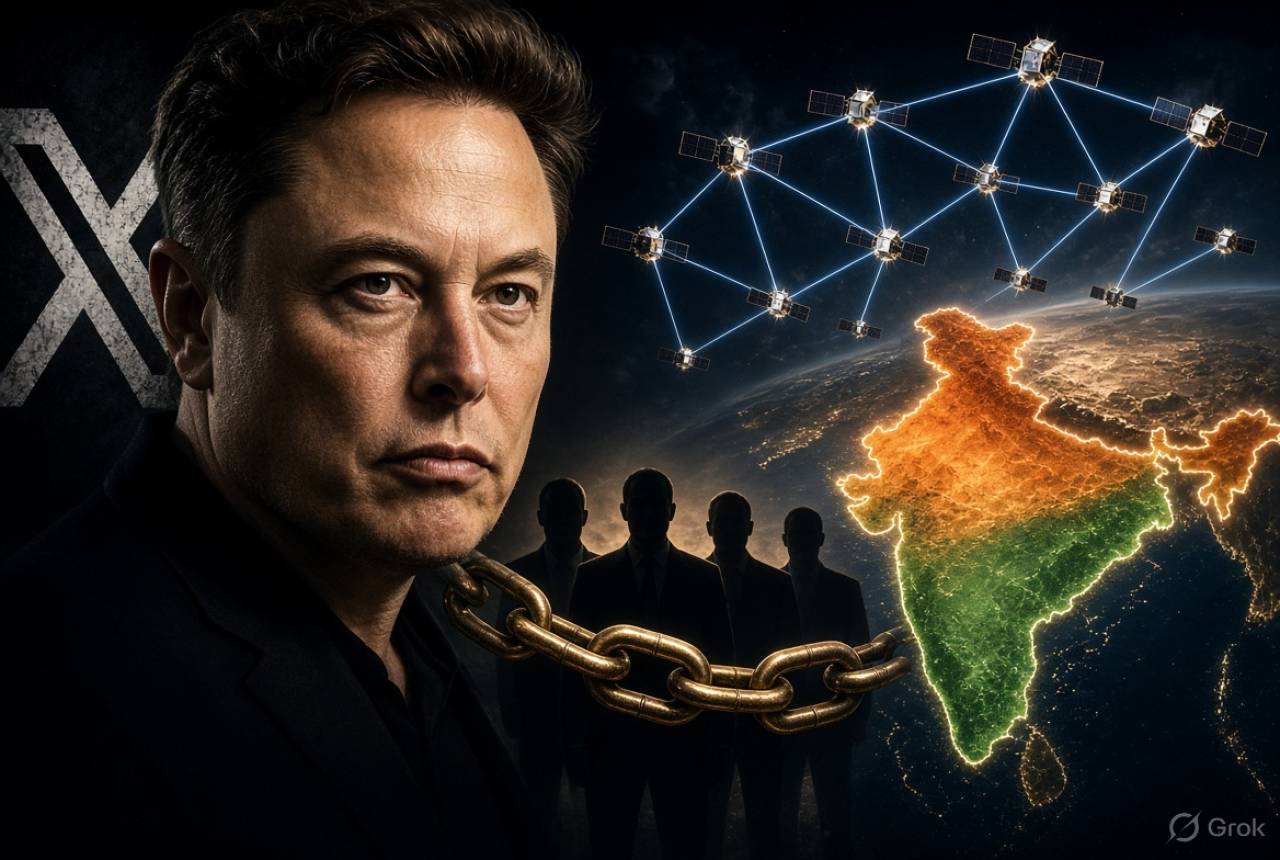
Starlink promises internet access across remote India, but who controls the signal? The Nayara Energy dispute raises serious questions about India's digital sovereignty.
As India prepares to expand satellite broadband, the debate goes beyond internet access. The larger question is whether essential digital services can remain operational when foreign companies or governments control the technology behind them.
Satellite broadband promises to connect millions of Indians who remain beyond the reach of reliable internet services. From remote Himalayan villages and border districts to disaster-prone regions, Elon Musk's Starlink could bring high-speed connectivity to places where laying optical fibre is difficult, expensive or commercially unviable.
The promise is attractive, but India must also consider who will control these networks once people, businesses and public institutions begin depending on them.
A technology that connects a remote village can transform lives. But if the same service can be restricted or suspended through decisions taken outside India, the country faces a challenge that goes beyond telecommunications. It becomes a question of digital sovereignty.
The Nayara Energy Case Offers a Warning
Former Indian diplomat Syed Akbaruddin, writing in the Hindustan Times, has drawn attention to the risks of depending on foreign-controlled technologies for essential services.
The experience of Nayara Energy, an Indian oil refining company with Russia's Rosneft among its shareholders, illustrates the problem.
In September 2026, the Delhi High Court directed SAP India to restore software support to Nayara Energy after services were disrupted in connection with European Union sanctions. The dispute involved software licences, updates and technical support essential to the company's operations.
The court's intervention reinforced the importance of contractual obligations and the application of Indian law to services provided within the country.
A similar dispute had emerged in July 2025 when Microsoft suspended certain digital services to Nayara Energy. Services were subsequently restored after the company approached the Delhi High Court.
These incidents exposed a serious vulnerability. An Indian company operating within India could lose access to important digital systems because of sanctions, commercial decisions or legal restrictions originating abroad.
The immediate problem concerned software. The larger concern is whether comparable disruptions could affect other critical technologies.
Why Starlink Raises a Bigger Question
Unlike conventional broadband networks that depend largely on terrestrial infrastructure, Starlink uses a constellation of low-Earth-orbit satellites to deliver internet connectivity.
Its technological advantage is particularly relevant to India's difficult geographical regions. Satellite internet could support schools, healthcare facilities, emergency responders and communities where conventional networks remain unreliable.
However, the infrastructure is operated by a foreign company, and important aspects of network management remain outside India's direct control.
The experience of Ukraine demonstrates why this matters.
During the Russia-Ukraine war, Starlink became an important communication system for Ukrainian forces. Reports of restrictions affecting military operations, including drone missions, raised questions about who ultimately determines how such networks may be used.
Elon Musk has also acknowledged the US government's role in setting operational boundaries for Starshield, the military-focused satellite network developed by SpaceX.
Starlink and Starshield are distinct services, and restrictions involving military applications do not automatically establish that ordinary civilian connections would face similar treatment.
Nevertheless, the broader concern remains relevant. Foreign-owned satellite networks operate within legal, regulatory and strategic environments shaped by their home countries.
For India, the risk does not necessarily arise from hostility or deliberate interference. It arises from dependence on infrastructure over which Indian institutions may have limited authority.
Friendly diplomatic relations cannot guarantee uninterrupted technological access under every future circumstance.
Digital Sovereignty Does Not Mean Digital Isolation
India cannot build a competitive technology economy by shutting out foreign companies.
Indian IT firms operate internationally, Indian engineers contribute to global technological development, and domestic businesses depend on software, equipment and services developed across several countries.
Foreign participation brings investment, expertise, competition and access to advanced technologies.
The question, therefore, is not whether India should permit companies such as Starlink to operate. It is whether India has adequate safeguards against excessive dependence on any single foreign-controlled provider.
Digital sovereignty should not be confused with technological self-sufficiency in every sector.
A more practical definition is the ability of a country to maintain essential digital services when external suppliers, sanctions or geopolitical developments interrupt access.
India does not need to manufacture every technology it uses. It needs the capacity to respond when a technology it depends upon becomes unavailable.
That distinction should guide the country's approach to satellite broadband.
What India Must Do Before Dependence Deepens
Protecting digital sovereignty requires more than regulatory approvals and assurances from service providers.
The first requirement is enforceable contractual protection.
Agreements with foreign technology companies should clearly define service continuity obligations, access to operational data, recovery procedures and the conditions under which services may be suspended.
The Nayara Energy disputes demonstrate the importance of contractual rights. However, judicial remedies alone cannot guarantee immediate restoration when technical systems or operational decisions remain outside Indian control.
The second requirement is tested contingency planning.
Government departments, hospitals, banks, emergency services and other essential institutions should not depend exclusively on a connectivity provider without a credible alternative.
Backup arrangements must be tested regularly. A recovery plan that exists only in official documents offers little protection during an actual disruption.
The third requirement is risk-based regulation.
A household using satellite broadband for entertainment does not face the same consequences from an outage as a hospital, defence installation or disaster-response agency.
Critical users should therefore be subject to stronger continuity and resilience requirements.
The fourth requirement is investment in domestic technological capabilities.
India should develop indigenous satellite communication systems, strengthen its ground infrastructure and encourage domestic companies to participate in advanced communication technologies.
Local infrastructure alone cannot guarantee sovereignty over a foreign-operated satellite network. However, domestic expertise, diversified providers and independent alternatives can reduce vulnerability.
India's Own Experience Shows What Is Possible
India has previously responded to restrictions on foreign technology through sustained domestic development.
Following the 1998 nuclear tests, international sanctions affected several Indian technological programmes. The Light Combat Aircraft project faced difficulties after an American partner withdrew from work associated with its flight-control system.
Indian scientists and engineers continued developing the necessary capabilities, contributing to the eventual progress of the indigenous aircraft programme.
The experience demonstrated that technological restrictions can create serious obstacles, but they can also strengthen the case for long-term domestic investment.
India's Unified Payments Interface (UPI) offers another example of homegrown technological capability.
Developed through India's domestic payments ecosystem, UPI has become a major digital public infrastructure platform, supporting transactions at enormous scale.
Satellite communications present different technological and financial challenges. Building a competitive satellite constellation requires substantial capital, launch capabilities, spectrum coordination and sophisticated network management.
Still, the underlying lesson remains useful: strategic technological capabilities require patient investment rather than dependence on short-term commercial arrangements alone.
The Question Every Starlink Approval Must Answer
Akbaruddin's argument can be reduced to a practical test.
If an essential digital service suddenly becomes unavailable, who has the authority and technical capability to restore it?
Can Indian institutions restore the service independently? Can users migrate to another provider? How long would recovery take?
If restoration depends entirely on the discretion of an overseas company or government, India faces a strategic vulnerability.
If domestic institutions have credible alternatives and tested recovery mechanisms, the risk becomes more manageable.
For Starlink, this means that regulatory approval should be accompanied by meaningful safeguards.
These should include clear data-handling obligations, appropriate local operational capabilities, transparent service suspension procedures, continuity commitments and realistic alternatives for critical users.
Such conditions must also recognise technical limits. An Indian ground station or locally stored customer data cannot, by itself, ensure that a satellite network continues functioning if its operator disables access.
The purpose of regulation should be to reduce dependence and improve resilience, not to create a false impression of control.
India Needs Connectivity Without Surrendering Control
The arrival of satellite broadband could significantly improve internet access across India.
Remote communities could gain better educational opportunities, healthcare facilities could access digital services, and emergency teams could communicate more effectively during disasters.
Rejecting such technology simply because it originates abroad would be economically and strategically unwise.
But embracing it without examining the risks would be equally shortsighted.
India's debate should not be reduced to Starlink versus no Starlink. The real question is how the country can benefit from foreign innovation without placing essential services beyond its ability to protect.
The Nayara Energy disputes show how external legal and commercial decisions can disrupt technology-dependent Indian businesses. The experience of satellite communications in conflict zones demonstrates that connectivity can also carry strategic consequences.
Neither example proves that Starlink will interrupt civilian services in India. Both provide reasons to prepare for circumstances in which access may become restricted.
India needs the connectivity Starlink promises, but it also needs the ability to withstand its loss.
The objective should not be to keep foreign technology out. It should be to ensure that when technology becomes essential to Indian life, the country's institutions retain meaningful options to keep those services running.
A connected India must also be a resilient India. Sovereignty, ultimately, is not about who supplies the signal. It is about whether the country can function when that signal disappears.

























Leave a Comment