
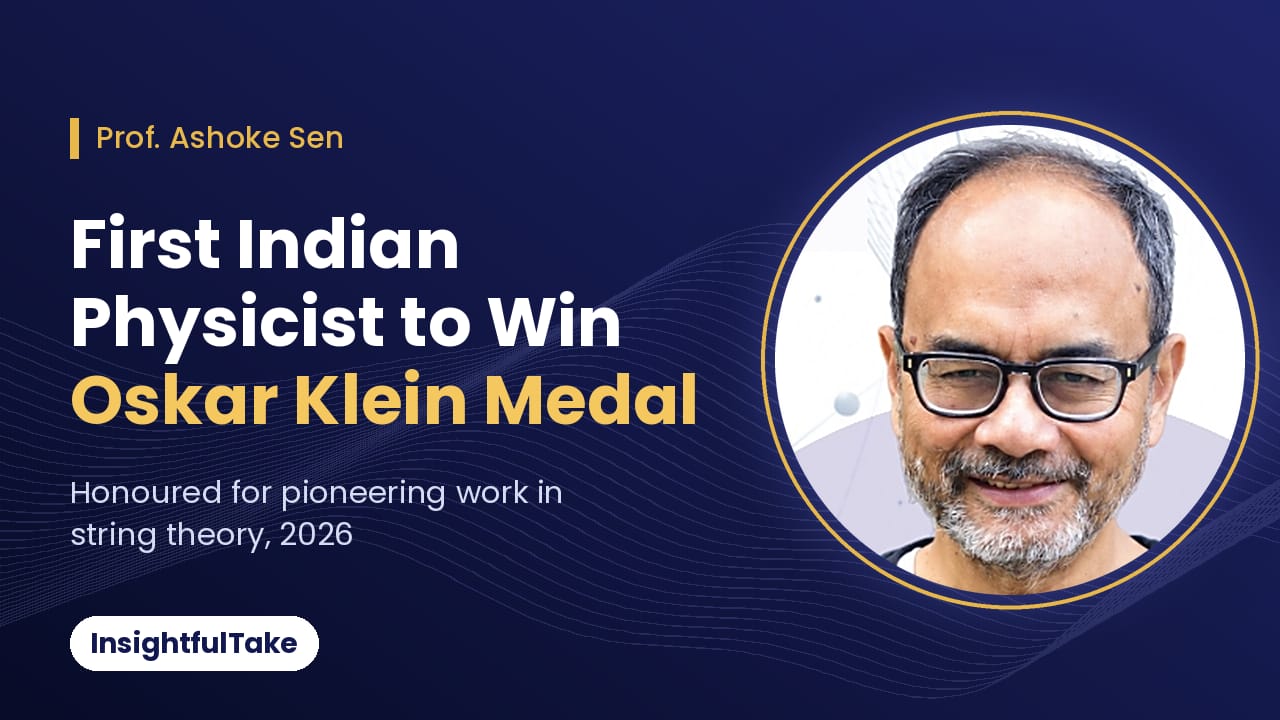
Bengaluru-based string theorist honoured for work that has advanced our understanding of black holes, quantum gravity and the fundamental laws of the universe.
Indian science has another milestone to celebrate. Professor Ashoke Sen, Infosys Madhava Chair Professor at the International Centre for Theoretical Sciences (ICTS-TIFR) in Bengaluru, has been awarded the 2026 Oskar Klein Medal, becoming the first Indian physicist to receive the honour.
The Office of the Principal Scientific Adviser to the Government of India congratulated Prof. Sen, recognising his contributions to theoretical physics and his work at the frontiers of our understanding of the universe.
A Medal With Global Recognition
The Oskar Klein Medal is awarded jointly by Stockholm University and the Nobel Committee for Physics of the Royal Swedish Academy of Sciences. It recognises distinguished contributions to physics and is named after Swedish theoretical physicist Oskar Klein.
Prof. Sen's recognition marks a milestone for Indian physics. It also brings international attention to research that seeks to explain some of the most fundamental questions about matter, gravity and the structure of the universe.
The Science Behind the Honour
Prof. Sen is internationally recognised for his pioneering contributions to string theory, a theoretical framework that seeks to describe fundamental particles and forces through tiny, one-dimensional strings. Three areas of his research stand out.
S-duality: Connecting Strong and Weak Interactions
S-duality describes a relationship in which a theory under strong coupling can be mathematically equivalent to another description under weak coupling. Such relationships allow physicists to investigate problems that would otherwise be extremely difficult to solve.
Prof. Sen's work helped establish important connections between seemingly different string theories, advancing the understanding of their underlying mathematical structure.
Black Hole Entropy: Counting Microscopic States
Black holes present one of the most challenging questions in modern physics. Although they are defined by extreme gravitational conditions, they also possess entropy, a measure associated with the number of microscopic states that can produce the same macroscopic properties.
Prof. Sen's research helped develop methods to count these microscopic states in string theory, particularly for certain classes of black holes. This work strengthened the connection between quantum theory and gravity and contributed to efforts to understand the microscopic origins of black hole entropy.
String Field Theory: Building a Deeper Mathematical Framework
String field theory seeks to describe the dynamics of strings using a framework that draws on concepts from quantum field theory. Prof. Sen's contributions have helped deepen the mathematical understanding of string theory and the relationships between different formulations of the subject.
Together, these research contributions have played an important role in the development of modern string theory and the continuing effort to understand the fundamental laws of nature.
A Distinguished Record of Achievements
The Oskar Klein Medal adds to Prof. Sen's extensive list of national and international honours.
He received the Padma Shri in 2001 and the Padma Bhushan in 2013, two of India's highest civilian awards. His international recognition includes the Breakthrough Prize in Fundamental Physics in 2012 and the Dirac Medal in 2014.
These awards reflect the influence of his research across the global theoretical physics community. His career also highlights the contribution of Indian scientists to fundamental research conducted at the highest international level.
Why It Matters for India
String theory is primarily a field of fundamental research, with no established direct commercial application. Its value lies in exploring questions that existing scientific theories cannot fully answer.
Research in fundamental physics can take decades to influence other areas of science and technology. Yet it plays an important role in developing mathematical methods, training researchers and expanding the boundaries of scientific knowledge.
Prof. Sen's achievement demonstrates the importance of sustained support for advanced scientific research. Indian institutions can contribute to international scientific progress when researchers have access to strong academic environments, experienced mentors and the freedom to pursue complex questions over many years.
For students and early-career researchers, his journey offers an example of how curiosity-driven research can lead to international recognition. It also reinforces the need to invest in basic science alongside research directed towards immediate technological and economic needs.
A Moment of Pride for Indian Science
The congratulatory message from the Office of the Principal Scientific Adviser reflects the wider significance of Prof. Sen's achievement for India's scientific community.
His receipt of the Oskar Klein Medal is both a personal milestone and a moment of recognition for Indian theoretical physics. It highlights the contribution of Indian researchers to some of the most challenging questions in modern science.
As physicists continue to investigate black holes, quantum gravity and the structure of spacetime, Prof. Sen's research remains part of an important international scientific conversation.
The medal recognises his contributions to the field while drawing attention to the questions that continue to drive theoretical physics. For India, the achievement is a reminder that investment in fundamental research can help build scientific knowledge, nurture future researchers and strengthen the country's place in the global scientific community.






















Leave a Comment