
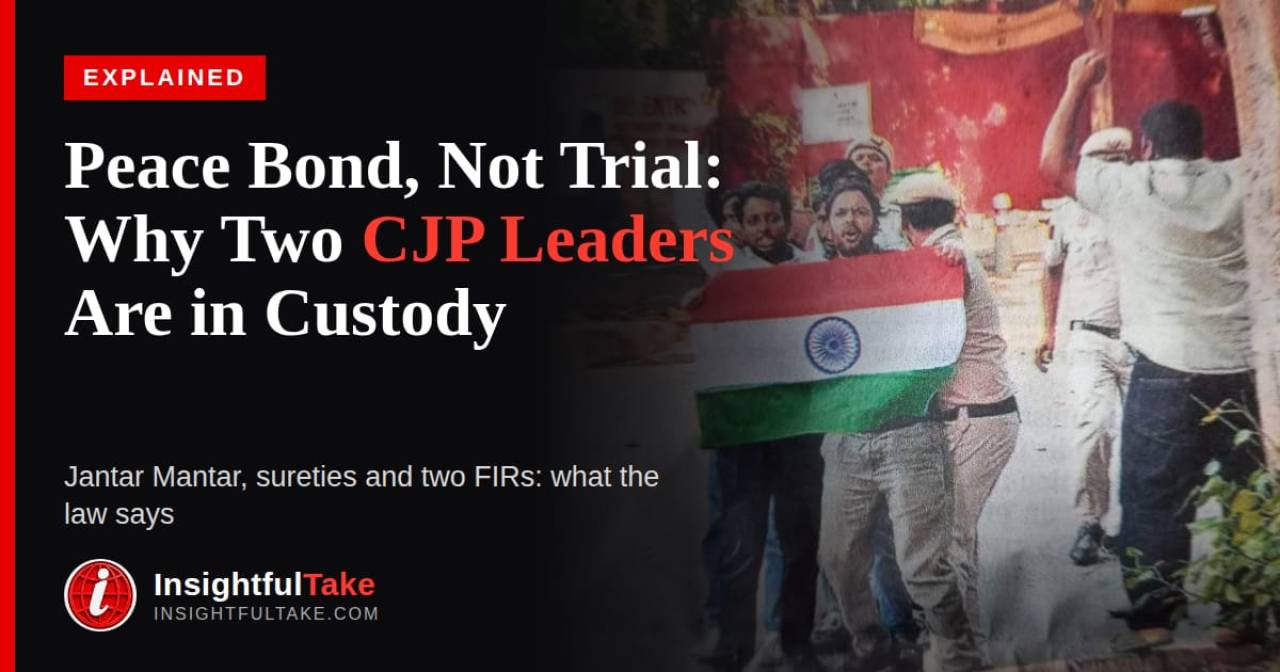
A protest at Jantar Mantar has turned into a courtroom test of how far preventive law can go in policing dissent.
When Saurav Das and Ashutosh Ranka of the Cockroach Janta Party (CJP) walked into Jantar Mantar carrying the national flag, they were joining a long Delhi tradition of public protest. Two weeks later, they are in judicial custody, and the dispute is no longer just about electoral rolls. It is about how far the state can go in detaining people before a trial.
How It Began
The CJP, a youth-driven movement with a strong social media presence, has been demanding the resignation of Chief Election Commissioner Gyanesh Kumar. The party alleges irregularities in the Special Intensive Revision (SIR) of electoral rolls. The Election Commission has denied wrongdoing.
On October 10, Das and Ranka were detained at Terminal 3 of Delhi's airport. Police initiated preventive proceedings under Sections 126 and 170 of the Bharatiya Nagarik Suraksha Sanhita (BNSS), and the two furnished bail bonds of ₹50,000 each.
A day later, Delhi Police removed Jantar Mantar's designated protest-site status. The decision has since been challenged before the Supreme Court and the Delhi High Court.
On October 13, Das and Ranka went to Jantar Mantar carrying the tricolour. Police alleged that they and eleven others jumped the gates. They were detained within minutes.
The next day, a Special Executive Magistrate (SEM) remanded them to five days of judicial custody, citing concerns about a possible breach of peace.
Two Cases, One Incident
The legal dispute has two layers.
The first concerns the peace-bond proceedings. Police allege that Das and Ranka violated the bond they signed on October 11, which required them to maintain peace for a year. On October 19, the SEM extended their custody by two days, rejected their sureties and observed that their conduct showed "no respect for law".
The second layer involves criminal proceedings. Two FIRs registered at Connaught Place and Parliament Street police stations concern the same Jantar Mantar incident. The allegations include disobedience of an order issued by a public servant under Section 223 of the Bharatiya Nyaya Sanhita (BNS), house trespass under Section 332, criminal conspiracy under Section 61(2), obstruction and assault involving public servants, and voluntarily causing hurt.
Both cases have been transferred to the Delhi Police Crime Branch.
What the Petitioners Argue
Das and Ranka have approached the Delhi High Court, challenging the extension of their custody as illegal and arbitrary and alleging a violation of Article 21 of the Constitution, which protects life and personal liberty.
Their petition raises three principal concerns.
- Sureties and release: The petitioners rely on the Delhi High Court's Aldanish Rein ruling, which they say supports the release of an arrested person on a personal bond once sureties have been furnished, pending their verification. They contend that they remained in custody for six days despite offering several sureties.
- Grounds for rejecting sureties: According to the petition, some sureties were rejected because they supposedly had "no control over the Respondents" or could not recall their parentage. The petitioners argue that this approach conflicts with Section 140 of the BNSS, which should involve an inquiry into a surety's fitness rather than what they describe as "a gruelling exercise".
- Independent judicial assessment: They also argue that the SEM relied on the investigating officer's submissions without independently assessing whether continued detention was justified.
The petitioners further contend that protesting at a site that has lost its designated status is a matter of regulation and does not, by itself, establish a threat to public order.
The State's Case
Police and the magistrate view the events as a pattern of conduct rather than an isolated incident.
Their position is that the two leaders repeatedly called for protests at locations where demonstrations were not permitted and then proceeded to a restricted site after signing an undertaking to maintain peace.
From this perspective, a magistrate responsible for preventing breaches of the peace could reasonably question the conduct of people who allegedly acted against an undertaking within days of signing it.
The state also points to the allegations of injury to security personnel, arguing that these are matters to be examined through the criminal justice process.
The central legal question, however, is whether the circumstances justify continued detention under the preventive proceedings and whether the rejection of the sureties followed the law.
The Real Question
Strip away the political arguments, and three issues remain.
First, a peace bond is a preventive tool, not a punishment.
Its purpose is to prevent a possible breach of peace, not to punish someone for an act that has already occurred. When a bond-related proceeding results in detention while the same incident also forms the basis of criminal FIRs, the distinction between prevention and punishment becomes important.
A breach of a bond does not automatically establish guilt in a separate criminal case. The allegations in the FIRs must be proved independently through the criminal justice process.
The courts must therefore examine whether continued detention serves a legitimate preventive purpose or risks becoming punishment before guilt has been established.
Second, a surety is a safeguard, not a trap.
Courts are entitled to examine a surety's identity, financial means and suitability. These checks help ensure that the legal conditions attached to release are meaningful.
But the process can become unreasonable if a surety is rejected for failing to establish an unrealistic degree of personal knowledge about the accused. A surety's responsibility is to provide the assurance required by law, not to know every detail of another person's life.
The High Court's assessment of the grounds for rejection could therefore have implications beyond this particular case.
Third, the right to protest must be balanced against the power to regulate public spaces.
Authorities can designate protest sites and impose reasonable restrictions to maintain public order. The state has a legitimate interest in ensuring that demonstrations do not disrupt essential services or threaten public safety.
But the timing and circumstances of a restriction also matter. If a protest site is removed from the designated list shortly before a planned demonstration, and participants are subsequently detained for entering it, questions arise about the fairness and transparency of the decision.
The pending challenges to the de-notification will be important in determining whether the change was legally justified and how it affects the right to assemble peacefully.
The issue is not whether every protest must be permitted at every location. It is whether restrictions are imposed and enforced through a fair, lawful and consistent process.
What to Watch
Three developments will shape the outcome.
- The High Court's interpretation of Aldanish Rein and Section 140 of the BNSS: This could clarify the standards for examining sureties and the circumstances in which their rejection is justified.
- The Crime Branch investigation: The evidence will determine whether the allegations of trespass, obstruction, assault and hurt can be sustained.
- The challenge to Jantar Mantar's de-notification: The courts will have to examine the legality of the decision and its implications for public demonstrations in the capital.
Whatever the outcome, the case highlights how battles over personal liberty can turn on procedural provisions that most citizens rarely encounter until they are directly affected by them.
The CJP's allegations concerning electoral rolls remain a separate issue to be examined on their merits. But the treatment of the two men who raised those concerns, and the legal provisions used to detain them, is already under scrutiny.



























Leave a Comment