
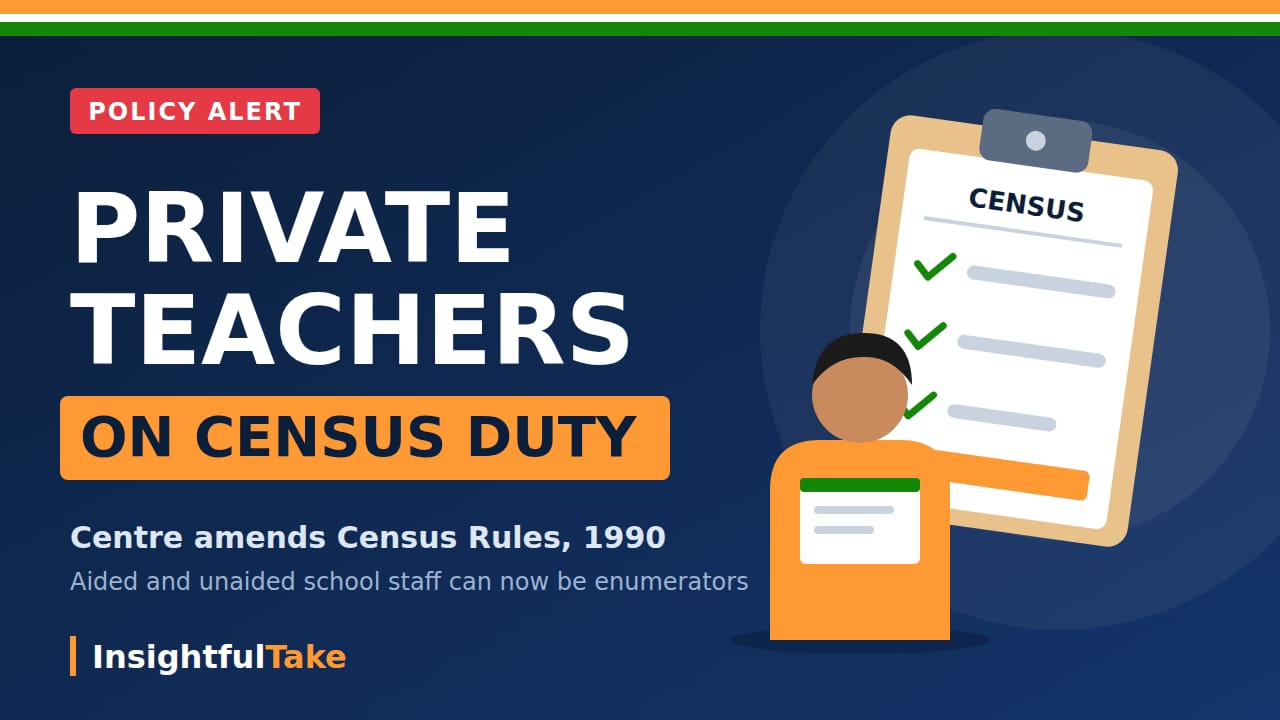
Private school teachers can now be assigned census duty under amended rules, expanding the workforce available to count India's population.
The Centre has changed the rules governing who can be assigned to count India’s population. Teachers from private schools, including aided and unaided institutions, can now be appointed as census enumerators.
The Census (Amendment) Rules, 1990, were notified on October 16, 2026. The amendment allows states and Union territories to include teachers employed by private bodies in the census workforce. The notification was issued by Registrar General of India and Census Commissioner Mritunjay Kumar Narayan.
What Was the Rule Before?
The original Census Rules of 1990 allowed teachers, clerks, officials and “any other person” to be appointed as enumerators. However, they did not clearly specify which categories of teachers or officials could be assigned census duties.
This lack of clarity became a point of legal dispute, particularly over whether teachers from private unaided schools could be required to perform government-assigned work.
Why Did the Centre Change the Rules?
The amendment follows legal challenges in several High Courts, including the Punjab and Haryana High Court, against the practice of assigning census duties to teachers from private unaided schools.
The petitioners argued that private unaided schools are not government institutions and that their employees should not be compelled to perform government duties.
By explicitly including teachers from private educational institutions in the rules, the Centre has sought to remove the ambiguity surrounding their appointment for census work.
Who Can Now Be Appointed as an Enumerator?
The amended rules identify three broad categories of people who can be assigned census duties:
- Teachers: Teachers employed by educational institutions run by the government, local authorities, or aided and unaided private bodies, societies and trusts.
- Clerks and officials: Employees of the Central Government, state governments, local authorities and various establishments. These include public sector undertakings, statutory bodies, banks, companies, institutions, societies and trusts.
- Other suitable persons: Individuals whom a state government or Union territory administration considers suitable for the assignment.
The notification also provides for the deployment of clerical staff and other individuals appointed by the state or Centre.
The government has exercised its powers under Section 18(1) of the Census Act, 1948, to introduce the changes.
What Does a Census Enumerator Do?
A census enumerator visits households, collects relevant information and records details needed for the population count. Enumerators form the backbone of the exercise, which requires a large workforce to reach households across the country within a limited period.
Teachers have traditionally been a major part of the census workforce because they are available across towns and villages, possess the necessary literacy and administrative skills, and are often familiar with local communities.
Why the Amendment Matters for Schools and Teachers
For private schools, the amendment means their teachers can now be formally included in the pool of personnel assigned census duties.
Private school managements have previously raised concerns that sending teachers away from classrooms disrupts academic schedules. Teachers' organisations have also criticised the additional burden of non-teaching assignments, including election duties, surveys and other government exercises.
The amendment is likely to renew the debate over how such responsibilities affect classroom teaching and students' learning.
While the new rules clarify the Centre's position on the eligibility of private school teachers, questions about workload, scheduling and the practical implementation of these assignments may remain important.
For state governments and Union territories, the change expands the pool of available personnel and could reduce legal obstacles in planning census operations.
Where Does the Census Stand?
Enumeration has already been completed in some of India's most difficult-to-reach regions.
In Ladakh and the snow-bound, non-synchronous areas of Jammu and Kashmir, Himachal Pradesh and Uttarakhand, the exercise took place from September 1 to 30.
These regions are counted earlier because heavy snowfall can make travel and access to remote settlements difficult later in the year.
Final Take
Two developments will be worth monitoring.
First, the status of pending High Court petitions challenging the deployment of private school teachers for census work. The amendment could affect how these cases proceed, although their legal outcomes will depend on the courts.
Second, how state governments implement the revised rules. Adequate training, coordination with schools, appropriate time off and fair compensation will be important in ensuring that census duties do not unnecessarily disrupt teaching.
The amendment expands the categories of people who can be called upon to help count India's population. For private school teachers, it brings a government responsibility that has long been contested into more explicit legal territory.


















Leave a Comment