
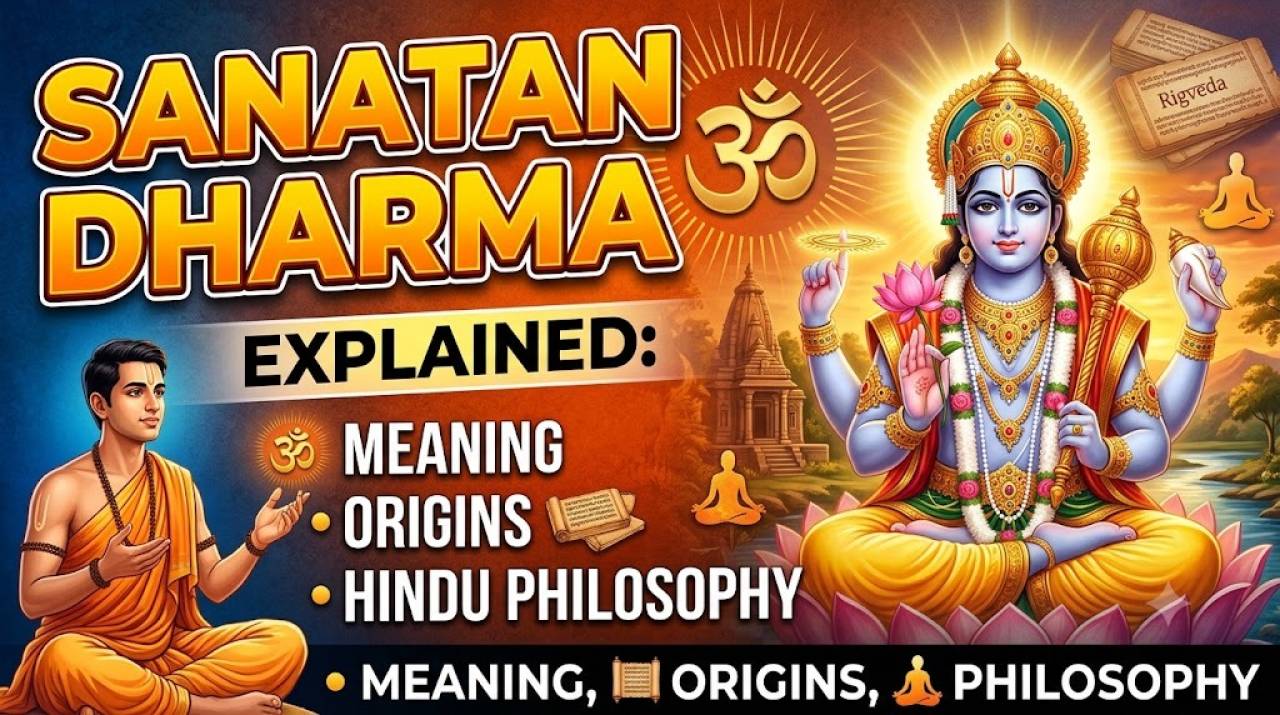
Many people identify as followers of Sanatan Dharma, but few can explain what Sanatan actually means. Its meaning goes far beyond a religious label.
Ask people on the street what Sanatan means, and many may confidently identify themselves as followers of Sanatan Dharma but struggle to explain the word itself. It is a revealing gap between religious identity and religious understanding. The word is widely used in public conversations, religious gatherings and everyday life, yet its deeper meaning deserves greater attention.
Sanatan Dharma is commonly understood as the eternal way of life associated with Hinduism. But what makes it eternal? Does it refer only to ancient religious traditions, or does it express a deeper philosophy about human existence, moral responsibility and the nature of truth?
To understand Sanatan Dharma, we must look beyond the word's popularity and explore the ideas it carries.
What Does Sanatan Actually Mean?
Sanatan is a Sanskrit word that means eternal, enduring, perennial or without an identifiable beginning or end. Dharma, however, is a much broader concept than the English word religion. Depending on the context, it can mean duty, righteousness, moral order, responsibility, or the principles that sustain life and society.
Together, Sanatan Dharma is commonly translated as “Eternal Dharma”, “Eternal Law” or “Eternal Way”.
The word dharma is particularly important because it does not refer merely to worship, rituals or belief in a particular deity. It also concerns how a person should live, act and fulfil their responsibilities.
For example, honesty, compassion, self-restraint, generosity and respect for other living beings are values that can guide human conduct across generations. They are not limited to a particular temple, region or period of history.
In the Hindu philosophical understanding, Sanatan Dharma points towards enduring spiritual and moral principles that remain relevant even as societies change.
Why Is Hinduism Called Sanatan Dharma?
Unlike religions commonly associated with a single historical founder, Hinduism developed through a long and diverse evolution of philosophical schools, spiritual practices, sacred texts, devotional traditions and local customs. Its heritage includes the Vedas, Upanishads, Bhagavad Gita, Ramayana, Mahabharata and the Puranas, among many other works.
These traditions do not always offer identical answers to life's fundamental questions. Some emphasise devotion to a personal God, others focus on philosophical inquiry, and still others explore meditation, disciplined action or the realisation of the self.
The term Sanatan Dharma expresses the belief that certain spiritual truths and principles transcend particular historical periods and individual teachers.
For many Hindus, it is therefore a meaningful name for their religious and philosophical heritage. It emphasises continuity, the enduring nature of dharma and the search for truth rather than the authority of a single founder.
However, historical accuracy matters here. Although the expression Sanatan Dharma has roots in classical Sanskrit literature, historians distinguish its older use to describe enduring duties or principles from its later adoption as a collective name for Hinduism. Its widespread use as an alternative name for Hinduism became prominent during the nineteenth century. This does not diminish its religious significance; it helps us understand how the term acquired its present meaning.
The Bhagavad Gita and the Idea of Sanatan
One important reference appears in the Bhagavad Gita, where Arjuna uses the expression sanatana dharma while expressing concern about the destruction of family traditions during war.
In Chapter 1, Verse 40, Arjuna says that when a family is destroyed, its enduring family duties and traditions are lost, and moral disorder follows.
The context is significant. Arjuna is not simply discussing a religious label. He is worried about the breakdown of responsibilities, customs and ethical order that hold families and communities together.
The passage illustrates how the word sanatan can describe something enduring across generations. It also shows that the expression must be understood in its textual context rather than reduced to a slogan.
The Bhagavad Gita's wider teaching further emphasises dharma through Krishna's guidance to Arjuna about duty, right action, self-knowledge and spiritual understanding.
Is Sanatan Dharma Only About Worship?
A common misunderstanding is that religion begins and ends with rituals, festivals, pilgrimages and temple visits. These practices are important to many Hindus, but the philosophical idea of dharma extends beyond them.
A person may visit a temple every morning, observe religious fasts and recite sacred verses. Yet if that person routinely deceives others, exploits the vulnerable or acts without compassion, an important question arises: how fully are the values associated with dharma reflected in that person's conduct?
Sanatan Dharma, understood as an ethical and spiritual ideal, invites people to examine their actions alongside their beliefs.
The Hindu tradition contains many discussions of truth, non-violence, charity, forgiveness, self-discipline and the responsibility to act according to dharma. Different schools interpret these duties in different ways, and moral questions can involve difficult choices. Nevertheless, the relationship between spiritual understanding and responsible conduct remains central to Hindu thought.
Faith, in this sense, is not merely something to profess. It is also something to practise.
Does Eternal Mean That Everything Must Remain Unchanged?
The word Sanatan may create the impression that everything associated with Hinduism must remain exactly as it was in the distant past. But the history of Hindu traditions tells a more complex story.
Hinduism encompasses numerous philosophical schools, regional traditions, languages, forms of worship and interpretations of sacred texts. It has evolved through debate, reform, the work of spiritual teachers and encounters with changing societies.
The enduring character of Sanatan Dharma is therefore understood by its adherents not simply as the preservation of every historical custom, but as the continuity of deeper spiritual principles.
This distinction matters. A practice may be old without necessarily being eternal, just as a new interpretation may seek to express an enduring ethical principle in contemporary circumstances.
The challenge is to distinguish between the principles a tradition considers timeless and the customs that have developed within particular social and historical settings.
Understanding Sanatan Beyond Slogans
If we identify ourselves as followers of Sanatan Dharma, we should be able to explain what the term means and why it matters to us. Religious understanding should not depend solely on what we hear in public speeches, social media posts or debates.
A meaningful engagement with Sanatan Dharma begins with curiosity: reading the Bhagavad Gita, exploring the Upanishads, understanding the concept of dharma and learning about the different philosophical traditions within Hinduism.
It also requires the humility to recognise that a vast tradition cannot be fully explained through a single definition.
Ultimately, Sanatan Dharma represents, for many Hindus, an enduring spiritual and ethical vision of life. Its significance lies not only in its antiquity but also in the questions it asks about truth, duty, self-knowledge and the relationship between human beings and the larger order of existence.
The next time someone asks what Sanatan means, the answer need not be complicated.
Sanatan means eternal or enduring, while Dharma refers to the principles, duties and moral order that sustain life. Sanatan Dharma is the Hindu tradition's widely used expression for an enduring spiritual and ethical way of life.
Understanding these words is a small but meaningful step towards understanding one's own religious heritage. And a faith understood with knowledge, reflection and responsibility is far richer than one expressed through identity alone.























Leave a Comment