
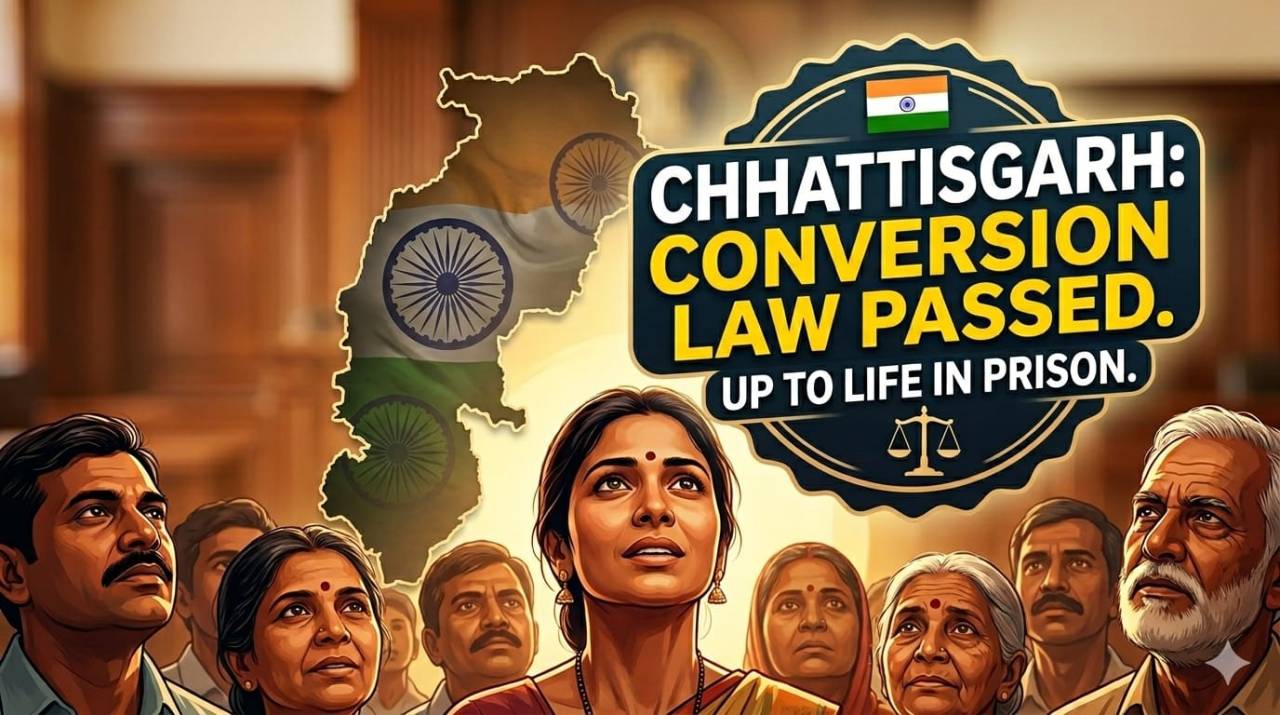
A new law in Chhattisgarh has sparked a sharp national debate. It brings life imprisonment for mass religious conversions. Supporters call it protection of culture. Critics warn of misuse and loss of personal freedom. Here is what the new anti-conversion bill really means.
In a major legislative move, the Chhattisgarh Legislative Assembly has passed the Chhattisgarh Dharm Swatantraya Vidheyak 2026 (Freedom of Religion Bill 2026). The new law, aimed at curbing forced and fraudulent religious conversions, introduces some of the harshest penalties in the country, including life imprisonment for "mass conversions."
The bill was passed on March 19, 2026, following a five-hour debate and a subsequent walkout by the opposition Indian National Congress. It officially replaces the decades-old Freedom of Religion Act of 1968, which the government argued was no longer sufficient to address modern-day challenges such as digital inducements and organized "changai sabhas" (faith healing meetings).
Why the New Law Was Necessary
Chief Minister Vishnu Deo Sai described the bill as a "historic milestone" for preserving the cultural identity and social harmony of Chhattisgarh. According to the Chief Minister’s Office (CMO), the legislation is specifically designed to protect vulnerable sections of society, including women, minors, and members of Scheduled Castes (SC) and Scheduled Tribes (ST).
Home Minister Vijay Sharma, who tabled the bill, noted that the 1968 law lacked the teeth to handle conversions influenced through social media, electronic communication, or sophisticated economic promises.
Key Provisions: Life Terms and Heavy Fines
The 2026 Bill creates a tiered system of punishments based on the severity of the offence:
- Mass Conversions: Defined as the conversion of two or more individuals in a single event. Those found guilty face 10 years to life imprisonment and a minimum fine of ₹25 lakh.
- Vulnerable Groups: If the illegal conversion involves a minor, a woman, or a person from the SC/ST/OBC community, the punishment ranges from 10 to 20 years in prison with a minimum fine of ₹10 lakh.
- General Violations: Any other illegal conversion through force, fraud, or allurement carries a jail term of 7 to 10 years and a fine of ₹5 lakh.
- Public Servants: Government officials found participating in illegal conversions face a minimum of 10 years and up to 20 years in prison.
- Victim Compensation: Courts can order the accused to pay up to ₹10 lakh in compensation to the victim.
The New Process for Legal Conversion
The state has implemented a rigorous administrative process for those wishing to change their faith voluntarily. To ensure transparency, the following steps are now mandatory:
- Prior Declaration: Individuals intending to convert must submit a formal declaration to the District Magistrate (DM) or an Additional District Magistrate at least 60 days in advance.
- Public Scrutiny: The DM will publish the details of the proposed conversion at the tehsildar office, gram panchayat, and local police station.
- Objections and Inquiry: Authorities will have 30 days to verify the authenticity of the conversion. If no force or allurement is found, the conversion can proceed.
What Does Not Count as "Conversion"?
The bill makes a crucial distinction regarding "Reconversion." Returning to one’s ancestral religion (Ghar Wapsi) will not be treated as a conversion under this law and does not require the same declaration process.
Additionally, the law clarifies that marriages performed solely for the purpose of religious conversion will be declared invalid unless the specific legal notification process was followed.
Political and Social Response
While the ruling Bharatiya Janata Party government maintains the law is a shield for the state's traditional culture, the Opposition Congress expressed deep concerns. They argued that the bill could be misused to harass individuals and demanded it be sent to a Select Committee for further review. Critics have also pointed out that the public display of conversion details could compromise the privacy and safety of citizens.
All offences under the new Act are cognizable and non-bailable, with trials to be conducted in designated special courts.


















Leave a Comment