
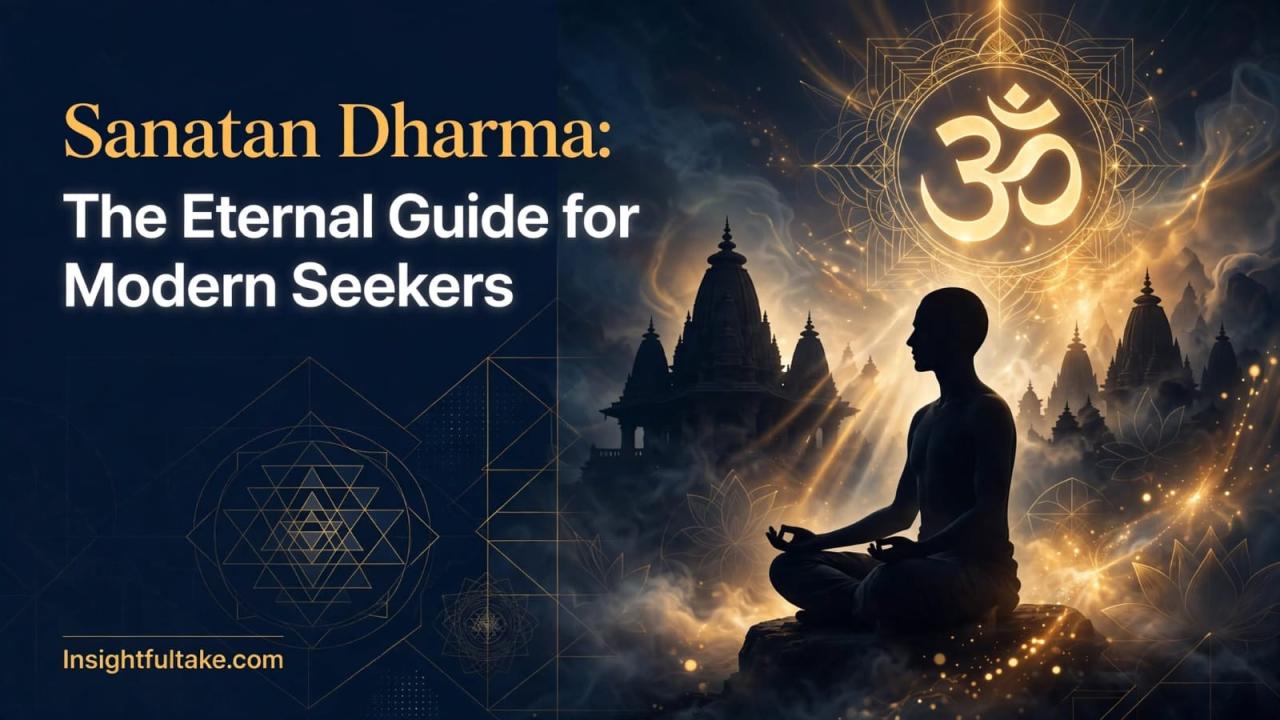
At a time when modern life is becoming increasingly complicated, the ancient wisdom of Sanatan Dharma offers a different perspective on happiness, responsibility, human relationships and the purpose of existence.
Human civilisation has made remarkable progress. Technology has brought distant continents closer, medical science has extended human life, and information is available almost instantly. Yet, despite these achievements, many people struggle with anxiety, loneliness and a persistent sense of dissatisfaction. Material comforts have multiplied, but questions about happiness, morality and the meaning of life remain largely unanswered.
These concerns are hardly new. Thousands of years ago, Indian sages and philosophers were contemplating similar questions. Their reflections gradually shaped a vast spiritual and philosophical tradition known as Sanatan Dharma.
For generations, Sanatan Dharma has influenced Indian society, literature, philosophy and everyday conduct. Its teachings extend beyond temples, ceremonies and religious observances. They address the relationship between individuals and society, humanity and nature, and the physical and spiritual dimensions of existence.
In an age dominated by consumerism, competition and technological change, these ideas invite renewed attention.
What Does Sanatan Dharma Mean?
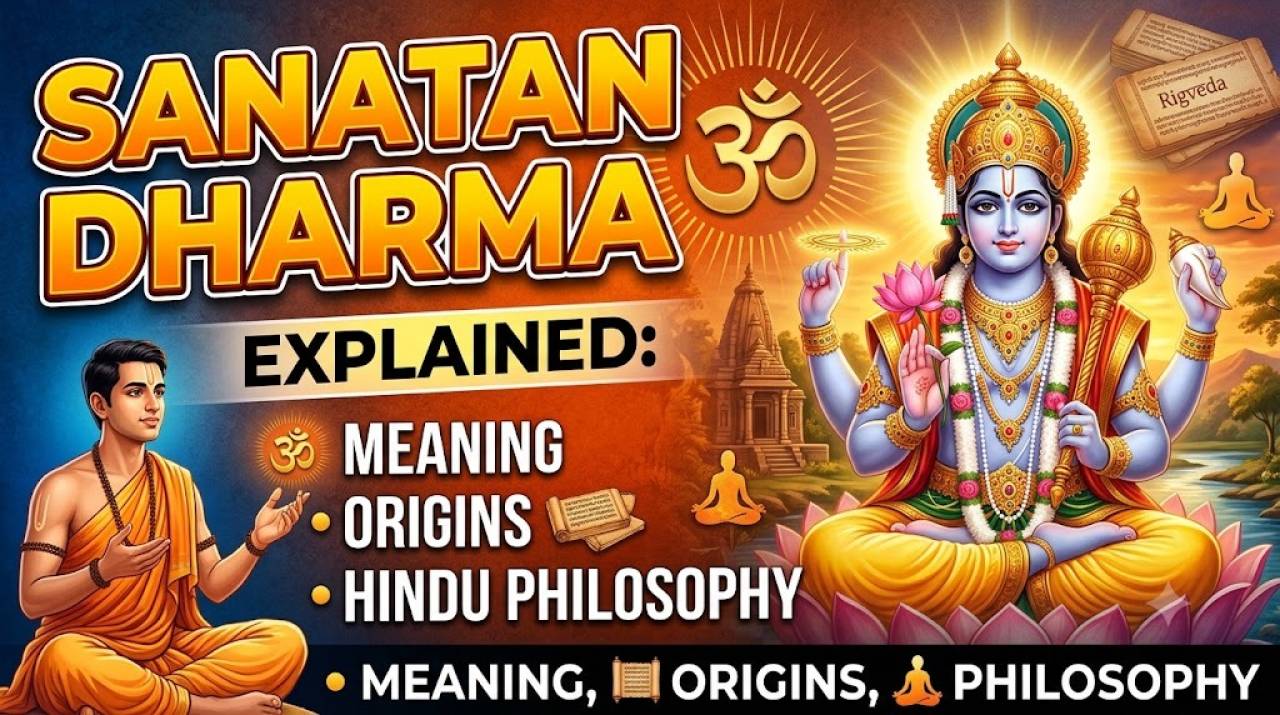
The expression Sanatan Dharma originates from Sanskrit. Sanatan means eternal, everlasting or enduring, while Dharma carries several meanings, including righteousness, duty, moral responsibility and the principles that sustain order.
Together, the words are commonly understood as the eternal principles governing righteous living.
Sanatan Dharma is closely associated with Hinduism, although its meaning extends beyond a simple religious designation. It represents a philosophical understanding of existence developed through centuries of spiritual inquiry, debate and cultural practice.
Unlike religious traditions founded by a single historical personality, Hinduism evolved through diverse schools of thought and spiritual practices. Its philosophical foundations appear in ancient texts such as the Vedas, Upanishads and Bhagavad Gita.
These scriptures explore fundamental questions about human existence. What constitutes a good life? What are our responsibilities towards others? Why do human beings suffer? Is there something beyond material existence?
Different philosophical schools offer different interpretations. Nevertheless, the importance of ethical conduct, self-discipline, knowledge and spiritual development remains central to much of the tradition.
The idea of Dharma is particularly significant. It suggests that human freedom must coexist with responsibility. An individual's actions have consequences, not merely for personal circumstances but also for family, society and the natural world.
Was Sanatan a King or Historical Figure?
A misconception occasionally arises that Sanatan Dharma derives its name from an ancient king or religious founder. There is no historical basis for this interpretation.
The word Sanatan is an adjective describing something eternal. It does not refer to a monarch or an individual responsible for establishing the tradition.
Hindu scriptures, however, mention a sage named Sanatana, one of the four Kumaras. According to traditional accounts, these four sages—Sanaka, Sanandana, Sanatana and Sanatkumara—are associated with spiritual knowledge, renunciation and the pursuit of truth.
Their presence in Hindu sacred literature should not be confused with the origin of the expression Sanatan Dharma.
The distinction matters because the tradition draws its identity from enduring philosophical principles rather than allegiance to a particular historical founder.
Why Sanatan Dharma Remains Relevant in Modern Society
The circumstances of human life have changed dramatically over the centuries. Ancient communities depended largely on agriculture and traditional social structures. Modern societies function through industries, digital networks and global markets.
Yet human emotions have changed remarkably little.
Fear, ambition, jealousy, attachment, compassion and the desire for happiness continue to influence human behaviour. People still struggle to reconcile personal ambitions with moral obligations.
Sanatan Dharma addresses these concerns through ideas that remain open to interpretation in contemporary life.
Finding Peace in an Age of Anxiety
Modern society places enormous emphasis on achievement. Professional success, financial security and social recognition often become measures of personal worth.
The pressure to succeed can leave little room for reflection.
Indian spiritual traditions have long emphasised the importance of understanding the mind. Practices such as yoga, meditation and disciplined living encourage individuals to examine their thoughts and develop greater awareness.
These practices have philosophical and spiritual roots extending beyond their contemporary association with physical fitness and wellness.
The Bhagavad Gita offers another perspective through its discussion of action and attachment.
In Chapter 2, Verse 47, Krishna teaches Arjuna that a person has a claim to action, but not to its fruits.
The teaching does not discourage ambition or responsibility. Rather, it cautions against becoming so attached to expected results that the process of living loses its meaning.
For a student preparing for examinations, a professional confronting uncertainty or an individual experiencing disappointment, the principle offers a practical lesson.
Effort remains within human control. Outcomes do not always follow personal expectations.
Recognising this distinction can encourage perseverance without allowing success or failure to determine one's entire sense of worth.
Respecting Nature Rather Than Exploiting It
One of the striking features of Hindu traditions is their spiritual relationship with nature.
Rivers, mountains, forests, trees and animals occupy important places in religious narratives and cultural practices.
The Ganga is revered as sacred. The peepal and banyan trees hold religious significance. Numerous animals appear in Hindu mythology as companions or vehicles of deities.
Such associations reflect a worldview in which human beings are not entirely separate from the natural environment.
This perspective deserves attention at a time when climate change, pollution, deforestation and declining biodiversity threaten ecological stability.
Modern environmental science explains the consequences of ecological destruction through measurable evidence. Traditional religious philosophy approaches the relationship through ethical and spiritual understanding.
The two are not identical, but they can reinforce a shared principle: nature deserves respect and responsible treatment.
Of course, religious reverence does not automatically guarantee environmental protection. Sacred rivers continue to suffer pollution, and religious activities themselves can sometimes damage fragile ecosystems.
The challenge, therefore, is to translate cultural respect into responsible behaviour.
Protecting rivers, conserving water, reducing waste and preserving forests would give practical meaning to the traditional idea of living in harmony with nature.
Understanding Diversity and Religious Thought
Sanatan Dharma encompasses a remarkable diversity of philosophical traditions.
Some schools emphasise devotion to a personal deity. Others focus on knowledge, meditation, disciplined action or the nature of ultimate reality.
The Advaita tradition associated with Adi Shankaracharya emphasises the non-dual nature of ultimate reality. Other philosophical schools offer different understandings of the relationship between the individual soul, God and the universe.
This intellectual diversity has shaped Hindu philosophical discourse for centuries.
The Rig Veda contains the celebrated expression Ekam Sat Vipra Bahudha Vadanti, commonly interpreted as the idea that truth is one, though the wise describe it in different ways.
The verse has frequently been invoked to express the value of philosophical openness.
However, it would be misleading to suggest that every historical practice associated with Hindu society has always reflected equality or tolerance. Like other civilisations, Indian society has experienced discrimination, hierarchy and conflict.
The enduring relevance of spiritual philosophy lies partly in its capacity to encourage critical reflection on such contradictions.
A tradition that values the search for truth must also allow individuals to question practices that undermine human dignity.
Cultural Identity in a Changing World
For millions of Indians, Sanatan Dharma is inseparable from cultural memory.
Its influence appears in classical literature, music, dance, architecture, festivals and family traditions.
Diwali, Holi, Navratri and other celebrations carry religious significance while also strengthening social relationships and community participation.
Indian communities living abroad have carried these traditions across generations. Temples, cultural organisations and festivals have become important centres for preserving heritage and maintaining connections with India.
The international popularity of yoga and growing interest in Indian philosophical texts have also introduced aspects of this heritage to wider audiences.
Yet cultural pride becomes more meaningful when accompanied by understanding.
Knowing why a festival is celebrated, what a scripture teaches or how a philosophical idea developed provides a deeper connection than merely repeating inherited customs.
Traditions survive not only because they are preserved but also because successive generations discover their relevance.
Sanatan Dharma in the Digital Age
The internet has transformed how religious and philosophical knowledge circulates.
Teachings once encountered primarily through family traditions, religious institutions or printed commentaries are now available through online lectures, digital libraries, podcasts and social media.
Young people can explore translations of the Bhagavad Gita, listen to discussions on Vedanta or learn about different schools of Indian philosophy without travelling to traditional centres of learning.
This accessibility has created opportunities for wider engagement.
However, the digital presentation of religion also raises concerns.
Complex philosophical ideas are frequently reduced to motivational slogans. Scriptural quotations circulate without context, while historical claims are sometimes presented without reliable evidence.
Social media rewards emotional reactions and simplified narratives. Serious philosophical inquiry requires patience, interpretation and a willingness to examine competing viewpoints.
A short video may introduce someone to an ancient teaching, but it cannot replace a careful understanding of the text and its historical context.
For modern seekers, the challenge is to distinguish genuine learning from superficial religious content.
Sanatan Dharma's intellectual heritage is far too extensive to be understood through hashtags alone.
Beyond Rituals: The Importance of Ethical Living
Religious observances remain important to many followers of Sanatan Dharma. Prayer, fasting, pilgrimage and temple worship provide spiritual meaning and strengthen community bonds.
However, philosophical teachings also place considerable emphasis on conduct.
Concepts such as Satya (truthfulness), Ahimsa (non-violence), Daya (compassion) and Seva (service) have influenced Hindu ethical thought, although their interpretation varies across traditions.
Their relevance extends beyond religious identity.
A person may observe elaborate rituals while behaving dishonestly in professional life. Another may rarely visit a temple but consistently demonstrate kindness, integrity and responsibility.
This raises an important question about the relationship between religious practice and moral character.
Rituals can express devotion, but ethical conduct determines how that devotion influences the lives of others.
In contemporary society, the principle can be applied to everyday situations.
An employer who treats workers fairly, a public servant who refuses corruption, or a citizen who respects another person's dignity demonstrates values that religious philosophy has long encouraged.
Spirituality acquires greater social meaning when it influences behaviour rather than remaining confined to ceremonial observance.
Can Ancient Wisdom Answer Modern Questions?
It would be unrealistic to expect ancient scriptures to provide direct solutions to every contemporary problem.
Sanatan Dharma cannot replace scientific research, modern medicine, democratic institutions or evidence-based public policy.
Nor should every ancient practice be accepted without examination simply because it belongs to a respected tradition.
Its continuing importance lies elsewhere.
It encourages reflection on questions that technological progress alone cannot resolve.
What should human beings consider valuable? How much wealth is enough? What obligations do individuals have towards society? Can ambition coexist with compassion? How should people respond to suffering and uncertainty?
These questions remain relevant regardless of technological advancement.
The strength of a philosophical tradition is not necessarily measured by its ability to resist change. It may also be measured by its capacity to engage with new circumstances while retaining meaningful ethical principles.
For Sanatan Dharma, that engagement requires both respect for inherited wisdom and the freedom to question inherited practices.
The Eternal Search for Meaning
Humanity has travelled a considerable distance since the earliest Indian philosophical texts were composed. The world now operates through technologies that ancient thinkers could scarcely have imagined.
Nevertheless, the search for a meaningful life continues.
People still desire happiness, struggle with uncertainty and seek relationships founded on trust and affection. They continue to ask whether existence has a purpose beyond material achievement.
Sanatan Dharma remains relevant because it engages with these enduring concerns.
Its teachings on duty, self-knowledge, compassion and the relationship between human beings and nature offer a framework for reflection. They need not be interpreted as ready-made answers to every difficulty.
For those who follow the tradition, Sanatan Dharma provides a spiritual foundation. For others, its philosophical literature can offer an opportunity to understand an important part of humanity's intellectual heritage.
Perhaps its greatest contribution is the reminder that progress and wisdom are not necessarily the same.
A civilisation may acquire extraordinary technological power without developing an equally strong sense of moral responsibility.
The task before modern society is not to abandon progress in favour of the past. It is to ensure that progress serves human dignity, social harmony and the wellbeing of the natural world.
Sanatan Dharma's enduring message is that the quality of human life depends not merely on what we achieve, but also on how we live, what we value and how we treat one another.
It is worth considering in every age.


























Leave a Comment