
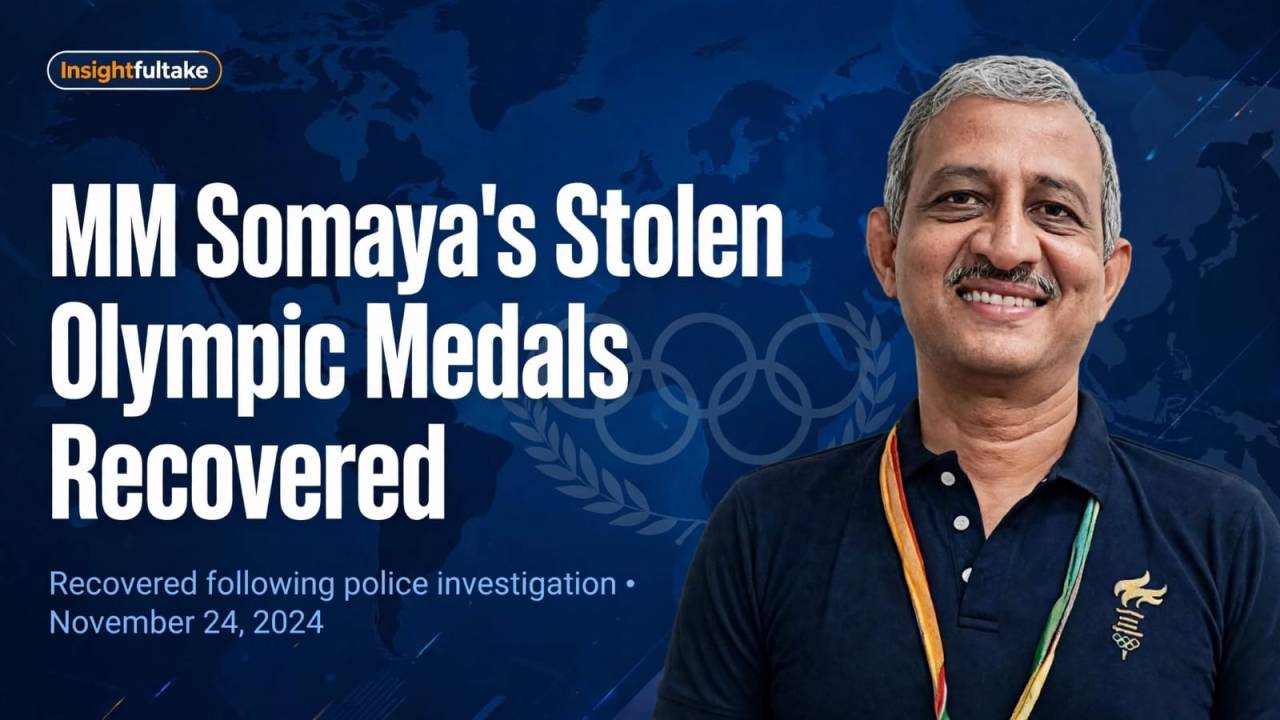
The recovery of MM Somaya's Olympic medals exposes a bigger question: who protects India's sporting history when its champions are left to guard it themselves?
Last month, thieves broke into a house in east Bengaluru while the family was away in Kodagu. They were looking for cash and jewellery. As media reported, they had no idea that the collection of metal objects they swept into their bag included an Olympic gold medal from Moscow 1980.
The police have since recovered the medals and arrested two suspects, while a third remains at large. It is a happy ending, but the incident should make us uncomfortable.
The Facts Behind the Theft
The house belongs to MM Somaya, a member of the Indian hockey team that won gold at the 1980 Moscow Olympics. Eight medals were stolen, including a silver from the 1982 Asian Games and a bronze from the 1986 Seoul Asian Games.
The collection also included a 1982 Champions Trophy bronze, participation medals from the 1984 and 1988 Olympics, and a commemorative medal marking the 300th birth anniversary of Guru Gobind Singh.
Two of the pieces had been sold to a firm in Rajajinagar. The other six were recovered from a suspect's home in Hoskote. The police commissioner described it as one of the toughest cases the force had faced because there were no clues to follow.
The detail that stays with me is that the medals were not recovered because any system of protection was in place. They were recovered despite the absence of one. A burglar's ignorance saved them from being treated as nothing more than scrap, and the police intervened before they could be melted down.
A Gold Medal With a Story Attached
India's hockey gold at the 1980 Moscow Olympics was the country's eighth Olympic gold in the sport. It also remains the last Olympic gold India has won in its national game.
That medal is not merely a personal keepsake. It marks the end of an era that shaped how generations of Indians understood sporting pride. Yet its physical custody rested entirely on one family's front door.
This is not a criticism of Somaya, who did what most Indian athletes do. We tell our champions that the medals belong to them, and then leave them to decide where to keep them.
Few have access to a vault or a museum willing to preserve their achievements. As a result, the nation's sporting memory remains scattered across wardrobes, trunks and drawers in private homes.
We Have Been Here Before
This is not the first such incident. In 2004, Rabindranath Tagore's Nobel Prize medallion was stolen from Visva-Bharati University in Santiniketan. It was never recovered.
That theft took place inside an institution, not a private home, yet the result was the same.
The lesson is that India has often treated its honours as objects of sentiment rather than assets of national heritage. They deserve the same documentation, preservation and security that we would expect for valuable paintings, manuscripts and historical artefacts.
What a Country Should Do
First, create a national registry.
Every major medal won by an Indian athlete at the Olympic Games, Asian Games or world championships should be catalogued, photographed and documented by the Sports Ministry or the Sports Authority of India.
A medal that has been officially documented is harder to sell quietly and easier to identify if it surfaces in the market.
Second, give athletes an option to preserve their medals.
Athletes should have the choice to loan or donate their medals to a national sports museum, while keeping replicas at home for display. Many may welcome this arrangement, particularly veteran sportspersons in their sixties and seventies who worry about what will happen to their legacy.
Nobody should be forced to surrender what they earned. But the choice should exist.
Third, provide support for security.
A retired athlete living on a modest pension cannot reasonably be expected to maintain a bank locker or an alarm system for decades.
Subsidised bank lockers or insurance cover for medal-holders would cost relatively little compared with the public money spent celebrating new champions.
Fourth, build a sporting culture that remembers.
India invests heavily in its athletes of the moment, and rightly so. But a country that celebrates its latest medal while neglecting the physical records of earlier achievements is treating its sporting history as disposable.
Honouring champions should not end with ceremonies, speeches and social media posts. Their achievements must also be preserved for future generations.
Gratitude, But Not Complacency
The Bengaluru police deserve credit. They solved a case with virtually no leads and returned a piece of national sporting history. Somaya himself reacted with remarkable grace, saying he felt as though he had won the medals all over again.
That generosity of spirit is precisely why we should not leave him, or any other former champion, dependent on luck.
The medals came home this time. The burglars did not understand their value, and the police pursued the case persistently. Neither circumstance amounts to a protection policy.
If Olympic gold is to remain more than a line in a record book, India must protect it as the national treasure it represents. That responsibility begins long before the next break-in, not after it.
























Leave a Comment