
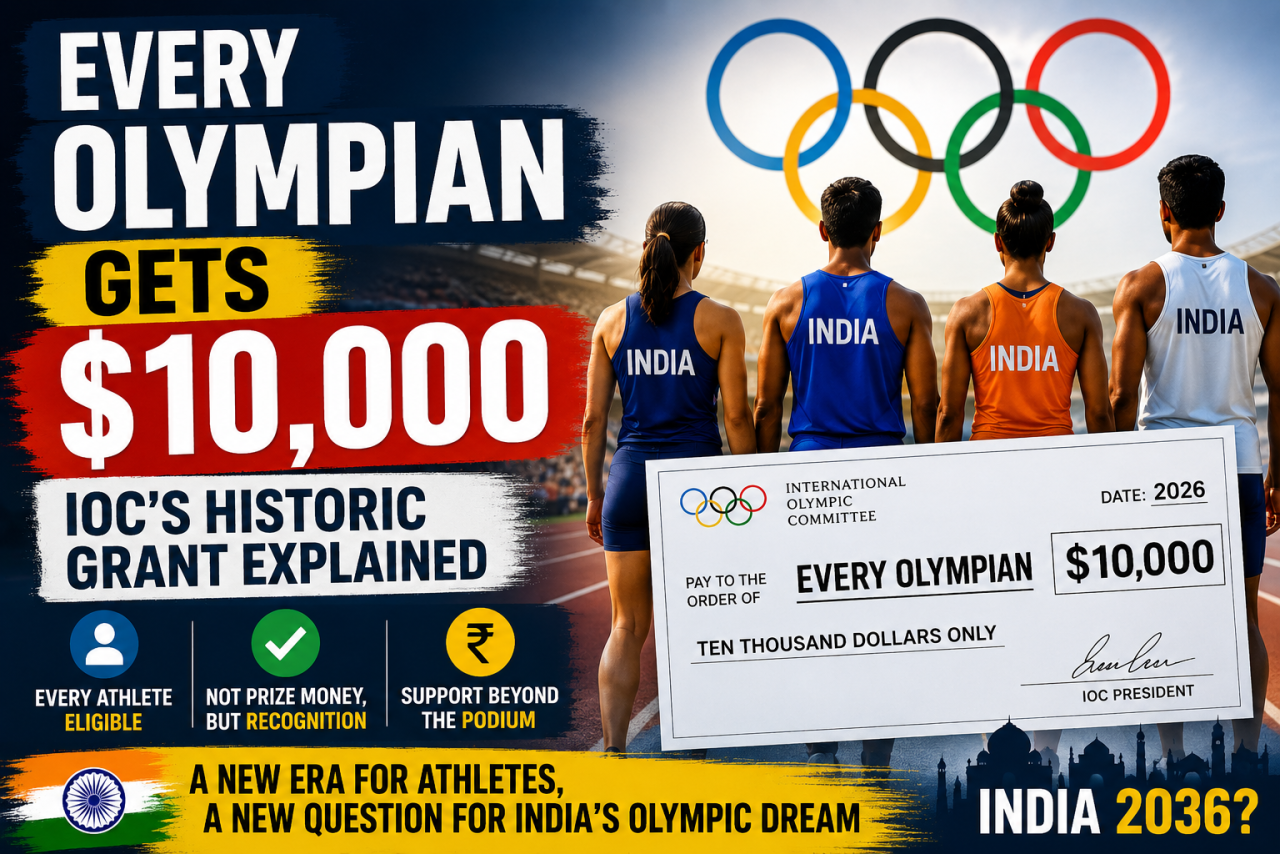
For the first time, the IOC will financially recognise every Olympian—not just medal winners. The decision could reshape athlete welfare and influence India's Olympic future.
The International Olympic Committee (IOC) has approved a new grant programme under which every athlete who competes at the Olympic Games will be eligible to apply for a $10,000 grant. The decision was taken at the IOC Session in Lausanne and will first apply to athletes who participated in the 2026 Milan Cortina Winter Olympics. It will later be extended to athletes competing at the 2028 Los Angeles Summer Olympics.
The programme represents a significant policy change for the Olympic movement. Until now, the IOC did not provide any direct financial support linked to participation in the Games. Athletes generally depended on assistance from national federations, governments, sponsors, or personal resources. While medal winners in many countries receive rewards, athletes who qualify for the Olympics but do not finish on the podium often receive little financial recognition.
According to the IOC, the grant is not intended to function as prize money. Instead, it is designed as a participation grant that recognises the effort required to reach the Olympic Games. Athletes will be required to satisfy eligibility conditions, including compliance with anti-doping regulations.
The distinction between prize money and a participation grant is important. Prize money rewards sporting performance and final results. The new IOC scheme recognises qualification for the Olympics itself as an achievement. In doing so, it acknowledges the years of training, competition, and preparation required to reach the world's highest sporting stage.
The announcement comes during the first year of IOC President Kirsty Coventry's tenure. Coventry, a former Olympic champion from Zimbabwe, had emphasised athlete welfare during her campaign for the presidency. The grant programme is one of the first major initiatives introduced under her leadership and reflects a broader effort to place athletes more directly at the centre of Olympic policy.
The move also follows an ongoing debate about athlete compensation in international sport. In recent years, some sporting bodies have argued that athletes should receive a greater share of the revenues generated by major events. World Athletics, for example, introduced prize money for gold medallists at the Paris Olympics. While the IOC has not adopted that model, the new grant suggests a willingness to explore new forms of athlete support.
For India, the decision arrives at an important time. The country is pursuing its bid to host the 2036 Olympic Games and is currently engaged in discussions with the IOC. At the same time, Indian sport continues to face challenges related to funding, infrastructure, and athlete support.
Many Indian athletes train with limited financial security, particularly in disciplines that receive less commercial attention. Although government schemes and private sponsorship have expanded in recent years, access to stable funding remains uneven. For such athletes, a guaranteed grant after Olympic participation may not be transformative, but it can provide additional support and recognition.
The amount itself is unlikely to cover the full cost of preparing for an Olympic cycle. Expenses related to coaching, equipment, travel, nutrition, and recovery are often much higher. However, the significance of the programme lies less in its monetary value and more in the principle it establishes.
By introducing a participation grant, the IOC has formally recognised that athletes contribute to the Olympic movement regardless of whether they win medals. The decision does not end discussions about athlete compensation, but it indicates a change in how the organisation views the role and welfare of competitors.
As India advances its Olympic ambitions and prepares for future Games, the policy offers a reminder that sporting success depends not only on medals and infrastructure, but also on the systems that support athletes throughout their careers.
The International Olympic Committee (IOC) has approved a new grant programme under which every athlete who competes at the Olympic Games will be eligible to apply for a $10,000 grant. The decision was taken at the IOC Session in Lausanne and will first apply to athletes who participated in the 2026 Milan Cortina Winter Olympics. It will later be extended to athletes competing at the 2028 Los Angeles Summer Olympics.
The programme represents a significant policy change for the Olympic movement. Until now, the IOC did not provide any direct financial support linked to participation in the Games. Athletes generally depended on assistance from national federations, governments, sponsors, or personal resources. While medal winners in many countries receive rewards, athletes who qualify for the Olympics but do not finish on the podium often receive little financial recognition.
According to the IOC, the grant is not intended to function as prize money. Instead, it is designed as a participation grant that recognises the effort required to reach the Olympic Games. Athletes will be required to satisfy eligibility conditions, including compliance with anti-doping regulations.
The distinction between prize money and a participation grant is important. Prize money rewards sporting performance and final results. The new IOC scheme recognises qualification for the Olympics itself as an achievement. In doing so, it acknowledges the years of training, competition, and preparation required to reach the world's highest sporting stage.
The announcement comes during the first year of IOC President Kirsty Coventry's tenure. Coventry, a former Olympic champion from Zimbabwe, had emphasised athlete welfare during her campaign for the presidency. The grant programme is one of the first major initiatives introduced under her leadership and reflects a broader effort to place athletes more directly at the centre of Olympic policy.
The move also follows an ongoing debate about athlete compensation in international sport. In recent years, some sporting bodies have argued that athletes should receive a greater share of the revenues generated by major events. World Athletics, for example, introduced prize money for gold medallists at the Paris Olympics. While the IOC has not adopted that model, the new grant suggests a willingness to explore new forms of athlete support.
For India, the decision arrives at an important time. The country is pursuing its bid to host the 2036 Olympic Games and is currently engaged in discussions with the IOC. At the same time, Indian sport continues to face challenges related to funding, infrastructure, and athlete support.
Many Indian athletes train with limited financial security, particularly in disciplines that receive less commercial attention. Although government schemes and private sponsorship have expanded in recent years, access to stable funding remains uneven. For such athletes, a guaranteed grant after Olympic participation may not be transformative, but it can provide additional support and recognition.
The amount itself is unlikely to cover the full cost of preparing for an Olympic cycle. Expenses related to coaching, equipment, travel, nutrition, and recovery are often much higher. However, the significance of the programme lies less in its monetary value and more in the principle it establishes.
By introducing a participation grant, the IOC has formally recognised that athletes contribute to the Olympic movement regardless of whether they win medals. The decision does not end discussions about athlete compensation, but it indicates a change in how the organisation views the role and welfare of competitors.
As India advances its Olympic ambitions and prepares for future Games, the policy offers a reminder that sporting success depends not only on medals and infrastructure, but also on the systems that support athletes throughout their careers.























Leave a Comment