
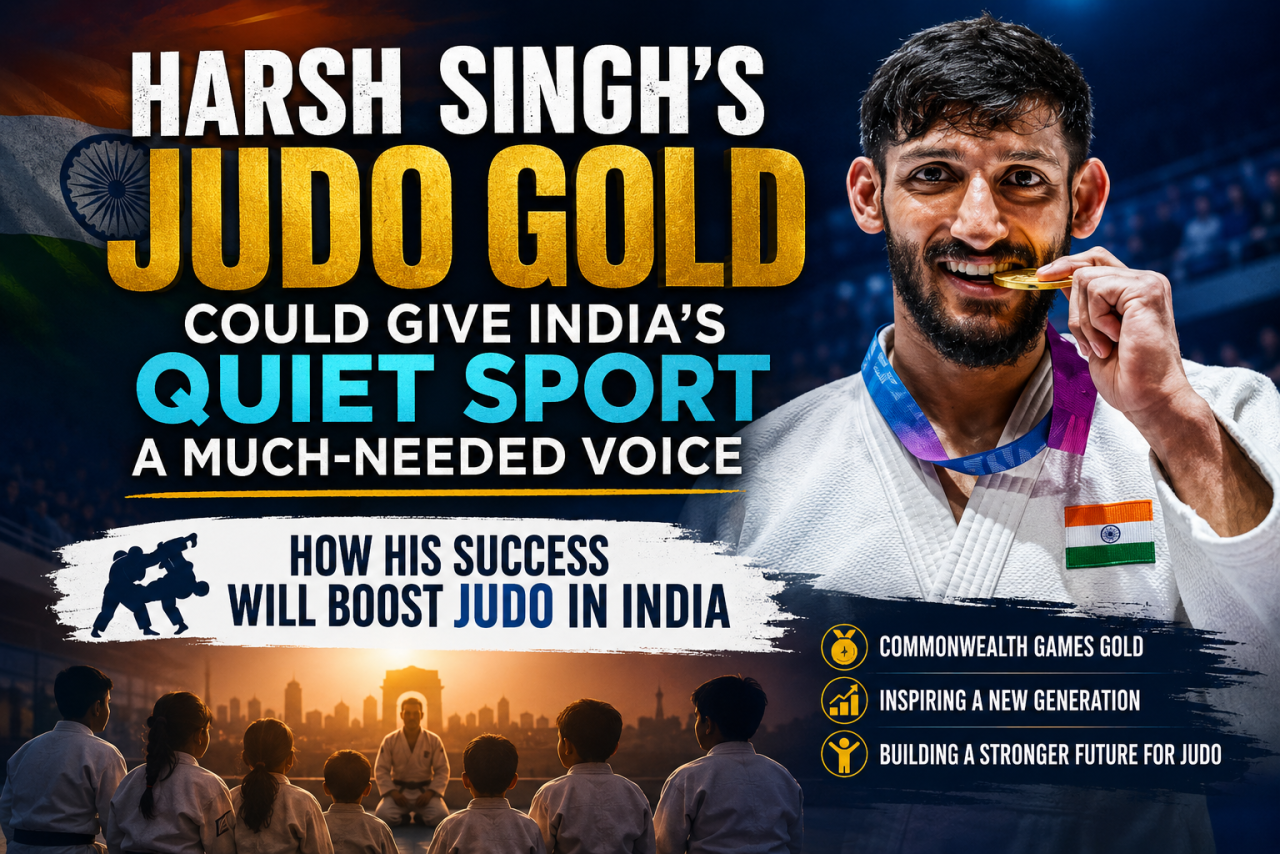
Harsh Singh’s judo triumph could put India’s overlooked sport in the spotlight and inspire a new generation of judo players..
For years, judo in India has lived in the shadow of sports that receive bigger crowds, stronger sponsorships and more media attention. Many young Indians know the names of cricketers, badminton players, boxers and wrestlers, but far fewer can name a top Indian judoka.
That may begin to change after Harsh Singh’s gold medal in the men’s 60kg judo event at the Commonwealth Games in Glasgow.
Singh’s victory is important not only because it has added another international gold to India’s medal tally. It is important because his story can change the way people look at judo itself. A sport that once appeared distant to many Indian families may suddenly look like a realistic career option for young athletes.
People in his Delhi neighbourhood who earlier knew little about judo are now thinking about putting their children into the sport. That could be the real impact of his victory.
A sport that has struggled for attention
Judo has many qualities that should make it attractive in India. It requires strength, speed, balance, discipline and intelligence. Unlike some sports, an athlete does not need to be exceptionally tall or physically imposing to succeed. Different weight categories give athletes opportunities to compete according to their body type.
Yet judo has struggled to build a strong sporting culture in India.
One reason is visibility. When a sport does not regularly appear on television or social media, parents rarely consider it when thinking about their children's future. Schools often have better facilities for cricket, football, athletics or badminton. In many places, a young person may not even know where a proper judo training centre is located.
There is another problem. Parents naturally want to see a clear connection between sporting talent and opportunity. If a sport has few successful athletes and limited financial rewards, convincing a child to spend years training in it becomes difficult.
This is where a success like Singh's becomes significant.
The power of one medal
A major international medal can do something that years of promotion sometimes cannot. It can create curiosity.
A child who sees Harsh Singh standing on the podium may ask, "Can I also do judo?" A parent who previously considered judo only a martial art may begin to see it as a competitive sport. A school may think about starting a judo programme. A local coach may receive more students.
This is how sporting cultures are built.
Singh's victory therefore needs to be viewed beyond the medal ceremony. His gold could become a gateway through which more Indian children discover judo.
His own journey makes the achievement even more meaningful. The report says Singh suffered an anterior cruciate ligament injury and a meniscus injury in his right knee during training in August 2024. Surgery was suggested, but he initially struggled to accept the possibility of being away from competition for a year.
Later, another knee problem convinced him that surgery was necessary. He then went through a long recovery process.
For a 23-year-old athlete, such a setback can be mentally devastating. A young competitor is expected to improve every year. An injury can suddenly stop that progress.
Singh returned anyway.
His comeback sends a message that is larger than judo. Sporting success is not always about talent alone. It is also about patience, rehabilitation, discipline and the ability to continue when the future looks uncertain.
India needs more than one Harsh Singh
However, celebrating Singh should not mean expecting one athlete to transform Indian judo by himself.
If his success is to create a lasting impact, the system around the sport must also improve.
India needs more judo academies, better coaching, modern training equipment and regular competitions at the school and college levels. Young judokas need access to sports science, nutrition, physiotherapy and psychological support.
The financial side also matters.
Training at a serious international level can be expensive. Travel, equipment, coaching, recovery and competition fees can put pressure on families. Talented athletes from modest backgrounds can easily disappear from the sporting system if support arrives too late.
Corporate sponsors and state governments can play an important role here. A successful athlete provides the visibility that sponsors need. But sponsorship should not begin only after an athlete wins a major medal. Support should reach athletes when they are still developing.
From a medal to a movement
The biggest opportunity after Singh's victory is to take judo to India's schools.
Imagine a situation where schools introduce basic judo training alongside other sports. Children learn falling techniques, balance, discipline and controlled combat under qualified coaches. Those who show talent can then move to district, state and national competitions.
That would create a proper pathway from school sport to elite competition.
Judo can also become an important option for children who do not find their place in mainstream sports. Not every child is suited to cricket or football. India's sporting future will become stronger when young people have a wider choice of disciplines.
Harsh Singh has shown what is possible when an athlete gets the opportunity, training and determination to compete at the highest level.
Now the challenge is to ensure that his gold does not remain an isolated success.
A medal can make people notice a sport. A champion can make children dream about it. But a strong sporting system can turn those dreams into careers.
For Indian judo, Harsh Singh's gold may therefore be more than a Commonwealth Games triumph. It could be the moment when a quiet sport finally begins to find its voice.
For years, judo in India has lived in the shadow of sports that receive bigger crowds, stronger sponsorships and more media attention. Many young Indians know the names of cricketers, badminton players, boxers and wrestlers, but far fewer can name a top Indian judoka.
That may begin to change after Harsh Singh’s gold medal in the men’s 60kg judo event at the Commonwealth Games in Glasgow.
Singh’s victory is important not only because it has added another international gold to India’s medal tally. It is important because his story can change the way people look at judo itself. A sport that once appeared distant to many Indian families may suddenly look like a realistic career option for young athletes.
People in his Delhi neighbourhood who earlier knew little about judo are now thinking about putting their children into the sport. That could be the real impact of his victory.
A sport that has struggled for attention
Judo has many qualities that should make it attractive in India. It requires strength, speed, balance, discipline and intelligence. Unlike some sports, an athlete does not need to be exceptionally tall or physically imposing to succeed. Different weight categories give athletes opportunities to compete according to their body type.
Yet judo has struggled to build a strong sporting culture in India.
One reason is visibility. When a sport does not regularly appear on television or social media, parents rarely consider it when thinking about their children's future. Schools often have better facilities for cricket, football, athletics or badminton. In many places, a young person may not even know where a proper judo training centre is located.
There is another problem. Parents naturally want to see a clear connection between sporting talent and opportunity. If a sport has few successful athletes and limited financial rewards, convincing a child to spend years training in it becomes difficult.
This is where a success like Singh's becomes significant.
The power of one medal
A major international medal can do something that years of promotion sometimes cannot. It can create curiosity.
A child who sees Harsh Singh standing on the podium may ask, "Can I also do judo?" A parent who previously considered judo only a martial art may begin to see it as a competitive sport. A school may think about starting a judo programme. A local coach may receive more students.
This is how sporting cultures are built.
Singh's victory therefore needs to be viewed beyond the medal ceremony. His gold could become a gateway through which more Indian children discover judo.
His own journey makes the achievement even more meaningful. The report says Singh suffered an anterior cruciate ligament injury and a meniscus injury in his right knee during training in August 2024. Surgery was suggested, but he initially struggled to accept the possibility of being away from competition for a year.
Later, another knee problem convinced him that surgery was necessary. He then went through a long recovery process.
For a 23-year-old athlete, such a setback can be mentally devastating. A young competitor is expected to improve every year. An injury can suddenly stop that progress.
Singh returned anyway.
His comeback sends a message that is larger than judo. Sporting success is not always about talent alone. It is also about patience, rehabilitation, discipline and the ability to continue when the future looks uncertain.
India needs more than one Harsh Singh
However, celebrating Singh should not mean expecting one athlete to transform Indian judo by himself.
If his success is to create a lasting impact, the system around the sport must also improve.
India needs more judo academies, better coaching, modern training equipment and regular competitions at the school and college levels. Young judokas need access to sports science, nutrition, physiotherapy and psychological support.
The financial side also matters.
Training at a serious international level can be expensive. Travel, equipment, coaching, recovery and competition fees can put pressure on families. Talented athletes from modest backgrounds can easily disappear from the sporting system if support arrives too late.
Corporate sponsors and state governments can play an important role here. A successful athlete provides the visibility that sponsors need. But sponsorship should not begin only after an athlete wins a major medal. Support should reach athletes when they are still developing.
From a medal to a movement
The biggest opportunity after Singh's victory is to take judo to India's schools.
Imagine a situation where schools introduce basic judo training alongside other sports. Children learn falling techniques, balance, discipline and controlled combat under qualified coaches. Those who show talent can then move to district, state and national competitions.
That would create a proper pathway from school sport to elite competition.
Judo can also become an important option for children who do not find their place in mainstream sports. Not every child is suited to cricket or football. India's sporting future will become stronger when young people have a wider choice of disciplines.
Harsh Singh has shown what is possible when an athlete gets the opportunity, training and determination to compete at the highest level.
Now the challenge is to ensure that his gold does not remain an isolated success.
A medal can make people notice a sport. A champion can make children dream about it. But a strong sporting system can turn those dreams into careers.
For Indian judo, Harsh Singh's gold may therefore be more than a Commonwealth Games triumph. It could be the moment when a quiet sport finally begins to find its voice.


















Leave a Comment