
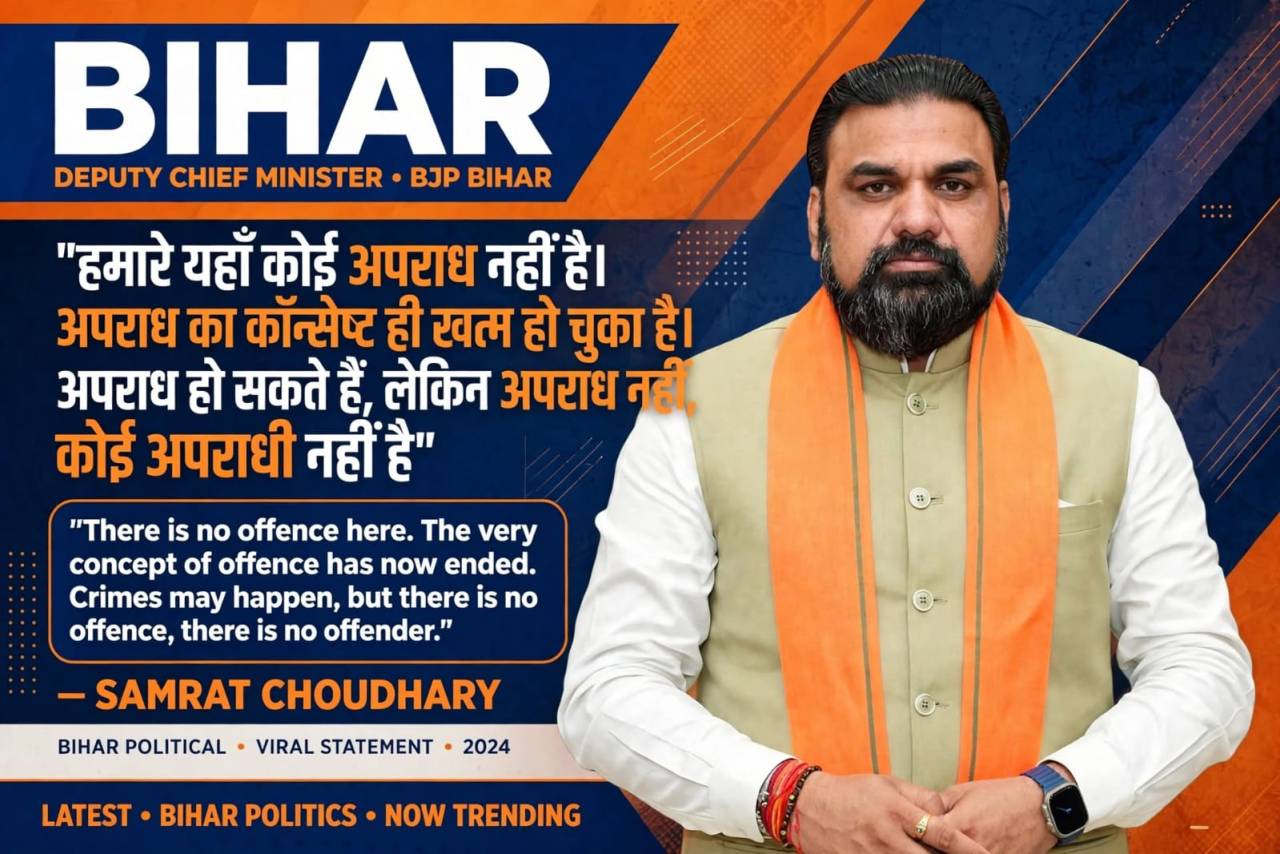
When a Chief Minister claims that crime has disappeared but struggles to explain what still happens in the state, the question is no longer about vocabulary. It is about governance, accountability and public safety.
Bihar Chief Minister Samrat Choudhary may have intended to project his government's success in controlling crime. Instead, a sentence delivered at a public event in Delhi has raised an uncomfortable question about how seriously the state's leadership views its law-and-order responsibilities.
Speaking at an event organised by the National Highways Authority of India (NHAI) on November 3, Choudhary made a remarkable claim. According to his statement, the concept of apraadh (crime) had ended in Bihar. There could be 'crime', he suggested, but no 'apraadh' and no criminals.
"Crime ho sakte hain, lekin apraadh nahi," he said.
The distinction did not survive even a basic translation. Crime and apraadh mean the same thing. The statement quickly circulated on social media, turning what might have been a verbal slip into a political controversy.
For a Chief Minister who also holds the Home portfolio, the episode raises a larger question: can a government's record on public safety be established through confident declarations, or must it be demonstrated through evidence?
A statement that invited its own criticism
There are two possible interpretations of Choudhary's remark. He may have made a verbal mistake while attempting to describe a decline in organised criminal activity. Alternatively, he may have been trying to suggest that isolated criminal incidents still occur, but organised crime has been brought under control.
The second interpretation would be consistent with his earlier political position. In July 2025, when he was Deputy Chief Minister, Choudhary had argued that organised crime was no longer a major problem in Bihar and that murders arising from personal disputes were difficult for the government to prevent.
But the distinction between organised crime and individual offences does not mean that one category can be dismissed from the law-and-order assessment.
A murder remains a murder, whether it results from a personal dispute, gang rivalry, political hostility or a financial disagreement. For the victim's family, the circumstances do not make the loss any less devastating.
RJD working president and Leader of the Opposition Tejashwi Yadav seized on the statement, sharing the video and questioning Prime Minister Narendra Modi's decision to appoint Choudhary as Chief Minister. His remark about a political 'supaari' to destroy Bihar was an opposition attack, not evidence. But the underlying question about the government's claims deserves a serious answer.
The burden of proving Bihar is safer
This is not the first time Choudhary has made strong statements about crime control.
In February, he challenged RJD leader Rabri Devi to name criminals, promising that anyone she identified would be arrested within 24 hours. In May, he said the police had been given a free hand to act against criminals.
Such statements project confidence and send a message that the government intends to act firmly. However, the real measure of policing is not the strength of a political warning but whether investigations are completed, offenders are prosecuted and citizens can approach the police without fear.
The Opposition has repeatedly questioned the government's record, citing incidents of violence and allegations of police excesses. In September, Tejashwi Yadav also demanded Choudhary's resignation over an alleged sexual harassment case in Jamui district.
The ruling NDA, meanwhile, argues that law and order deteriorated during the previous RJD-led government and that stricter policing and technology have improved the situation.
Both sides have political interests in presenting their preferred version of Bihar. But public safety cannot become a competition in political memory. Citizens are entitled to ask what is happening now.
What do the numbers say?
There is a straightforward way to move beyond political claims: publish and examine the data.
The National Crime Records Bureau (NCRB) provides a framework for assessing registered offences, including murder, crimes against women, crimes against children, kidnapping and other serious offences.
However, crime figures alone do not tell the complete story. Registration practices, investigation quality, chargesheet rates, convictions and delays in the judicial process also matter.
A state may report fewer registered cases without necessarily becoming safer. Under-reporting, reluctance to approach police stations and delays in registering complaints can complicate the picture.
Similarly, a rise in registered cases does not automatically indicate worsening policing. It may also reflect improved reporting and greater willingness among victims to seek legal intervention.
That is why the government needs to present a comprehensive picture rather than rely on selective statistics.
As Chief Minister and Home Minister, Choudhary has both the authority and responsibility to explain the state's performance.
Education is not the real test but Accountability
The controversy has also revived questions about Choudhary's educational qualifications. His election affidavit lists a Pre-Foundation Course qualification from Madurai Kamaraj University. Jan Suraaj founder Prashant Kishor has repeatedly questioned his educational background, while Choudhary has defended the qualifications he declared.
The issue has generated political exchanges, but educational qualifications are not a constitutional prerequisite for becoming Chief Minister. A politician's ability to govern should ultimately be judged by performance, administrative competence and accountability.
A verbal mistake does not establish whether someone can govern effectively. Equally, holding the highest executive office does not place a leader's statements beyond scrutiny.
The more important issue is whether Bihar's police machinery is delivering the safety that the government promises.
Bihar needs safer streets, not a new dictionary
Bihar has spent years trying to overcome its reputation for weak law enforcement, criminal influence and insecurity. Improvements, where achieved, deserve recognition. But declaring the concept of crime extinct does not make the problem disappear.
The government should put forward comparable crime statistics, district-wise policing performance, investigation and conviction figures, and details of action taken in cases involving women and children.
These are measurable indicators. They can establish whether the state's law-and-order situation is improving and where the administration still needs to do better.
Choudhary's remark may eventually be remembered as an unfortunate choice of words. But the questions it has triggered should not disappear with the news cycle.
A government cannot end crime by changing its vocabulary. It can only do so by strengthening the rule of law.
























Leave a Comment