
Festival flights can cost five times more than usual. Who is responsible when reaching home becomes an expensive affair?
When a Supreme Court bench told a petitioner on Monday, "Don't travel by air," it refused an urgent listing of a plea alleging a nearly 700 per cent rise in airfares. The remark quickly spread online because it sounded like a dismissal of a problem millions of Indians face during festival seasons. But the issue deserves closer examination than a one-line courtroom exchange.
The real question is not whether people should travel by air during festivals. It is why a domestic flight that costs around ₹4,500 on an ordinary day can suddenly cost more than ₹22,000 when families are trying to get home.
The figures cited in the court proceedings offer a useful starting point.
What the Numbers Actually Show
The 700 per cent increase was the petitioner's claim before the court. The fare comparisons reported alongside it provide a more detailed picture.
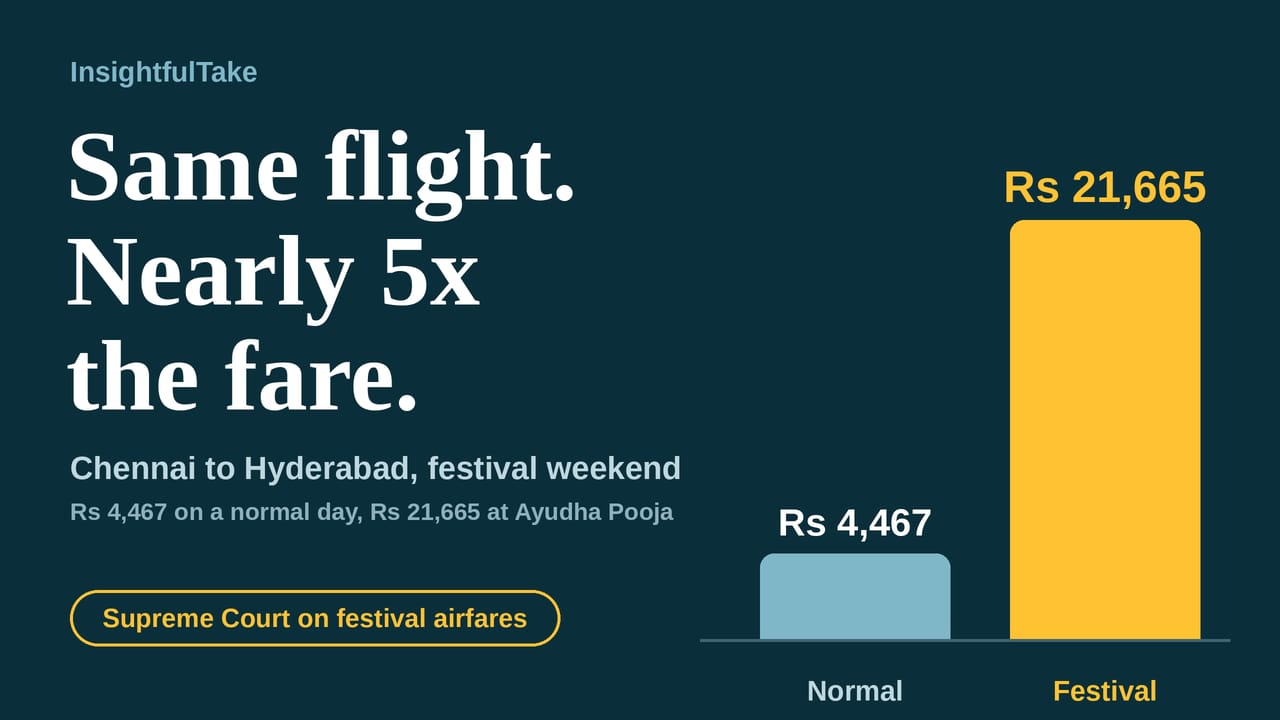
On the Chennai-Hyderabad route, the fare increased from ₹4,467 to ₹21,665 during the Ayudha Pooja weekend, nearly five times the normal price. Chennai-Bengaluru fares rose from ₹4,474 to ₹18,041. On Chennai-Delhi, the fare climbed from ₹9,208 to ₹23,099.
The pattern is revealing. Under normal conditions, fares across these routes ranged from roughly ₹4,400 to ₹9,200. During the festival period, they moved into a much narrower band of ₹16,600 to ₹23,100.
In effect, a relatively short flight between Chennai and Hyderabad could cost almost as much as a much longer journey to Delhi.
Distance and fuel consumption help explain ordinary fare differences. During festival periods, however, another factor becomes more important: the number of passengers competing for a limited number of seats.
How Festival Surge Pricing Works
Airlines generally sell seats through different fare categories. The cheapest seats are available in limited numbers. As bookings increase, those categories close and the system moves to higher-priced tickets.
During an ordinary week, airlines have an incentive to sell seats at lower prices rather than fly with empty capacity. Festival travel changes that calculation.
Demand for particular dates rises sharply. Families want to reach their hometowns before the celebrations and return immediately afterwards. The cheaper fare categories disappear quickly, leaving passengers with fewer and more expensive options.
Three factors make the situation particularly difficult in India.
First, airlines cannot significantly increase their fleet or airport slot capacity for a few days of exceptional demand. Second, festival travel is often concentrated in one direction, with large numbers of passengers travelling home around the same time and returning together. Third, railway tickets are frequently sold out weeks in advance.
For passengers who cannot secure a train ticket or change their travel dates, flying becomes the remaining practical option. Airlines know that demand is unlikely to disappear simply because fares have increased.
This is where ordinary demand-based pricing becomes a serious public concern.
The Airline Defence, and Its Limits
Airlines have their own financial pressures. Representatives told the parliamentary panel that rising aviation turbine fuel prices have increased operating costs.
The financial difficulties are real. IndiGo reported a loss of ₹1,879.1 crore in the September quarter, while Air India's losses nearly doubled in 2025-26.
However, higher fuel costs do not explain every sudden increase in ticket prices.
Fuel prices do not triple between Tuesday and Friday simply because a festival weekend is approaching. They can explain a gradual increase in operating expenses and average fares over time, but they cannot fully explain why a Chennai-Hyderabad ticket becomes ₹17,000 more expensive within a few days.
Airlines are entitled to use dynamic pricing as part of their revenue-management systems. But there is a difference between recovering higher operating costs and charging substantially more because passengers have very few alternatives.
That distinction deserves attention from regulators.
What the Supreme Court Has Really Been Saying
The Supreme Court's latest remark should also be seen in the context of its earlier observations.
In January, the court expressed concern over unpredictable airfare fluctuations and described festival-season fare increases as exploitation. Justice Mehta referred to the high fares charged during the Kumbh period, while Justice Nath observed that similar practices occurred during festivals.
The bench subsequently described the matter as a very serious concern and gave the Centre time to complete its deliberations.
The petitioner's argument is that air travel has become an essential service for many people and that extreme fare increases require judicial intervention. The counterargument is that the right to travel does not automatically create a constitutional entitlement to a particular airfare.
There is a legal distinction worth understanding here.
India deregulated domestic airfares in 1991. The Directorate General of Civil Aviation (DGCA) does not routinely fix or approve ticket prices. Its role includes monitoring airline practices and addressing concerns relating to predatory or oligopolistic pricing.
Against this background, the bench's brief response to the latest urgent mentioning may be understood as a procedural decision rather than a final position on airfare regulation. The larger issue has already been under consideration.
The distinction matters. A courtroom remark should not be mistaken for a judicial verdict on whether airlines can charge any price they choose.
Where Does Airfare Regulation Stand?
The government has been considering changes to the existing framework.
On August 17, it submitted draft rules concerning airfares, surge pricing and excess baggage charges in a sealed cover before the court. The government indicated that the rules would be finalised within three weeks.
However, the subsequent notification status needs confirmation before publication. The submission of draft rules does not, by itself, mean that new regulations have come into force.
The larger question remains whether the government intends to establish enforceable limits on extreme fare fluctuations or rely primarily on monitoring and airline disclosures.
Price Caps Are Not the Only Answer
The usual debate revolves around two positions: impose a ceiling on airfares or allow airlines to determine prices through market demand.
Neither approach fully addresses the problem.
A rigid price cap could discourage airlines from adding capacity to routes where demand is exceptionally high. If operating costs rise and airlines cannot recover them, they may reduce flights or avoid certain routes. Passengers could then face an even smaller supply of seats.
On the other hand, leaving the system entirely to market forces gives passengers little protection when a handful of airlines control most available capacity on a route.
A middle path deserves consideration. Instead of fixing every ticket price, the government could introduce stronger transparency requirements and safeguards against excessive increases.
Some possible measures include:
- Requiring airlines to disclose fare categories and the broad pricing structure for each route.
- Encouraging additional flights or larger aircraft on routes experiencing exceptional seasonal demand.
- Giving the DGCA clearly defined powers and measurable triggers to investigate unusually high fares.
- Requiring airlines to explain extraordinary price increases when fares cross specified thresholds.
Such measures would not eliminate demand-based pricing. They would make the system more transparent and provide regulators with a clearer basis for intervention.
The Real Cost of Travelling Home
For millions of Indians, festival travel is not a holiday luxury. It is about reaching parents, attending family celebrations, observing traditions and spending a few days with relatives they may not see throughout the year.
A family of four facing a fivefold increase in airfare may have little choice but to cancel the trip. Others may spend a substantial part of their monthly income simply to reach home.
The Supreme Court's "Don't travel by air" remark may have been a response to an urgent listing request, but it has brought an important public issue back into focus.
Passengers can book early, travel on less popular dates or choose trains wherever tickets are available. These are practical suggestions, not solutions to the larger problem.
Aviation is a commercial business, but a market with limited competition and sharply concentrated seasonal demand also needs effective oversight.
The question is not whether airlines should be allowed to make profits. It is whether passengers should be left entirely at the mercy of a pricing system that becomes most expensive when they have the fewest alternatives.
Until that question receives a convincing regulatory answer, travelling home during a festival will remain an increasingly expensive proposition for many Indian families.
















Leave a Comment