
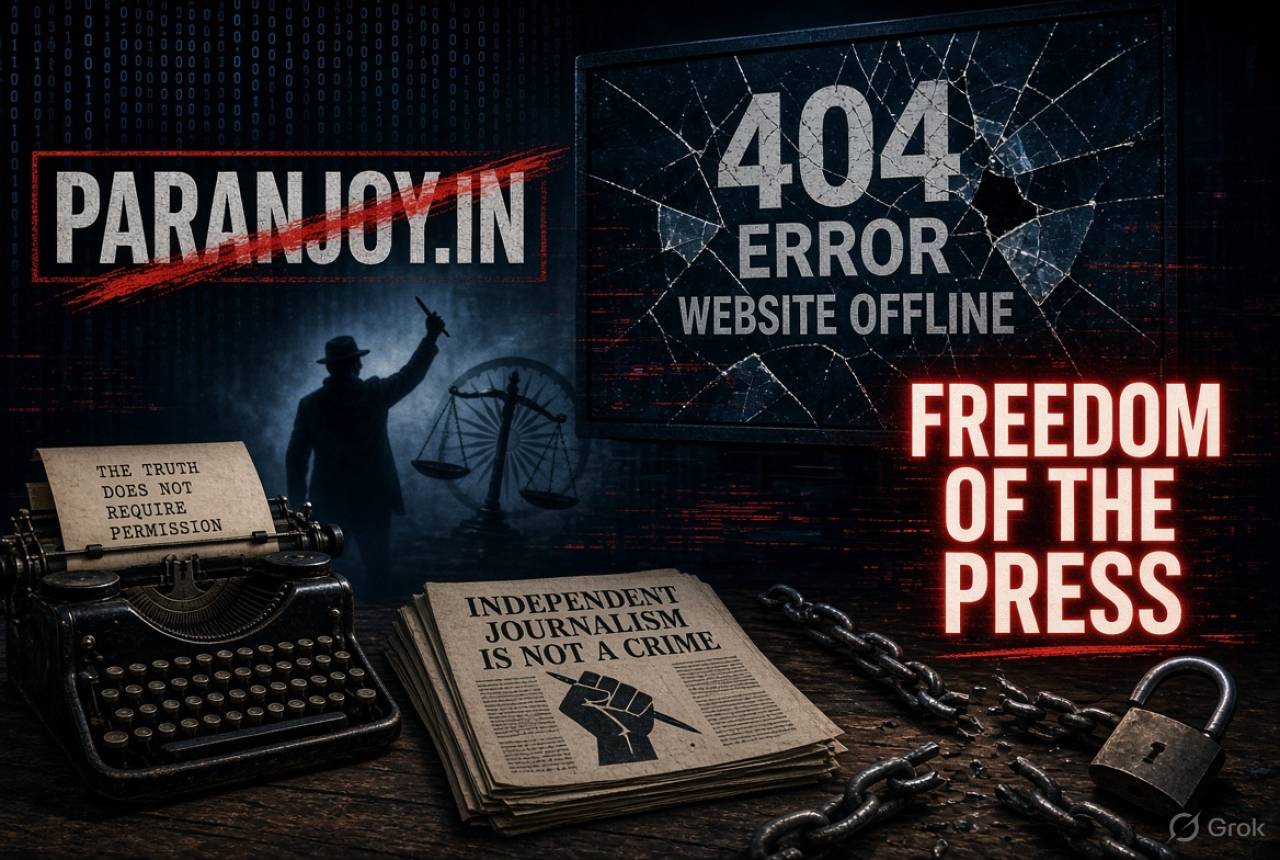
Can a dispute over one article justify erasing an entire independent journalist’s digital archive?
On the morning of 28 October 2026, the digital archive of veteran independent journalist Paranjoy Guha Thakurta disappeared from the internet. His website, paranjoy.in, along with its subdomains, including media.paranjoy.in and adanifiles.paranjoy.in, was abruptly suspended by hosting provider Hostinger. There was no prior notice, no opportunity to respond and no time to migrate the material. A 12-year-old digital repository containing decades of journalism, books, documentary films and investigative work was suddenly taken offline.
Hostinger’s explanation, communicated to a colleague at 6:48 am that morning, cited an abuse report categorised as “Fraud/Scam”. The company’s response was equally categorical that the account restoration was “not negotiable”.
The suspension raises serious questions about the growing vulnerability of independent journalism to private censorship. It came just days after Sameer Gehlaut, founder of the Indiabulls Group, obtained an ex-parte ad-interim injunction from a Patiala House court in New Delhi and personally emailed Thakurta, demanding the removal of a seven-year-old article.
The sequence of events has brought renewed attention to how legal proceedings, corporate complaints and private digital infrastructure can combine to restrict access to public-interest journalism.
A Long-Running Legal Dispute Behind the Takedown
The article at the centre of the dispute was originally published on NewsClick on 30 September 2019. Indiabulls Housing Finance Limited filed a criminal defamation complaint in March 2020.
More than five years later, in June and July 2025, a magistrate dropped proceedings against one accused while issuing summons to the remaining four, including Thakurta, under Sections 499 and 500 of the Indian Penal Code.
In late August 2026, Gehlaut's legal representatives issued a notice demanding that the article be taken down within 24–48 hours. The notice referred to a status report submitted by the Economic Offences Wing of Delhi Police. Thakurta's lawyers responded on 2 September.
The dispute escalated on 24 October, when Indiabulls Nests Limited and Gehlaut obtained an ex-parte injunction in Civil Suit No. 529/2026. The court order directed the removal and de-indexing of the disputed article, identified as Item A-33 in Schedule A. Thakurta was named as Defendant No. 19.
The following day, advocates emailed him a copy of the order and demanded compliance. On 26 October, Gehlaut personally wrote to Thakurta from his Indiabulls email address, warning of contempt proceedings under Order XXXIX Rule 2A of the Code of Civil Procedure if the specified URL was not deleted.
The next hearing is scheduled for 18 December 2026.
Meanwhile, a separate complaint seeking removal of the article from Google Search was also filed. Google Search Console subsequently informed Thakurta that the specific URL was being blocked from search results on google.co.in.
52 URLs Targeted, but Only One Archive Disappeared
A record in the Lumen Database, identified by Notice ID 101001876, provides a broader picture of the takedown demand.
The complaint reportedly covered 52 URLs across several national and international media organisations, including The Economic Times, Business Standard, The Caravan, Deccan Herald, Livemint, NDTV Profit, The Quint and Quartz. The original NewsClick article was also among the targeted links.
The request extended beyond established news organisations. Posts and content hosted on X, Facebook, Instagram, LinkedIn and Scribd were also included.
However, the original NewsClick article remains accessible, and most of the corporate media reports cited in the complaint continue to be available online.
The most sweeping consequence fell on paranjoy.in, whose entire archive was taken offline.
This distinction is central to the controversy. A legal direction concerning a particular article is one matter. The disappearance of an entire independent journalism archive containing hundreds of unrelated publications is quite another.
Hostinger's 'Fraud/Scam' Explanation Under Scrutiny
One of the most troubling aspects of the episode is Hostinger's stated reason for suspending the website.
The company did not cite the court injunction in its communication. Instead, it referred to an abuse report categorised as “Fraud/Scam”.
Independent security checks conducted on the morning of the suspension reportedly produced a different picture.
- VirusTotal: None of the 92 security vendors checked flagged paranjoy.in or media.paranjoy.in as malicious, fraudulent or phishing-related. The domain was categorised under news and media.
- Google Safe Browsing: The security service reported that no unsafe content was found on paranjoy.in and adanifiles.paranjoy.in.
The website was not an online financial service, a fundraising operation or a commercial scheme. It served as an archive of journalism, research, books, documentary films and public-interest investigations.
These findings do not establish what Hostinger received internally or what its abuse team reviewed. However, they raise legitimate questions about the verification process that preceded the suspension.
Even where a court order requires the removal or de-indexing of specific material, that does not automatically justify disabling an entire domain containing unrelated journalistic work.
The difference between targeted content restriction and the wholesale removal of an archive is fundamental to any discussion of proportionality and freedom of expression.
A Dangerous Precedent for Independent Journalism
Thakurta has indicated that his legal advisers are challenging the 24 October injunction before higher judicial forums. The legal proceedings must be allowed to follow their course.
But the broader issue cannot be confined to the defamation dispute.
The episode exposes a potentially dangerous method of restricting independent journalism: an interested party obtains an ex-parte order, a broad takedown complaint follows, and a private hosting company disables an entire digital platform without giving its owner an opportunity to respond.
Article 19(1)(a) of the Indian Constitution guarantees freedom of speech and expression. While this freedom is subject to reasonable restrictions under Article 19(2), the role of private technology companies in controlling access to public-interest information deserves greater scrutiny.
Independent journalists who maintain their own websites often do so to preserve editorial autonomy and protect their work from commercial and political pressures. Their archives are not merely collections of old articles. They represent years of research, documentation, interviews and investigative reporting.
When an entire archive can disappear following an unverified complaint, the consequences extend beyond the journalist concerned. Researchers, students, readers and future generations also lose access to material that may have considerable public value.
Hostinger Must Answer These Questions
The suspension leaves several important questions unanswered.
- Who submitted the “Fraud/Scam” abuse report, and when did Hostinger receive it?
- What verification did the company's abuse team conduct before classifying a 12-year-old journalism website as fraudulent?
- Why was no prior notice or opportunity to respond provided to the website owner?
- Why was the entire hosting account suspended instead of restricting access to the specific URL identified in the legal dispute?
- On what grounds did Hostinger declare restoration of the account “not negotiable”?
These are not merely technical questions about a hosting company's internal procedures. They concern the accountability of private platforms that exercise considerable control over the availability of independent information.
Until the circumstances are explained and the archive is restored, the episode will remain a troubling example of how legal processes and private digital infrastructure can intersect to silence journalism.
The original NewsClick article remains accessible. Reports published by several major media organisations remain online. Yet the independent journalist's entire digital archive has disappeared.
If a legal dispute concerns one article, why should an entire journalistic archive pay the price?
This is the question Hostinger must answer, and one that should concern everyone who values press freedom, editorial independence and a plural media landscape.




















Leave a Comment