
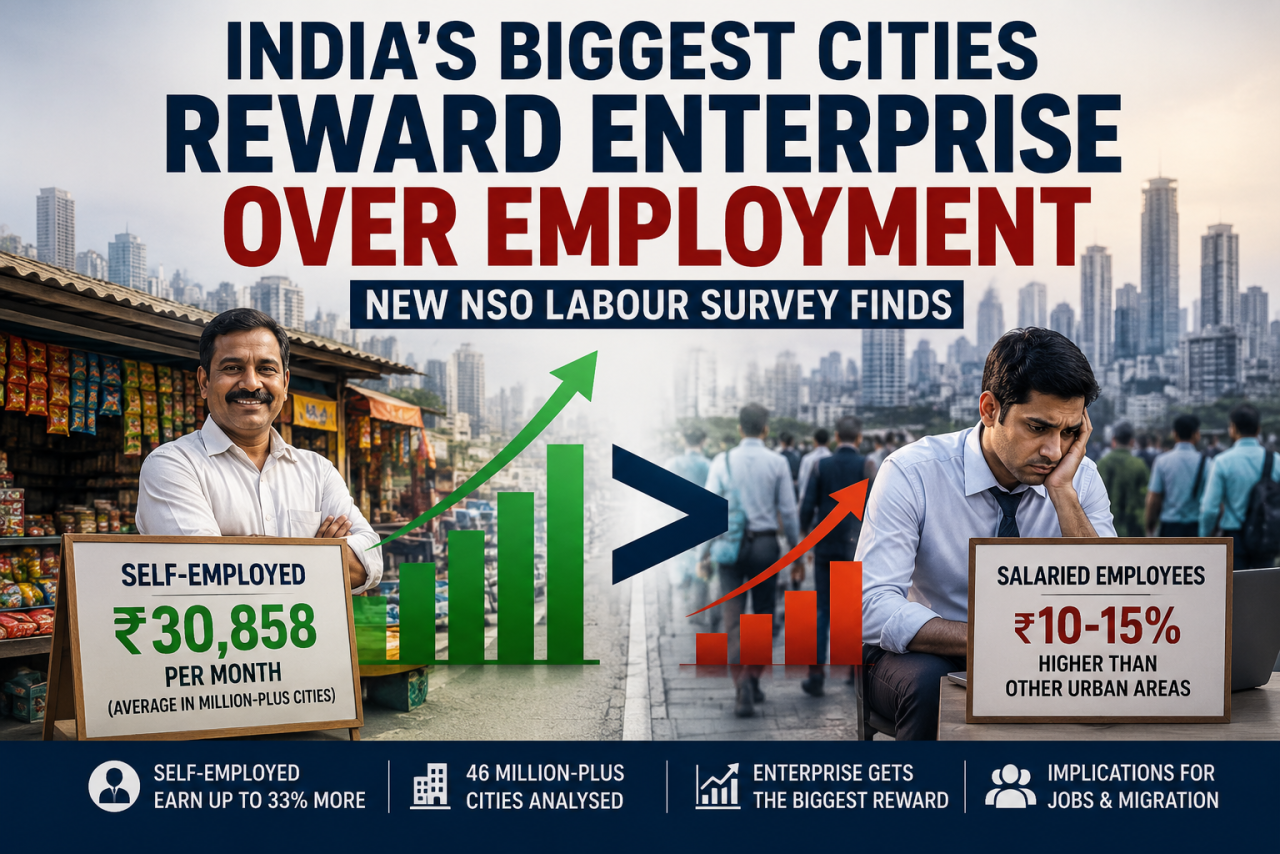
New government data on India's 46 million-plus cities reveals a sharp earnings premium for the self-employed, while salaried and casual workers see far smaller gains—suggesting India's largest urban centres reward enterprise more than employment.
For decades, India's migration story has largely been framed as one of distress—people leaving villages and small towns because economic opportunities are scarce. Fresh data from the National Statistics Office (NSO) offers a more nuanced explanation. It suggests that migration is driven not only by the lack of opportunities elsewhere but also by the unique economic advantages that India's biggest cities provide.
The NSO has, for the first time, separately examined labour market conditions across India's 46 million-plus cities—urban centres that had populations exceeding one million in the 2011 Census. One finding stands out: self-employed workers in these cities earned an average monthly income of ₹30,858 in 2025, roughly one-third higher than their counterparts in the rest of urban India. That sizeable earnings premium helps explain why India's largest cities continue to attract migrants.
The more significant insight, however, lies in how unevenly those gains are distributed across different categories of workers.
Enterprise Receives the Biggest Reward
Regular salaried employees and casual labourers also earn more in India's largest cities than elsewhere, but their wage advantage is considerably smaller—roughly between 10% and 15%. By contrast, self-employed workers enjoy a premium of nearly one-third.
This suggests that million-plus cities do not simply offer higher wages across the board. Instead, they disproportionately reward entrepreneurship, small business ownership and independent economic activity, where access to larger customer bases and denser markets creates greater opportunities for income growth.
Bigger Markets, Different Labour Markets
Labour force participation rates remain virtually identical between million-plus cities and other urban areas—52.4% compared with 52.1%. In other words, the advantage of larger cities is not that more people participate in the workforce.
Instead, the composition of employment changes.
Regular salaried employment accounts for nearly 59% of all jobs in million-plus cities, compared with less than 43% in other urban centres. Employment in public and private limited companies is also proportionately higher.
Even informal enterprises appear more growth-oriented. Nearly one-quarter of such businesses in million-plus cities employ at least one hired worker, compared with fewer than one-fifth elsewhere. Larger urban markets, therefore, are not merely home to more businesses—they appear to foster businesses that expand and generate employment.
Scale Matters More Than Individual Ability
The findings also challenge the assumption that workers in larger cities earn more simply because they are more productive or more skilled.
Gross Value Added (GVA) per establishment is nearly 29% higher in million-plus cities. Yet earnings per worker and per employee rise by only about 17% and 13%, respectively.
That difference points to the economic advantage created by urban scale itself. Larger markets provide businesses with greater access to customers, suppliers and commercial networks, allowing firms to generate higher output even when individual worker productivity improves only modestly.
The implication is straightforward: much of the productivity premium comes from the city, not necessarily from the worker.
The Gender Gap Persists
The survey also highlights encouraging signs of women's entrepreneurship in several cities. Surat, Vadodara and Pune report women owning more than 40% of unincorporated proprietorships, indicating strong participation in local business ecosystems.
However, that progress sits alongside a more persistent challenge. More than two-thirds of women outside the labour force continue to cite childcare and domestic responsibilities as the primary reason for not working.
The figures underline that while entrepreneurial opportunities exist, the benefits of urban economic growth remain unevenly distributed between men and women.
Averages Hide Wide Differences
The NSO cautions that national averages conceal substantial variation among India's 46 million-plus cities. Treating metropolitan centres such as Delhi and cities like Patna as directly comparable simply because both exceed the one-million population threshold inevitably masks important differences in local economies.
Even so, the broader policy message is difficult to ignore.
If the biggest earnings premium comes from access to larger markets rather than merely access to jobs, then strengthening the economic ecosystems of India's smaller cities could prove more effective than simply managing migration into existing metros.
The lesson from the data is not that migration is inevitable. It is that more cities need to become places where enterprise can flourish—and where people find compelling economic reasons to stay.
For decades, India's migration story has largely been framed as one of distress—people leaving villages and small towns because economic opportunities are scarce. Fresh data from the National Statistics Office (NSO) offers a more nuanced explanation. It suggests that migration is driven not only by the lack of opportunities elsewhere but also by the unique economic advantages that India's biggest cities provide.
The NSO has, for the first time, separately examined labour market conditions across India's 46 million-plus cities—urban centres that had populations exceeding one million in the 2011 Census. One finding stands out: self-employed workers in these cities earned an average monthly income of ₹30,858 in 2025, roughly one-third higher than their counterparts in the rest of urban India. That sizeable earnings premium helps explain why India's largest cities continue to attract migrants.
The more significant insight, however, lies in how unevenly those gains are distributed across different categories of workers.
Enterprise Receives the Biggest Reward
Regular salaried employees and casual labourers also earn more in India's largest cities than elsewhere, but their wage advantage is considerably smaller—roughly between 10% and 15%. By contrast, self-employed workers enjoy a premium of nearly one-third.
This suggests that million-plus cities do not simply offer higher wages across the board. Instead, they disproportionately reward entrepreneurship, small business ownership and independent economic activity, where access to larger customer bases and denser markets creates greater opportunities for income growth.
Bigger Markets, Different Labour Markets
Labour force participation rates remain virtually identical between million-plus cities and other urban areas—52.4% compared with 52.1%. In other words, the advantage of larger cities is not that more people participate in the workforce.
Instead, the composition of employment changes.
Regular salaried employment accounts for nearly 59% of all jobs in million-plus cities, compared with less than 43% in other urban centres. Employment in public and private limited companies is also proportionately higher.
Even informal enterprises appear more growth-oriented. Nearly one-quarter of such businesses in million-plus cities employ at least one hired worker, compared with fewer than one-fifth elsewhere. Larger urban markets, therefore, are not merely home to more businesses—they appear to foster businesses that expand and generate employment.
Scale Matters More Than Individual Ability
The findings also challenge the assumption that workers in larger cities earn more simply because they are more productive or more skilled.
Gross Value Added (GVA) per establishment is nearly 29% higher in million-plus cities. Yet earnings per worker and per employee rise by only about 17% and 13%, respectively.
That difference points to the economic advantage created by urban scale itself. Larger markets provide businesses with greater access to customers, suppliers and commercial networks, allowing firms to generate higher output even when individual worker productivity improves only modestly.
The implication is straightforward: much of the productivity premium comes from the city, not necessarily from the worker.
The Gender Gap Persists
The survey also highlights encouraging signs of women's entrepreneurship in several cities. Surat, Vadodara and Pune report women owning more than 40% of unincorporated proprietorships, indicating strong participation in local business ecosystems.
However, that progress sits alongside a more persistent challenge. More than two-thirds of women outside the labour force continue to cite childcare and domestic responsibilities as the primary reason for not working.
The figures underline that while entrepreneurial opportunities exist, the benefits of urban economic growth remain unevenly distributed between men and women.
Averages Hide Wide Differences
The NSO cautions that national averages conceal substantial variation among India's 46 million-plus cities. Treating metropolitan centres such as Delhi and cities like Patna as directly comparable simply because both exceed the one-million population threshold inevitably masks important differences in local economies.
Even so, the broader policy message is difficult to ignore.
If the biggest earnings premium comes from access to larger markets rather than merely access to jobs, then strengthening the economic ecosystems of India's smaller cities could prove more effective than simply managing migration into existing metros.
The lesson from the data is not that migration is inevitable. It is that more cities need to become places where enterprise can flourish—and where people find compelling economic reasons to stay.



























Leave a Comment