
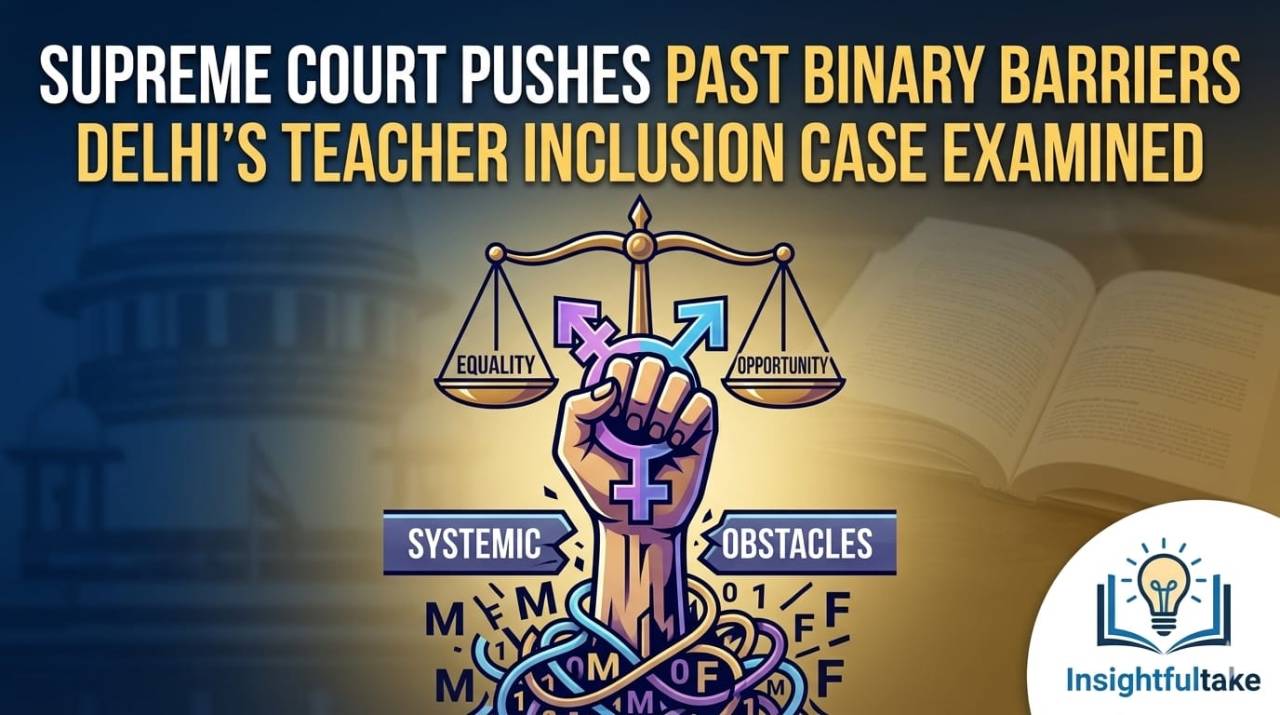
A missing checkbox sparks a national debate as the Supreme Court steps in to enforce transgender inclusion in Delhi’s teacher recruitment system.
The Supreme Court of India recently issued a significant interim order, allowing a transgender woman, Jane Kaushik, to apply for a teaching position under the Delhi government. This decision targets the Delhi Subordinate Services Selection Board (DSSSB) and specifically addresses the absence of a "transgender" category in its recruitment portal. The move goes beyond a single application—it marks a crucial step toward dismantling systemic barriers in public employment.
The Case of Jane Kaushik
Jane Kaushik, 31, holds degrees in political science and education. Despite her qualifications, she encountered a digital barrier: the DSSSB online application system offered only two gender options—male and female. This binary framework effectively erased her identity and prevented her from even submitting an application.
A Supreme Court bench comprising Justices JB Pardiwala and KV Viswanathan acknowledged this injustice. The court directed DSSSB to accept her application under the transgender category, ensuring her candidacy would not be rejected on the basis of gender classification.
A History of Legal Hurdles
Kaushik’s journey reflects a broader disconnect between legal provisions and real-world implementation:
- January 2023: A single judge of the Delhi High Court permitted her to apply for teaching posts.
- October 2025: The Supreme Court criticized the slow pace of transgender rights implementation, calling existing protections a “dead letter.”
- Current Status: The apex court has agreed to examine a broader plea seeking a comprehensive recruitment policy for transgender individuals in Delhi government jobs.
Moving Past “Dead Letter” Laws
India enacted the Transgender Persons (Protection of Rights) Act, 2019, followed by its rules in 2020, mandating non-discrimination in employment. However, many government systems still lack the infrastructure to enforce these provisions.
The court’s intervention highlights a critical gap: legislation alone is insufficient without corresponding administrative and technological updates. Application portals, recruitment guidelines, and official systems must reflect the legal recognition of transgender identities. The absence of a “transgender” option is not a minor oversight—it is a structural barrier that excludes qualified candidates.
Why Structural Change Matters
Kaushik’s plea extends beyond individual relief and calls for systemic reform, including:
- Separate Vacancies: Dedicated recruitment notifications for transgender candidates in teaching roles.
- Age Relaxations: Consideration of socio-economic challenges that may delay educational attainment.
- Comprehensive Policy: A clear framework ensuring inclusion across all public employment sectors.
If implemented, these measures could set a powerful precedent. Representation in classrooms plays a transformative role—transgender teachers not only challenge societal stigma but also foster inclusivity and awareness among students.
Final Take
The Supreme Court’s focus now shifts from interim relief to long-term structural reform. The case raises a fundamental question: why have systems failed to evolve despite clear legal mandates?
Public institutions are expected to lead social progress. Digital infrastructure must align with constitutional values and statutory rights. Equality is not merely symbolic—it requires accessible and functional pathways.
Jane Kaushik’s case underscores that meaningful justice often begins with challenging the “standard” systems that exclude. As attention turns to the Delhi government, the expectation is clear: rebuild recruitment frameworks to ensure they serve everyone, without exception.
The Supreme Court of India recently issued a significant interim order, allowing a transgender woman, Jane Kaushik, to apply for a teaching position under the Delhi government. This decision targets the Delhi Subordinate Services Selection Board (DSSSB) and specifically addresses the absence of a "transgender" category in its recruitment portal. The move goes beyond a single application—it marks a crucial step toward dismantling systemic barriers in public employment.
The Case of Jane Kaushik
Jane Kaushik, 31, holds degrees in political science and education. Despite her qualifications, she encountered a digital barrier: the DSSSB online application system offered only two gender options—male and female. This binary framework effectively erased her identity and prevented her from even submitting an application.
A Supreme Court bench comprising Justices JB Pardiwala and KV Viswanathan acknowledged this injustice. The court directed DSSSB to accept her application under the transgender category, ensuring her candidacy would not be rejected on the basis of gender classification.
A History of Legal Hurdles
Kaushik’s journey reflects a broader disconnect between legal provisions and real-world implementation:
- January 2023: A single judge of the Delhi High Court permitted her to apply for teaching posts.
- October 2025: The Supreme Court criticized the slow pace of transgender rights implementation, calling existing protections a “dead letter.”
- Current Status: The apex court has agreed to examine a broader plea seeking a comprehensive recruitment policy for transgender individuals in Delhi government jobs.
Moving Past “Dead Letter” Laws
India enacted the Transgender Persons (Protection of Rights) Act, 2019, followed by its rules in 2020, mandating non-discrimination in employment. However, many government systems still lack the infrastructure to enforce these provisions.
The court’s intervention highlights a critical gap: legislation alone is insufficient without corresponding administrative and technological updates. Application portals, recruitment guidelines, and official systems must reflect the legal recognition of transgender identities. The absence of a “transgender” option is not a minor oversight—it is a structural barrier that excludes qualified candidates.
Why Structural Change Matters
Kaushik’s plea extends beyond individual relief and calls for systemic reform, including:
- Separate Vacancies: Dedicated recruitment notifications for transgender candidates in teaching roles.
- Age Relaxations: Consideration of socio-economic challenges that may delay educational attainment.
- Comprehensive Policy: A clear framework ensuring inclusion across all public employment sectors.
If implemented, these measures could set a powerful precedent. Representation in classrooms plays a transformative role—transgender teachers not only challenge societal stigma but also foster inclusivity and awareness among students.
Final Take
The Supreme Court’s focus now shifts from interim relief to long-term structural reform. The case raises a fundamental question: why have systems failed to evolve despite clear legal mandates?
Public institutions are expected to lead social progress. Digital infrastructure must align with constitutional values and statutory rights. Equality is not merely symbolic—it requires accessible and functional pathways.
Jane Kaushik’s case underscores that meaningful justice often begins with challenging the “standard” systems that exclude. As attention turns to the Delhi government, the expectation is clear: rebuild recruitment frameworks to ensure they serve everyone, without exception.
























Leave a Comment