
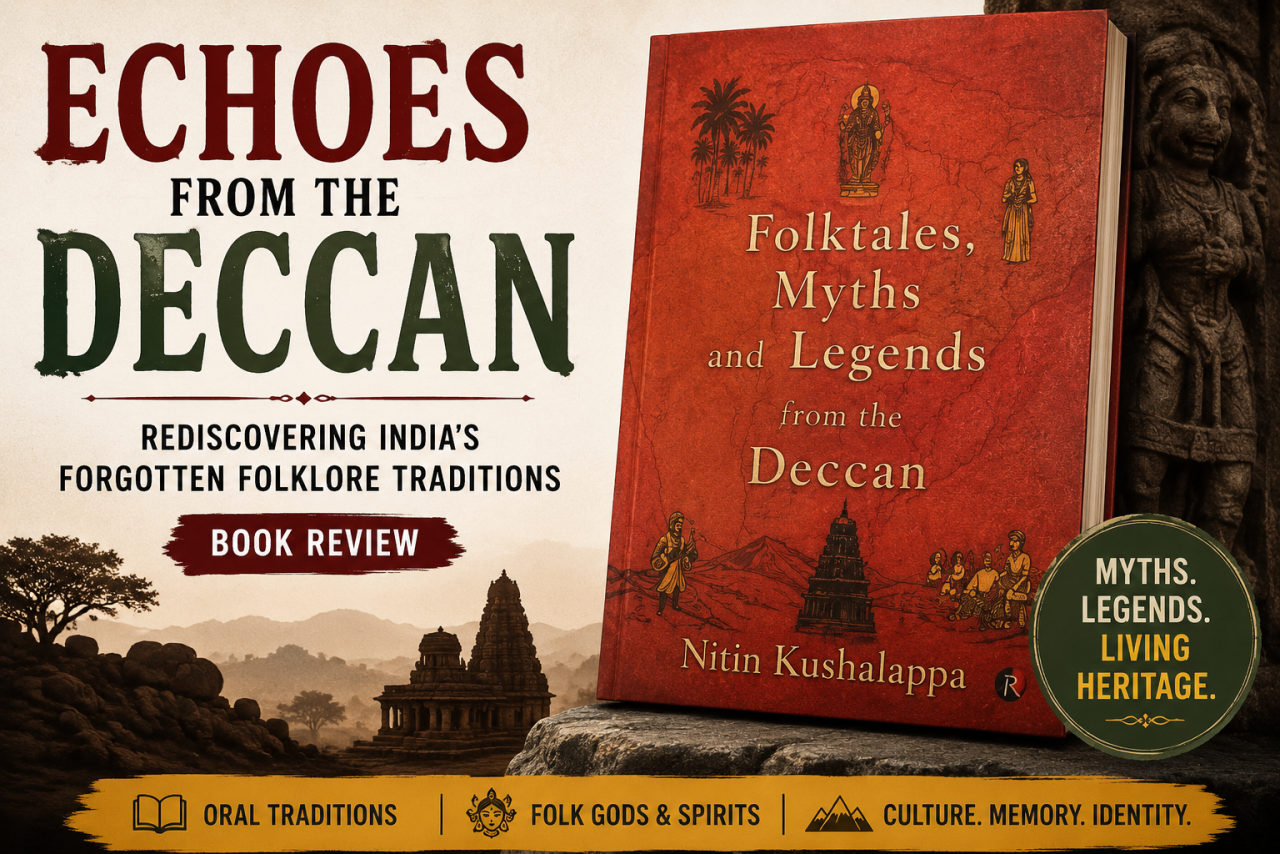
Beyond India’s grand epics lies a forgotten world of folk gods, sacred landscapes, and oral legends brought alive with rare authenticity.
In an age where mythology publishing is often dominated by retellings of the Ramayana and Mahabharata, Nitin Kushalappa’s Folktales, Myths and Legends from the Deccan arrives like a refreshing return to India’s lesser-heard storytelling traditions. Published by Rupa Publications, the book opens a doorway into the vast cultural landscape of southern and central India, where oral traditions have survived for generations through memory, ritual, and community life.
Rather than presenting mythology as distant fantasy, Kushalappa grounds his stories in the everyday lives of the people of the Deccan. The result is a collection that feels deeply rooted in land, language, and lived experience. The book travels across regions such as Kodagu, Tulunad, Bayaluseeme, and Kongu Nadu, drawing from Kannada, Tamil, Telugu, Tulu, Kodava, and Malayalam traditions. Through these narratives, readers encounter warrior-sorcerers, wandering philosophers, sacred spirits, village goddesses, and folk heroes who continue to exist in local belief systems.
One of the strongest aspects of the book is its sincerity. Kushalappa does not attempt to modernise folklore excessively or reshape it into commercial fantasy fiction. Instead, he preserves the quiet power of oral storytelling. Many of the tales feel raw and unfinished in a meaningful way, much like stories heard from elders during childhood. There are silences, ambiguities, and abrupt endings that reflect the authentic texture of folklore rather than polished literary fiction.
This approach gives the collection emotional depth. The stories do not rely on spectacle or dramatic twists. Their strength lies in atmosphere and cultural memory. Gods and spirits appear naturally within ordinary life, not as extraordinary interruptions. Rivers, forests, shrines, and hills become living presences. In many ways, the landscape itself acts as a character throughout the book.
Among the memorable narratives is the story of Junjappa, a humble cattle herder who becomes a revered spirit after an unjust death. The tale captures the deep connection between grief, justice, and folk spirituality in rural communities. Equally compelling are the stories of the Saptamatrikas, the seven mother goddesses associated with protection and survival during times of calamity. These stories reveal how folklore often emerges from collective fear, hope, and resilience.
The book also introduces readers to philosophical traditions through figures such as Yogi Vemana. His spiritual journey from indulgence to enlightenment adds an introspective dimension to the collection. Such narratives remind readers that Indian folklore is not only about gods and miracles but also about moral reflection, human weakness, and inner transformation.
Another admirable feature of the book is its accessibility. Kushalappa avoids heavy academic language and presents the stories in a lucid and engaging style. Glossaries and contextual notes help readers unfamiliar with regional traditions understand cultural references without interrupting the flow of storytelling. This makes the book suitable not only for mythology enthusiasts but also for younger readers and general audiences interested in Indian culture.
At the same time, the simplicity of the narration may not satisfy every reader equally. Those already deeply familiar with Indian mythology may occasionally find certain tales simplified or lacking deeper philosophical exploration. Some stories end just when they seem ready to unfold into more layered reflections. Readers expecting detailed historical or anthropological analysis may also feel the book leans more toward literary preservation than scholarly interpretation.
Yet this restraint may actually be one of the book’s greatest strengths. Oral traditions were never meant to function as academic texts. They were designed to be heard, remembered, and retold across generations. Kushalappa respects that tradition. He allows the stories to breathe without overexplaining them. In doing so, he preserves the mystery and fluidity that give folklore its enduring charm.
The collection also performs an important cultural task. Mainstream mythology publishing in India often overlooks regional traditions in favour of pan-Indian narratives. Folktales, Myths and Legends from the Deccan challenges this imbalance by highlighting voices and legends that rarely receive national attention. It reminds readers that India’s cultural identity is not built from a single narrative tradition but from countless local histories and memories.
For modern readers increasingly disconnected from oral storytelling traditions, this book becomes more than a collection of tales. It serves as an archive of disappearing cultural voices. In preserving these stories, Kushalappa also preserves fragments of regional identity, belief, and imagination that might otherwise fade with time.
Ultimately, Folktales, Myths and Legends from the Deccan is not a loud or sensational book. Its power lies in its quiet authenticity. It invites readers to slow down, listen carefully, and rediscover the forgotten rhythms of storytelling that once shaped communities across the Deccan plateau.
For anyone interested in Indian folklore, regional mythology, or the cultural richness of southern India, this book offers a rewarding and thoughtful reading experience — one that lingers long after the final page is turned.
In an age where mythology publishing is often dominated by retellings of the Ramayana and Mahabharata, Nitin Kushalappa’s Folktales, Myths and Legends from the Deccan arrives like a refreshing return to India’s lesser-heard storytelling traditions. Published by Rupa Publications, the book opens a doorway into the vast cultural landscape of southern and central India, where oral traditions have survived for generations through memory, ritual, and community life.
Rather than presenting mythology as distant fantasy, Kushalappa grounds his stories in the everyday lives of the people of the Deccan. The result is a collection that feels deeply rooted in land, language, and lived experience. The book travels across regions such as Kodagu, Tulunad, Bayaluseeme, and Kongu Nadu, drawing from Kannada, Tamil, Telugu, Tulu, Kodava, and Malayalam traditions. Through these narratives, readers encounter warrior-sorcerers, wandering philosophers, sacred spirits, village goddesses, and folk heroes who continue to exist in local belief systems.
One of the strongest aspects of the book is its sincerity. Kushalappa does not attempt to modernise folklore excessively or reshape it into commercial fantasy fiction. Instead, he preserves the quiet power of oral storytelling. Many of the tales feel raw and unfinished in a meaningful way, much like stories heard from elders during childhood. There are silences, ambiguities, and abrupt endings that reflect the authentic texture of folklore rather than polished literary fiction.
This approach gives the collection emotional depth. The stories do not rely on spectacle or dramatic twists. Their strength lies in atmosphere and cultural memory. Gods and spirits appear naturally within ordinary life, not as extraordinary interruptions. Rivers, forests, shrines, and hills become living presences. In many ways, the landscape itself acts as a character throughout the book.
Among the memorable narratives is the story of Junjappa, a humble cattle herder who becomes a revered spirit after an unjust death. The tale captures the deep connection between grief, justice, and folk spirituality in rural communities. Equally compelling are the stories of the Saptamatrikas, the seven mother goddesses associated with protection and survival during times of calamity. These stories reveal how folklore often emerges from collective fear, hope, and resilience.
The book also introduces readers to philosophical traditions through figures such as Yogi Vemana. His spiritual journey from indulgence to enlightenment adds an introspective dimension to the collection. Such narratives remind readers that Indian folklore is not only about gods and miracles but also about moral reflection, human weakness, and inner transformation.
Another admirable feature of the book is its accessibility. Kushalappa avoids heavy academic language and presents the stories in a lucid and engaging style. Glossaries and contextual notes help readers unfamiliar with regional traditions understand cultural references without interrupting the flow of storytelling. This makes the book suitable not only for mythology enthusiasts but also for younger readers and general audiences interested in Indian culture.
At the same time, the simplicity of the narration may not satisfy every reader equally. Those already deeply familiar with Indian mythology may occasionally find certain tales simplified or lacking deeper philosophical exploration. Some stories end just when they seem ready to unfold into more layered reflections. Readers expecting detailed historical or anthropological analysis may also feel the book leans more toward literary preservation than scholarly interpretation.
Yet this restraint may actually be one of the book’s greatest strengths. Oral traditions were never meant to function as academic texts. They were designed to be heard, remembered, and retold across generations. Kushalappa respects that tradition. He allows the stories to breathe without overexplaining them. In doing so, he preserves the mystery and fluidity that give folklore its enduring charm.
The collection also performs an important cultural task. Mainstream mythology publishing in India often overlooks regional traditions in favour of pan-Indian narratives. Folktales, Myths and Legends from the Deccan challenges this imbalance by highlighting voices and legends that rarely receive national attention. It reminds readers that India’s cultural identity is not built from a single narrative tradition but from countless local histories and memories.
For modern readers increasingly disconnected from oral storytelling traditions, this book becomes more than a collection of tales. It serves as an archive of disappearing cultural voices. In preserving these stories, Kushalappa also preserves fragments of regional identity, belief, and imagination that might otherwise fade with time.
Ultimately, Folktales, Myths and Legends from the Deccan is not a loud or sensational book. Its power lies in its quiet authenticity. It invites readers to slow down, listen carefully, and rediscover the forgotten rhythms of storytelling that once shaped communities across the Deccan plateau.
For anyone interested in Indian folklore, regional mythology, or the cultural richness of southern India, this book offers a rewarding and thoughtful reading experience — one that lingers long after the final page is turned.






















Leave a Comment