
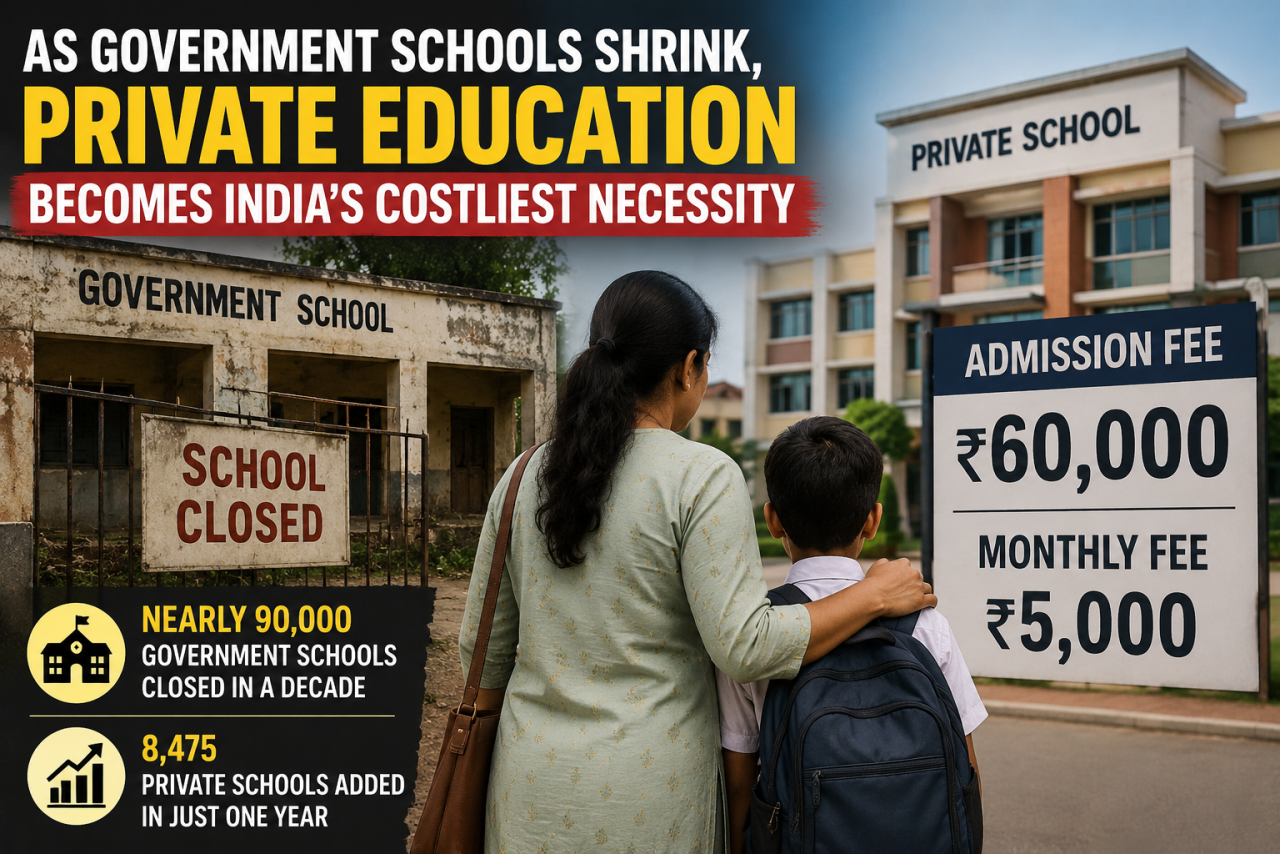
India promises free education, yet thousands of government schools are disappearing while private education grows increasingly expensive. The question is no longer whether education is a right, but how much families must pay to exercise it.
A parent's shock at a ₹60,000 admission fee for a kindergarten seat has become a familiar Indian story. Behind it lies a policy pattern: the state is closing public schools even as it debates capping what private ones can charge.
India's Constitution guarantees free and compulsory education under Article 21A, implemented through the Right to Education (RTE) Act, 2009. But that guarantee has a narrow scope. It applies only to children aged six to fourteen, covering Classes I to VIII. Kindergarten, nursery and other pre-primary years—the stage at which parents often face admission fees running into tens of thousands of rupees—remain outside its protection. In practice, the right to free education begins only after many families have already paid a substantial price to enter the education system.
The Schools That Closed Instead of Improving
While private pre-primary fees climbed steadily, the government school network contracted sharply. Parliament data presented in the Rajya Sabha in February 2026 showed that India lost 18,727 government schools between 2020-21 and 2024-25, while private unaided schools increased by 8,475 during the same period. Over a decade, the decline has been even more striking, with nearly 90,000 fewer government schools operating today than ten years ago. Uttar Pradesh and Madhya Pradesh recorded the steepest reductions.
The official explanation is "rationalisation"—merging schools with low enrolment to improve efficiency, reduce costs and consolidate resources. Uttar Pradesh alone merged around 27,000 primary schools with fewer than 50 students in 2025. The Allahabad High Court initially upheld the move, observing that larger schools could provide better infrastructure and facilities.
Yet the consequences on the ground are far from uniform. For children in remote villages, a merged school can mean walking several additional kilometres every day. Longer travel distances often discourage attendance, particularly among younger children and girls. Families that can afford it increasingly turn to nearby private schools, while those who cannot may struggle to keep their children in school at all.
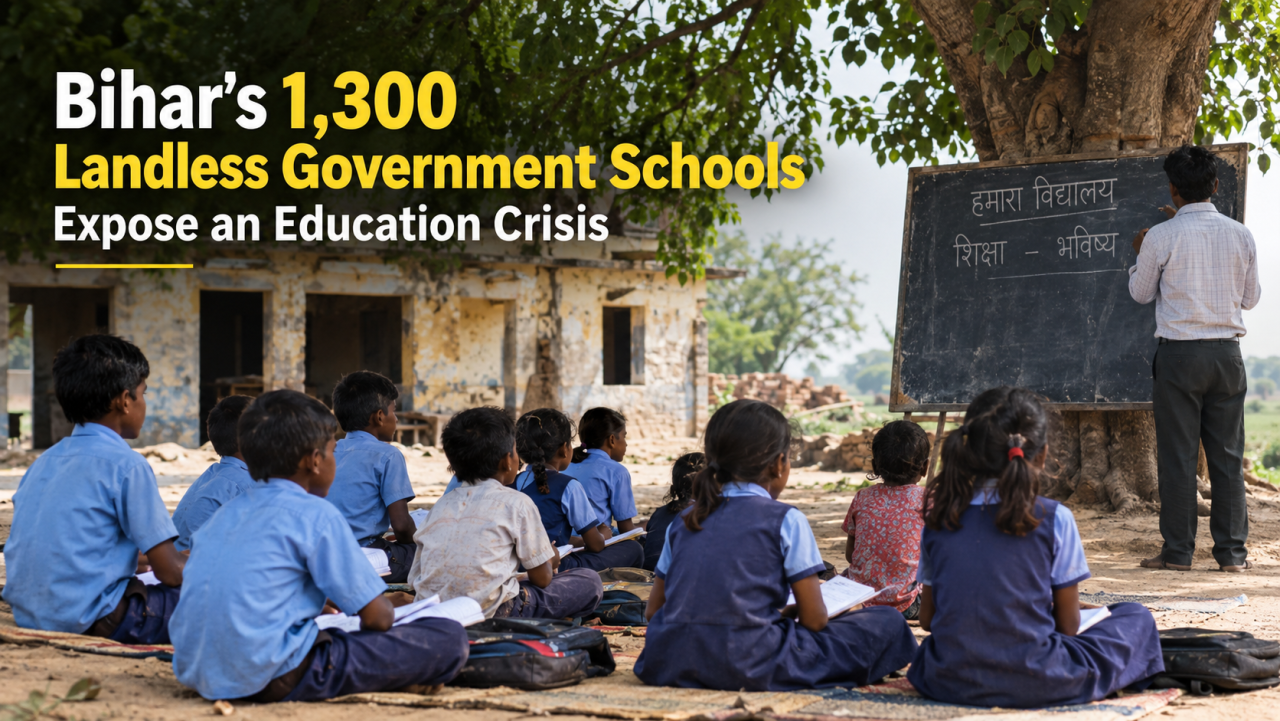
Not every state followed the same approach. Bihar was the only major state to register a net increase in government schools during this period, adding 965 institutions. Its experience suggests that large-scale closures are the result of policy choices rather than an unavoidable demographic trend.
When the State Retreats, Private Players Expand
The expansion of private schools mirrors the decline of public ones. Private unaided schools increased from 331,108 in 2023-24 to 339,583 in 2024-25, adding 8,475 institutions in a single year after several years of relatively modest growth.
Every government school that closes reduces the availability of a free public alternative. In many areas, private schools become the only practical option, operating with considerable freedom to determine admission charges and tuition fees.
Against this backdrop, admission fees of ₹60,000 and monthly tuition of ₹5,000 for a four-year-old appear less like isolated cases of overcharging and more like the predictable outcome of a shrinking public education system combined with expanding private demand.
Delhi's Answer—and Its Limits
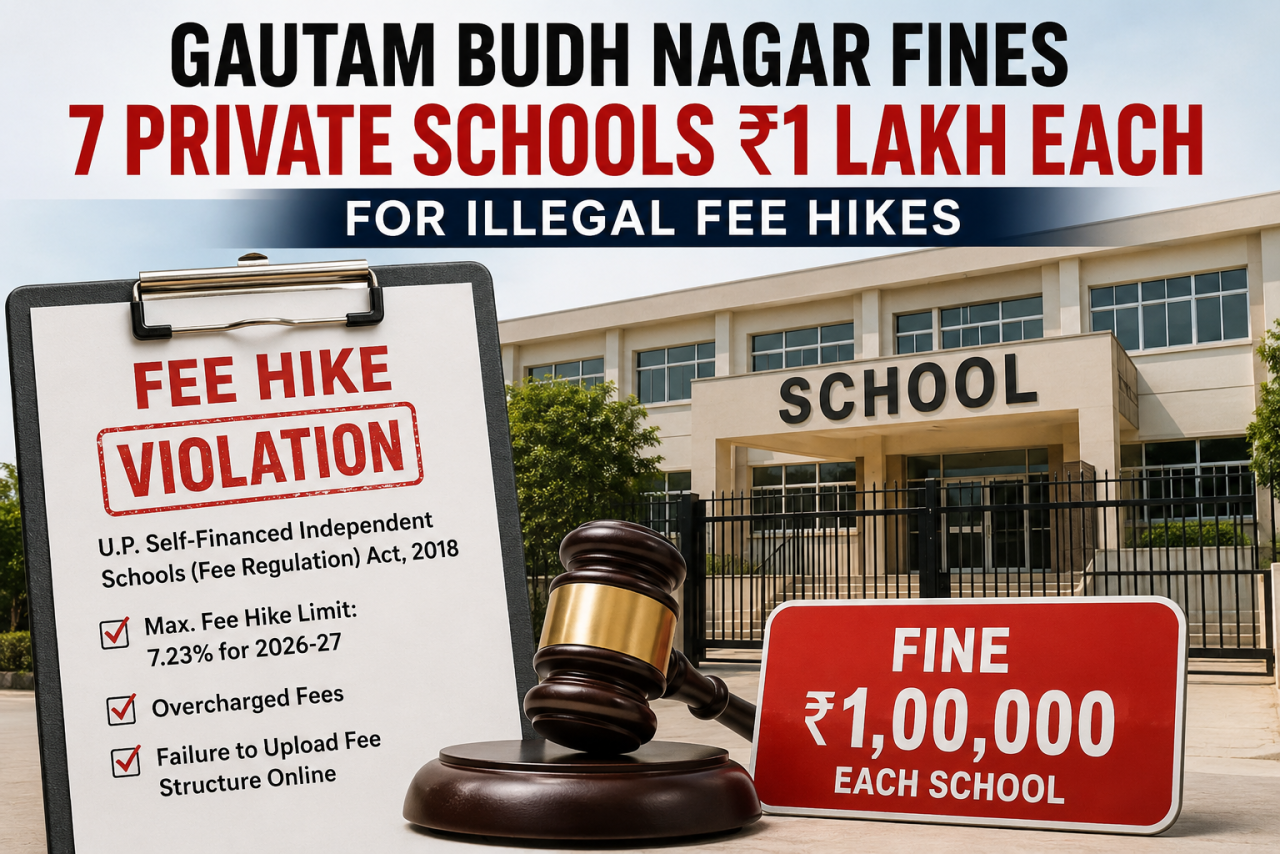
Delhi has taken the country's most direct step toward regulating private school fees. The Delhi School Education (Transparency in Fixation and Regulation of Fees) Act, 2025 requires private schools to obtain government approval before increasing fees through committees comprising government officials, school management, teachers and parents. The law also places limits on registration fees, admission charges and caution money while prescribing penalties for unauthorised collections.
Private school associations have challenged the legislation before the courts, arguing that unaided institutions possess a constitutional right to determine a reasonable fee structure under the Supreme Court's 2002 TMA Pai Foundation judgment.
Even while questioning aspects of the law's implementation, including its mid-academic-year rollout, the Supreme Court acknowledged that private school fees in Delhi have become "phenomenally high", lending weight to concerns over affordability. The Court has also sought clarification on whether the legislation applies prospectively or could affect fees already collected.
Whatever its eventual outcome, Delhi's law remains an exception. Although states such as Maharashtra and Karnataka are considering similar measures, most of India still lacks any comprehensive framework to regulate private school fees.
Two Policies Moving in Opposite Directions
The larger picture reveals not a single policy failure but two government approaches moving in opposite directions.
One policy encourages the closure or merger of government schools in pursuit of administrative efficiency. Another is beginning to recognise that private education, left largely unregulated, can impose a heavy financial burden on families.
Parents who begin saving years before their children even reach school age are responding rationally to this reality. As the network of government schools continues to shrink and private institutions become the primary providers of education in many areas, access to schooling increasingly depends not only on constitutional rights but also on a family's ability to pay.
The debate over school fees, therefore, is not merely about regulating private institutions. It is also about whether India can fulfil the promise of equitable education while the public system that was meant to guarantee it continues to contract.
A parent's shock at a ₹60,000 admission fee for a kindergarten seat has become a familiar Indian story. Behind it lies a policy pattern: the state is closing public schools even as it debates capping what private ones can charge.
India's Constitution guarantees free and compulsory education under Article 21A, implemented through the Right to Education (RTE) Act, 2009. But that guarantee has a narrow scope. It applies only to children aged six to fourteen, covering Classes I to VIII. Kindergarten, nursery and other pre-primary years—the stage at which parents often face admission fees running into tens of thousands of rupees—remain outside its protection. In practice, the right to free education begins only after many families have already paid a substantial price to enter the education system.
The Schools That Closed Instead of Improving
While private pre-primary fees climbed steadily, the government school network contracted sharply. Parliament data presented in the Rajya Sabha in February 2026 showed that India lost 18,727 government schools between 2020-21 and 2024-25, while private unaided schools increased by 8,475 during the same period. Over a decade, the decline has been even more striking, with nearly 90,000 fewer government schools operating today than ten years ago. Uttar Pradesh and Madhya Pradesh recorded the steepest reductions.
The official explanation is "rationalisation"—merging schools with low enrolment to improve efficiency, reduce costs and consolidate resources. Uttar Pradesh alone merged around 27,000 primary schools with fewer than 50 students in 2025. The Allahabad High Court initially upheld the move, observing that larger schools could provide better infrastructure and facilities.
Yet the consequences on the ground are far from uniform. For children in remote villages, a merged school can mean walking several additional kilometres every day. Longer travel distances often discourage attendance, particularly among younger children and girls. Families that can afford it increasingly turn to nearby private schools, while those who cannot may struggle to keep their children in school at all.
Not every state followed the same approach. Bihar was the only major state to register a net increase in government schools during this period, adding 965 institutions. Its experience suggests that large-scale closures are the result of policy choices rather than an unavoidable demographic trend.
When the State Retreats, Private Players Expand
The expansion of private schools mirrors the decline of public ones. Private unaided schools increased from 331,108 in 2023-24 to 339,583 in 2024-25, adding 8,475 institutions in a single year after several years of relatively modest growth.
Every government school that closes reduces the availability of a free public alternative. In many areas, private schools become the only practical option, operating with considerable freedom to determine admission charges and tuition fees.
Against this backdrop, admission fees of ₹60,000 and monthly tuition of ₹5,000 for a four-year-old appear less like isolated cases of overcharging and more like the predictable outcome of a shrinking public education system combined with expanding private demand.
Delhi's Answer—and Its Limits
Delhi has taken the country's most direct step toward regulating private school fees. The Delhi School Education (Transparency in Fixation and Regulation of Fees) Act, 2025 requires private schools to obtain government approval before increasing fees through committees comprising government officials, school management, teachers and parents. The law also places limits on registration fees, admission charges and caution money while prescribing penalties for unauthorised collections.
Private school associations have challenged the legislation before the courts, arguing that unaided institutions possess a constitutional right to determine a reasonable fee structure under the Supreme Court's 2002 TMA Pai Foundation judgment.
Even while questioning aspects of the law's implementation, including its mid-academic-year rollout, the Supreme Court acknowledged that private school fees in Delhi have become "phenomenally high", lending weight to concerns over affordability. The Court has also sought clarification on whether the legislation applies prospectively or could affect fees already collected.
Whatever its eventual outcome, Delhi's law remains an exception. Although states such as Maharashtra and Karnataka are considering similar measures, most of India still lacks any comprehensive framework to regulate private school fees.
Two Policies Moving in Opposite Directions
The larger picture reveals not a single policy failure but two government approaches moving in opposite directions.
One policy encourages the closure or merger of government schools in pursuit of administrative efficiency. Another is beginning to recognise that private education, left largely unregulated, can impose a heavy financial burden on families.
Parents who begin saving years before their children even reach school age are responding rationally to this reality. As the network of government schools continues to shrink and private institutions become the primary providers of education in many areas, access to schooling increasingly depends not only on constitutional rights but also on a family's ability to pay.
The debate over school fees, therefore, is not merely about regulating private institutions. It is also about whether India can fulfil the promise of equitable education while the public system that was meant to guarantee it continues to contract.















Leave a Comment