
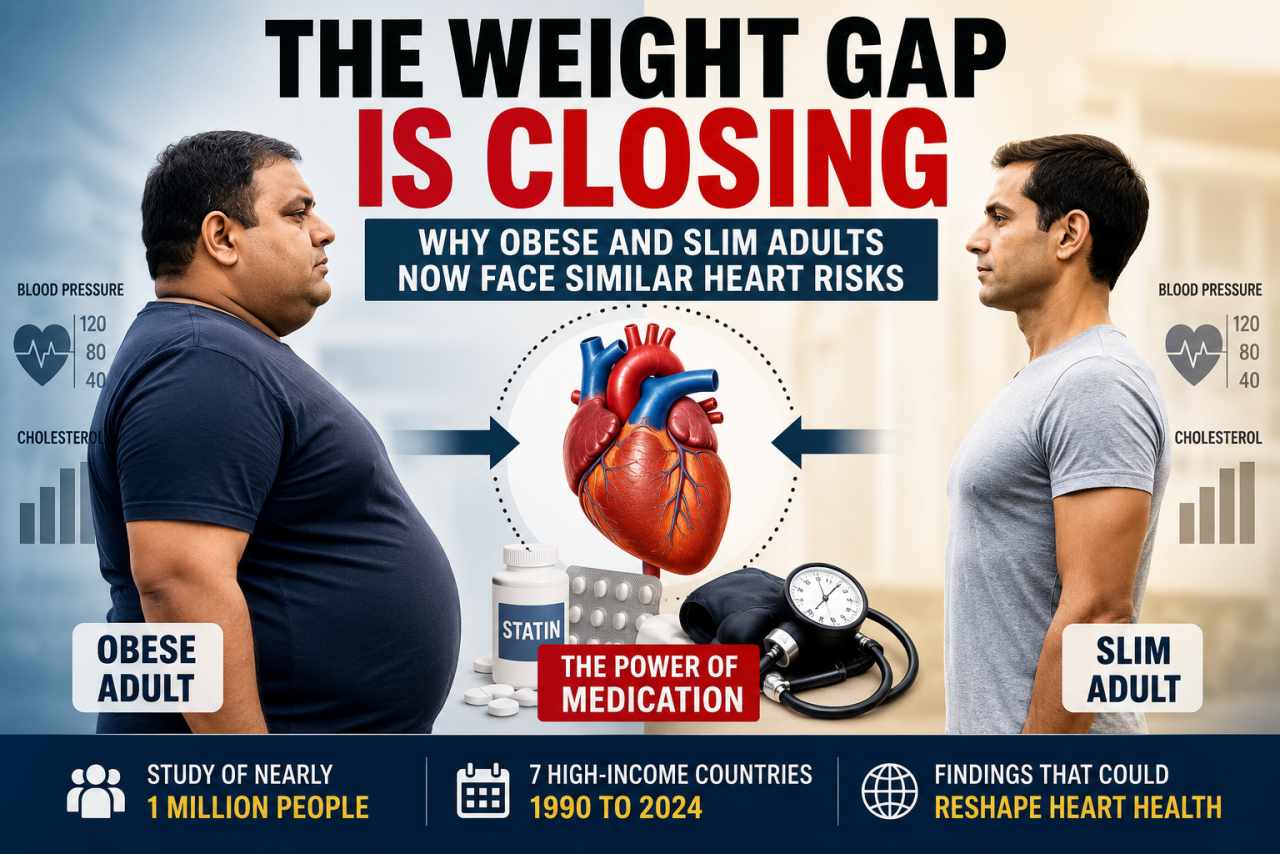
For decades, obesity meant higher heart risk. A landmark Lancet study now shows medication is changing that equation—but only where healthcare systems ensure timely diagnosis and treatment.
For decades, doctors have treated obesity and high cardiovascular risk as almost the same conversation. Carry excess weight, and your blood pressure and cholesterol were expected to follow.
A new study published in The Lancet this week complicates that picture and the reason has less to do with biology than with pills.
Researchers led by Majid Ezzati at Imperial College London analysed 110 health datasets covering nearly one million people across seven high-income countries — England, the United States, Japan, South Korea, Taiwan, Thailand, and Finland — tracking data from 1990 to 2024.
Their finding: among adults over 40, the gap in blood pressure and cholesterol levels between people with obesity and those with a normal Body Mass Index (BMI) has narrowed sharply, and in several countries has disappeared altogether.
The explanation isn't diet trends or exercise habits. It's medication. Wider and more consistent use of statins to control cholesterol, along with blood pressure drugs, has brought people with obesity down to cardiovascular risk levels once seen only in leaner adults. Ezzati called it a case where treatment has effectively cancelled out a risk factor that used to be almost automatic.
There's an important caveat buried in the data. The convergence only holds for older adults. Among people under 40, the gap in blood pressure and cholesterol between those with obesity and those with normal BMI has barely moved. Study co-author Ysé d'Ailhaud de Brisis pointed to a likely reason: younger adults are far less likely to be prescribed or taking these medications in the first place, even when their numbers call for it. That leaves cardiovascular risk meaningfully higher for younger people with obesity — a group the healthcare system is currently doing less to protect.
Why This Matters Beyond These Seven Countries
India wasn't part of this study, and that itself is worth sitting with. The countries analysed are wealthy, with health systems where statins and blood pressure medication are inexpensive, widely prescribed, and routinely monitored. That infrastructure is exactly what determines whether the "convergence" effect shows up at all.
India's own numbers make the stakes clear. Obesity and abdominal fat have been rising steadily across urban and increasingly rural India, and cardiovascular disease is already the country's leading cause of death, responsible for roughly a quarter of all mortality. Unlike in the countries this study covered, a large share of Indians with high blood pressure or unhealthy cholesterol remain undiagnosed or undertreated. Awareness, treatment, and control rates for hypertension in India still lag well behind high-income benchmarks.
If medication access is the variable driving the gap closure abroad, its relative scarcity here is precisely why India can't assume the same protective effect.
There's also a demographic wrinkle that cuts closer to home. Cardiovascular disease in India tends to strike 10 to 15 years earlier than in Western populations — squarely in the under-40 window that this study identifies as the group getting the least benefit from medication-driven risk reduction.
In other words, the very age group in which India's heart disease burden is concentrated is the one where this "success story" doesn't apply, even in the wealthy countries where it was observed.
Final Take
The Lancet study is genuine good news for older adults in health systems with strong medication access. Obesity is no longer the same cardiovascular death sentence it once was, provided the drugs reach the people who need them.
But this is a study about treatment coverage as much as it is about biology. For India, where coverage gaps remain wide and heart disease already arrives early, the more useful reading isn't reassurance. It's a reminder that screening, diagnosis, and access to affordable statins and blood pressure medication — especially for people under 40 — matter more here than almost anywhere the study actually looked.
Source: "Metabolic Traits in Obesity and Normal BMI in Industrialised Countries: A Multi-country Analysis of National Population-Based Studies," published in The Lancet.
For decades, doctors have treated obesity and high cardiovascular risk as almost the same conversation. Carry excess weight, and your blood pressure and cholesterol were expected to follow.
A new study published in The Lancet this week complicates that picture and the reason has less to do with biology than with pills.
Researchers led by Majid Ezzati at Imperial College London analysed 110 health datasets covering nearly one million people across seven high-income countries — England, the United States, Japan, South Korea, Taiwan, Thailand, and Finland — tracking data from 1990 to 2024.
Their finding: among adults over 40, the gap in blood pressure and cholesterol levels between people with obesity and those with a normal Body Mass Index (BMI) has narrowed sharply, and in several countries has disappeared altogether.
The explanation isn't diet trends or exercise habits. It's medication. Wider and more consistent use of statins to control cholesterol, along with blood pressure drugs, has brought people with obesity down to cardiovascular risk levels once seen only in leaner adults. Ezzati called it a case where treatment has effectively cancelled out a risk factor that used to be almost automatic.
There's an important caveat buried in the data. The convergence only holds for older adults. Among people under 40, the gap in blood pressure and cholesterol between those with obesity and those with normal BMI has barely moved. Study co-author Ysé d'Ailhaud de Brisis pointed to a likely reason: younger adults are far less likely to be prescribed or taking these medications in the first place, even when their numbers call for it. That leaves cardiovascular risk meaningfully higher for younger people with obesity — a group the healthcare system is currently doing less to protect.
Why This Matters Beyond These Seven Countries
India wasn't part of this study, and that itself is worth sitting with. The countries analysed are wealthy, with health systems where statins and blood pressure medication are inexpensive, widely prescribed, and routinely monitored. That infrastructure is exactly what determines whether the "convergence" effect shows up at all.
India's own numbers make the stakes clear. Obesity and abdominal fat have been rising steadily across urban and increasingly rural India, and cardiovascular disease is already the country's leading cause of death, responsible for roughly a quarter of all mortality. Unlike in the countries this study covered, a large share of Indians with high blood pressure or unhealthy cholesterol remain undiagnosed or undertreated. Awareness, treatment, and control rates for hypertension in India still lag well behind high-income benchmarks.
If medication access is the variable driving the gap closure abroad, its relative scarcity here is precisely why India can't assume the same protective effect.
There's also a demographic wrinkle that cuts closer to home. Cardiovascular disease in India tends to strike 10 to 15 years earlier than in Western populations — squarely in the under-40 window that this study identifies as the group getting the least benefit from medication-driven risk reduction.
In other words, the very age group in which India's heart disease burden is concentrated is the one where this "success story" doesn't apply, even in the wealthy countries where it was observed.
Final Take
The Lancet study is genuine good news for older adults in health systems with strong medication access. Obesity is no longer the same cardiovascular death sentence it once was, provided the drugs reach the people who need them.
But this is a study about treatment coverage as much as it is about biology. For India, where coverage gaps remain wide and heart disease already arrives early, the more useful reading isn't reassurance. It's a reminder that screening, diagnosis, and access to affordable statins and blood pressure medication — especially for people under 40 — matter more here than almost anywhere the study actually looked.
Source: "Metabolic Traits in Obesity and Normal BMI in Industrialised Countries: A Multi-country Analysis of National Population-Based Studies," published in The Lancet.


























Leave a Comment