
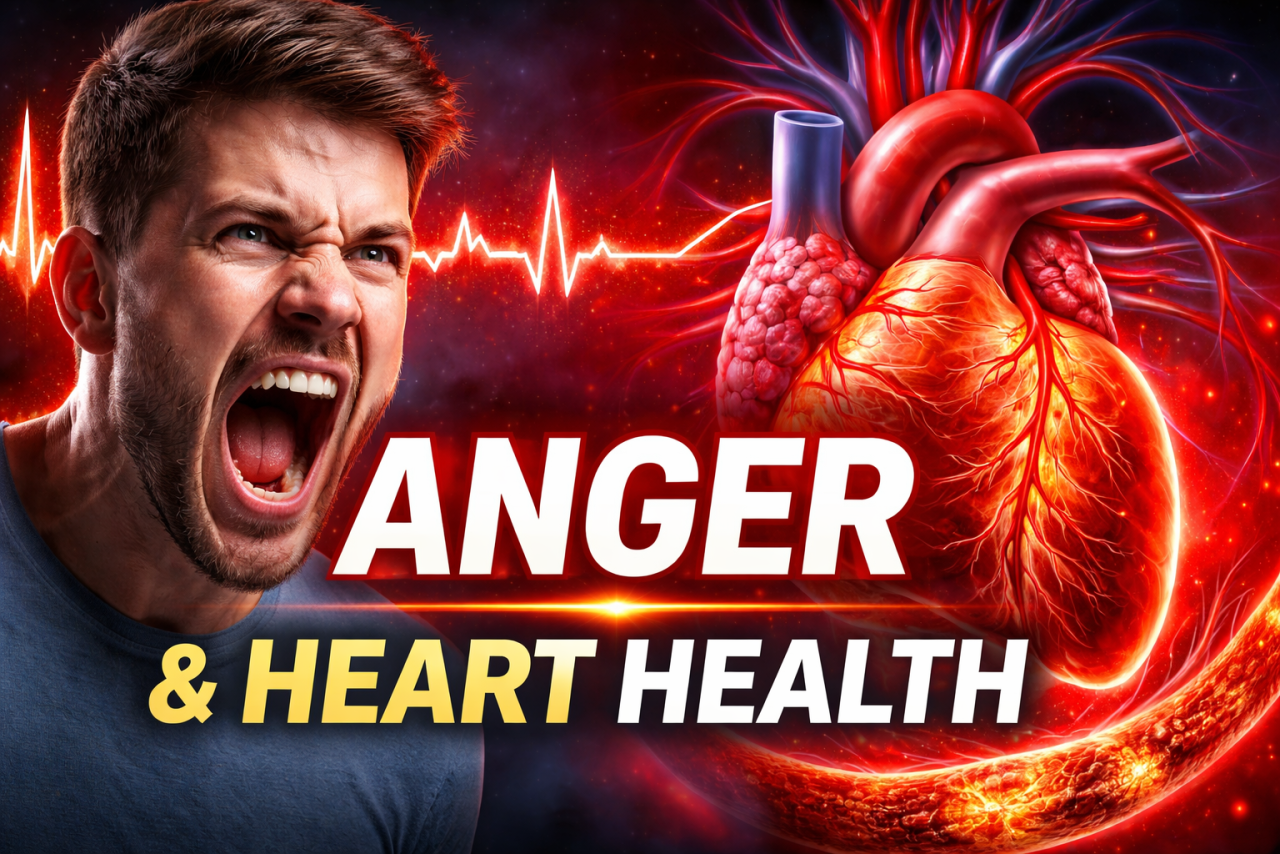
Eight minutes—that’s all it takes. Not to cool down, but to quietly damage your heart. New research reveals that a brief surge of anger can impair your blood vessels for nearly an hour, turning a moment of rage into a lingering physiological threat.
In the fast rhythm of modern life, anger is often dismissed as a fleeting emotional spike—an instinctive reaction that fades as quickly as it arrives. But new scientific findings are challenging that assumption, revealing that even a short burst of intense anger can leave a measurable and lingering impact on the human body. According to recent research, just eight minutes of anger may be enough to significantly disrupt vascular function, with effects that persist long after the emotion itself subsides.
The study, conducted on 280 adults, set out to examine how different emotional states influence cardiovascular health. Participants were asked to recall personal experiences that triggered specific emotions—anger, sadness, or anxiety—while researchers monitored changes in their vascular function. The results were striking. Those who relived anger-inducing moments experienced nearly a 50 percent reduction in their blood vessels’ ability to dilate, a critical function necessary for maintaining healthy blood flow.
This process, known as endothelial function, is central to cardiovascular well-being. The endothelium—the thin inner lining of blood vessels—plays a vital role in regulating circulation by allowing vessels to expand and contract as needed. When this function is impaired, blood flow becomes restricted, and the heart must work harder to pump blood through the body. In the case of anger, the study found that the endothelium temporarily stiffens, losing its natural elasticity and efficiency.
What is perhaps more concerning is the duration of this effect. The impairment did not vanish once participants calmed down. Instead, the reduced vascular function persisted for up to 40 minutes after the anger episode had passed. This suggests that the body remains in a state of physiological stress well beyond the emotional moment, quietly increasing strain on the cardiovascular system.
Interestingly, the same level of impact was not observed in participants who experienced sadness or anxiety. While these emotions are often associated with stress, they did not produce the same significant decline in endothelial function. This distinction positions anger as a uniquely potent trigger—an emotional state that translates more directly and aggressively into physical consequences for the heart.
Medical experts warn that while a single episode of anger is unlikely to cause immediate harm, the cumulative effect of repeated outbursts can be serious. Each instance of vascular impairment, though temporary on its own, contributes to a gradual weakening of the cardiovascular system over time. As these episodes accumulate, the body’s ability to repair and maintain healthy blood vessels diminishes.
According to insights aligned with the American Heart Association, chronic exposure to such vascular stress can elevate the risk of major cardiovascular conditions. These include heart attacks, strokes, and atherosclerosis—a condition characterized by the narrowing and hardening of arteries due to plaque buildup. Over time, the repeated restriction of blood flow and increased pressure on arterial walls create an environment where these diseases can take hold more easily.
The findings underscore a broader and often overlooked reality: emotional health is inseparable from physical health. In many cultures, anger is normalized—seen as a natural, even necessary, response to frustration, competition, or injustice. Yet this research suggests that the body does not treat anger as a harmless release. Instead, it responds with a cascade of physiological changes that can silently undermine long-term health.
This emerging understanding is prompting a shift in how healthcare professionals approach prevention. Managing anger is no longer viewed solely as a matter of emotional intelligence or mental well-being; it is increasingly recognized as a critical component of cardiovascular care. Simple interventions—such as deep breathing exercises, mindfulness practices, regular physical activity, and cognitive behavioral techniques—can play a meaningful role in reducing the frequency and intensity of anger episodes.
The implications extend beyond individual behavior to public health awareness. As lifestyles become more fast-paced and stress levels rise, the frequency of anger-triggering situations may increase. Without effective coping mechanisms, individuals may unknowingly expose themselves to repeated cycles of vascular stress, gradually elevating their risk of chronic heart disease.
At its core, the research offers a powerful reminder of the intricate connection between mind and body. Emotions are not confined to the realm of thought—they are deeply embedded in the body’s biological systems, capable of influencing everything from blood flow to long-term disease risk. Anger, in particular, emerges not just as a psychological experience, but as a physiological event with tangible consequences.
The message is not one of alarm, but of awareness. Occasional anger is a natural part of being human, and the body is equipped to recover from isolated incidents. The real risk lies in patterns—in the repeated, unregulated bursts of anger that gradually erode the resilience of the cardiovascular system.
In a world where stress is often unavoidable, the ability to pause, regulate, and respond thoughtfully becomes more than a personal virtue—it becomes a form of preventive medicine. Because beneath the surface of every heated moment, the heart is listening, responding, and, as science now shows, bearing the cost.




















Leave a Comment